Pearson Edexcel · A-Level · Economics B
Course version: 9EB0 · Version from Sept 2015
Methods of growth: b) Horizontal, vertical and conglomerate integration
Inorganic growth occurs through different types of integration.
Checked against the Pearson Edexcel 9EB0 specification (opens in a new tab) on .
- Point 2 of 2
- 4 key terms
Study notes
From the checked teaching notes for this specification point.
The idea
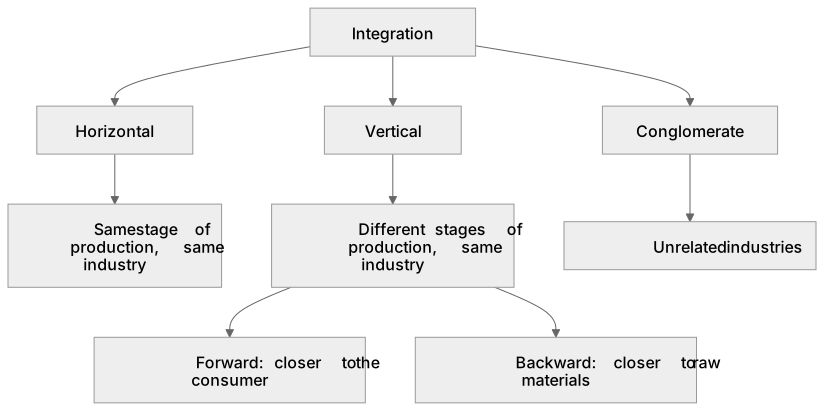
Inorganic growth occurs through different types of integration. Horizontal integration involves two firms at the exact same stage of production in the same industry merging, such as two rival banks joining to increase market share. Vertical integration occurs when firms at different stages of production in the same industry merge. This can be forward vertical integration, like a manufacturer buying a retail chain, or backward vertical integration, such as a coffee shop buying a coffee bean farm. Conglomerate integration happens when two businesses in entirely unrelated industries merge, such as a clothing retailer acquiring a food manufacturer, which helps to diversify risk across different markets.
What earns the marks
- Define horizontal integration as merging with a competitor at the same stage of production.
- Define vertical integration as merging with a firm at a different stage of the supply chain.
- Distinguish between forward vertical integration and backward vertical integration.
- Define conglomerate integration as the merging of firms operating in unrelated industries.
- Explain the motives for each type of integration, such as market power for horizontal or risk diversification for conglomerate.
Common mistakes and how to put them right
Confusing forward and backward vertical integration.
Put it right: Forward moves closer to the consumer, while backward moves closer to raw materials.
Assuming conglomerate integration guarantees higher profits.
Put it right: Acknowledge that a lack of expertise in a new market can lead to failure.
Stating horizontal integration always benefits consumers.
Put it right: Horizontal integration can reduce competition, potentially leading to higher prices.
Exam tips
- Always specify whether vertical integration is forward or backward when analysing a case study.
- Link horizontal integration to the concept of economies of scale and increased market power.
- Use the concept of risk diversification as the primary motive when explaining conglomerate integration.
Try the lesson
The start of the Methods of growth: b) Horizontal, vertical and conglomerate integration lesson, made from checked teaching notes for this specification point.
Have a go first
Which of the following scenarios is an example of forward vertical integration?
Listen
Inorganic growth occurs through different types of integration. Horizontal integration involves two firms at the exact same stage of production in the same industry merging, such as two rival banks joining to increase market share. Vertical integration occurs when firms at different stages of production in the same industry merge. This can be forward vertical integration, like a manufacturer buying a retail chain, or backward vertical integration, such as a coffee shop buying a coffee bean farm. Conglomerate integration happens when two businesses in entirely unrelated industries merge, such as a clothing retailer acquiring a food manufacturer, which helps to diversify risk across different markets. A strong answer earns marks for these points. Define horizontal integration as merging with a competitor at the same stage of production. Define vertical integration as merging with a firm at a different stage of the supply chain. Distinguish between forward vertical integration and backward vertical integration. Define conglomerate integration as the merging of firms operating in unrelated industries. A common slip: Confusing forward and backward vertical integration. Instead, forward moves closer to the consumer, while backward moves closer to raw materials. Exam tip: Always specify whether vertical integration is forward or backward when analysing a case study.
See it
Key words
Say what each word means before you turn the card.
Horizontal integration
Try answering aloud or in your head before turning the card.
Vertical integration
Try answering aloud or in your head before turning the card.
Conglomerate integration
Try answering aloud or in your head before turning the card.
Diversification
Try answering aloud or in your head before turning the card.
See every definition
- Horizontal integration
- Merging with a competitor at the same stage of production in the same industry, such as two rival banks joining to increase market share.
- Vertical integration
- Merging with a firm at a different stage of production in the same industry, which can be forward or backward.
- Conglomerate integration
- The merging of two businesses in entirely unrelated industries, which helps to diversify risk across different markets.
- Diversification
- Spreading risk across different markets, which conglomerate integration helps to achieve.
Label the diagram
Some boxes have lost their names. Pick the right name for each number.
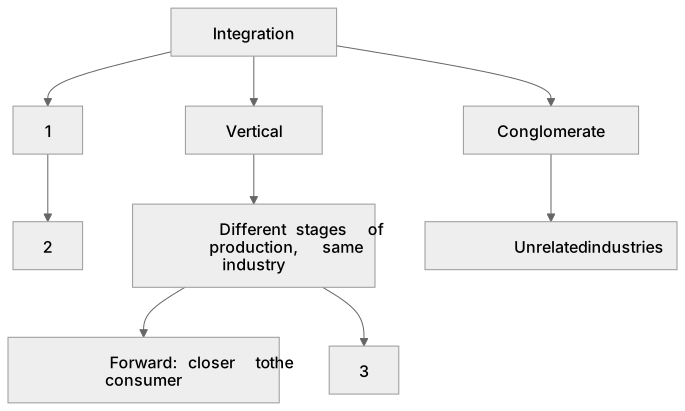
1Box 1
2Box 2
3Box 3
There is more to this lesson
The full lesson goes on to check your understanding and help you earn the marks. Create a free account to carry on, with your progress saved.
A week of Premium from your first lesson · Then the free plan continues · No card, no charge
Test your understanding of Methods of growth: b) Horizontal, vertical and conglomerate integration
Active recall beats re-reading. Take an instant quiz now to test what you’ve learned and lock it into long-term memory.
A week of Premium from your first lesson · Then the free plan continues · No card, no charge