Pearson Edexcel · A-Level · Economics B
Course version: 9EB0 · Version from Sept 2015
Oligopoly: c) Tacit agreement
Tacit agreement, or tacit collusion, occurs in an oligopoly when firms independently choose to avoid price competition without any formal or explicit communication.
Checked against the Pearson Edexcel 9EB0 specification (opens in a new tab) on .
- Point 3 of 4
- 2 key terms
Study notes
From the checked teaching notes for this specification point.
The idea
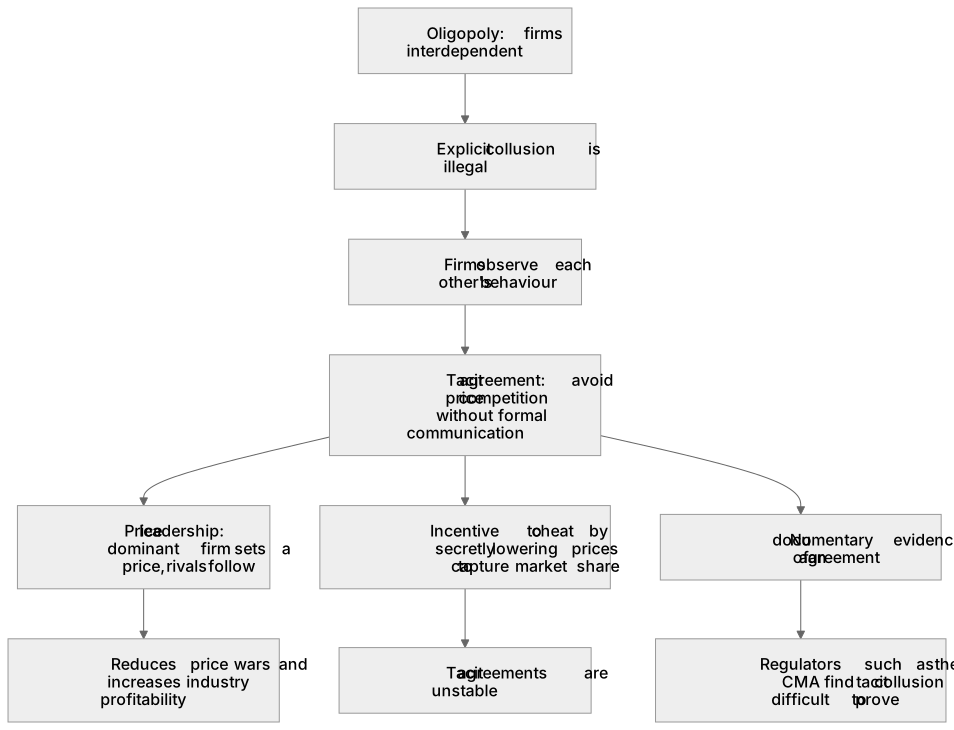
Tacit agreement, or tacit collusion, occurs in an oligopoly when firms independently choose to avoid price competition without any formal or explicit communication. Because explicit collusion is illegal, firms observe each other's behaviour and align prices to maximise joint profits. A common method is price leadership, where a dominant firm sets a price and rivals follow suit. This reduces price wars and increases industry profitability. However, tacit agreements are unstable; firms have a strong incentive to cheat by secretly lowering prices to capture market share. Regulators like the Competition and Markets Authority find tacit collusion difficult to prove because there is no documentary evidence of an agreement.
What earns the marks
- Definition of tacit agreement as unspoken, unwritten cooperation between firms to limit competition.
- Identification of price leadership as a primary mechanism for tacit collusion.
- Explanation of the motivation: to maximise joint profits and avoid destructive price wars.
- Recognition of the instability of tacit agreements due to the incentive to cheat.
- Understanding that tacit collusion is difficult for competition authorities to prosecute due to a lack of evidence.
Common mistakes and how to put them right
Mistaking tacit agreement for explicit collusion.
Put it right: Tacit agreement involves no formal communication or contract, whereas explicit collusion involves direct communication.
Assuming tacit agreements are legally binding.
Put it right: They are informal and rely on mutual observation, making them legally unenforceable and unstable.
Believing tacit collusion only occurs in monopolies.
Put it right: It is a characteristic behaviour of oligopolistic markets where firms are interdependent.
Exam tips
- Use price leadership as your primary example when explaining how tacit agreements function in practice.
- Emphasise the concept of interdependence when discussing why firms in an oligopoly might engage in tacit collusion.
- Contrast tacit agreement with cartels to demonstrate a clear understanding of the legal distinctions in competition law.
Try the lesson
The start of the Oligopoly: c) Tacit agreement lesson, made from checked teaching notes for this specification point.
Have a go first
What is meant by a tacit agreement in the context of an oligopolistic market?
Listen
Tacit agreement, or tacit collusion, occurs in an oligopoly when firms independently choose to avoid price competition without any formal or explicit communication. Because explicit collusion is illegal, firms observe each other's behaviour and align prices to maximise joint profits. A common method is price leadership, where a dominant firm sets a price and rivals follow suit. This reduces price wars and increases industry profitability. However, tacit agreements are unstable; firms have a strong incentive to cheat by secretly lowering prices to capture market share. Regulators like the Competition and Markets Authority find tacit collusion difficult to prove because there is no documentary evidence of an agreement. A strong answer earns marks for these points. Definition of tacit agreement as unspoken, unwritten cooperation between firms to limit competition. Identification of price leadership as a primary mechanism for tacit collusion. Explanation of the motivation: to maximise joint profits and avoid destructive price wars. Recognition of the instability of tacit agreements due to the incentive to cheat. A common slip: Mistaking tacit agreement for explicit collusion. Instead, tacit agreement involves no formal communication or contract, whereas explicit collusion involves direct communication. Exam tip: Use price leadership as your primary example when explaining how tacit agreements function in practice.
See it
Key words
Say what each word means before you turn the card.
Tacit agreement
Try answering aloud or in your head before turning the card.
Price leadership
Try answering aloud or in your head before turning the card.
See every definition
- Tacit agreement
- Unspoken, unwritten cooperation between firms in an oligopoly to limit competition, without any formal or explicit communication.
- Price leadership
- A method of tacit collusion where a dominant firm sets a price and rivals follow suit.
Label the diagram
Some boxes have lost their names. Pick the right name for each number.
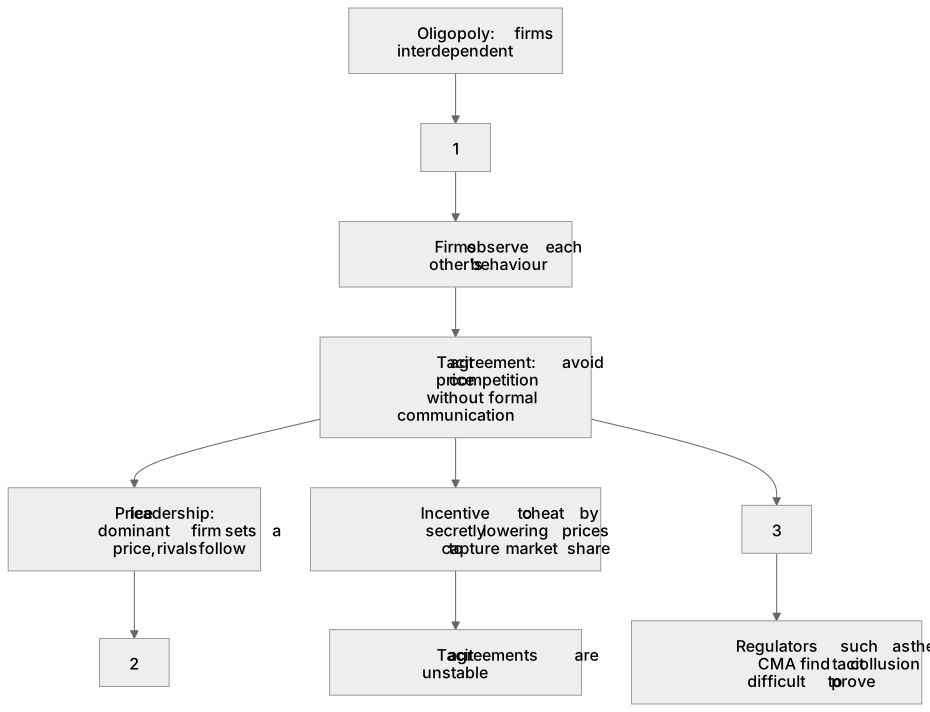
1Box 1
2Box 2
3Box 3
There is more to this lesson
The full lesson goes on to check your understanding and help you earn the marks. Create a free account to carry on, with your progress saved.
A week of Premium from your first lesson · Then the free plan continues · No card, no charge
Test your understanding of Oligopoly: c) Tacit agreement
Active recall beats re-reading. Take an instant quiz now to test what you’ve learned and lock it into long-term memory.
A week of Premium from your first lesson · Then the free plan continues · No card, no charge