Pearson Edexcel · A-Level · Economics B
Course version: 9EB0 · Version from Sept 2015
Oligopoly: d) Price discrimination
Price discrimination occurs when a firm charges different prices to different consumer groups for an identical good or service, for reasons unrelated to cost differences.
Checked against the Pearson Edexcel 9EB0 specification (opens in a new tab) on .
- Point 4 of 4
- 4 key terms
Study notes
From the checked teaching notes for this specification point.
The idea
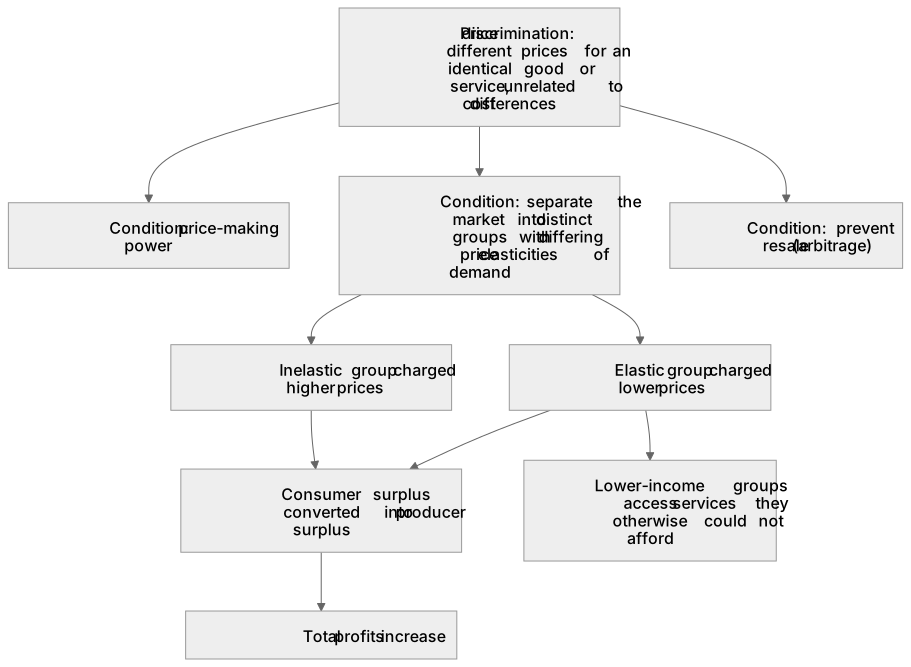
Price discrimination occurs when a firm charges different prices to different consumer groups for an identical good or service, for reasons unrelated to cost differences. To succeed, a firm must possess price-making power, separate the market into distinct groups with differing price elasticities of demand, and prevent resale (arbitrage). For example, train operators charge higher peak fares to commuters with inelastic demand, and lower off-peak fares to leisure travellers. This strategy allows firms to convert consumer surplus into producer surplus, increasing total profits. It can also benefit consumers by enabling lower-income groups to access services they otherwise could not afford, even though inelastic consumers pay higher prices.
What earns the marks
- Definition of price discrimination as charging different prices for the same product without cost justification.
- Identification of the necessary conditions: market power, market separation, and prevention of arbitrage.
- Explanation of how differing price elasticities of demand between sub-markets allow for profit maximisation.
- Analysis of the impact on consumer and producer surplus.
- Evaluation of the benefits and drawbacks for different consumer groups and the firm.
Common mistakes and how to put them right
Confusing price discrimination with product differentiation.
Put it right: Price discrimination involves the exact same product, whereas product differentiation involves charging different prices for slightly different products.
Forgetting the condition of preventing resale.
Put it right: State that arbitrage must be prevented, otherwise consumers in the cheaper market will sell to those in the expensive market.
Assuming price discrimination always harms consumers.
Put it right: Recognise that consumers with highly elastic demand may benefit from lower prices and increased access to the market.
Exam tips
- Always state the three necessary conditions for price discrimination when defining the concept in an extended response.
- Use a clear, real-world example, such as student discounts or peak and off-peak train travel, to illustrate market separation.
- When evaluating, contrast the loss of consumer surplus for inelastic buyers with the potential cross-subsidisation of loss-making services.
Try the lesson
The start of the Oligopoly: d) Price discrimination lesson, made from checked teaching notes for this specification point.
Have a go first
Which of the following is a necessary condition for an oligopolistic firm to successfully engage in price discrimination?
Listen
Price discrimination occurs when a firm charges different prices to different consumer groups for an identical good or service, for reasons unrelated to cost differences. To succeed, a firm must possess price-making power, separate the market into distinct groups with differing price elasticities of demand, and prevent resale (arbitrage). For example, train operators charge higher peak fares to commuters with inelastic demand, and lower off-peak fares to leisure travellers. This strategy allows firms to convert consumer surplus into producer surplus, increasing total profits. It can also benefit consumers by enabling lower-income groups to access services they otherwise could not afford, even though inelastic consumers pay higher prices. A strong answer earns marks for these points. Definition of price discrimination as charging different prices for the same product without cost justification. Identification of the necessary conditions: market power, market separation, and prevention of arbitrage. Explanation of how differing price elasticities of demand between sub-markets allow for profit maximisation. Analysis of the impact on consumer and producer surplus. A common slip: Confusing price discrimination with product differentiation. Instead, price discrimination involves the exact same product, whereas product differentiation involves charging different prices for slightly different products. Exam tip: Always state the three necessary conditions for price discrimination when defining the concept in an extended response.
See it
Key words
Say what each word means before you turn the card.
Price discrimination
Try answering aloud or in your head before turning the card.
Consumer surplus
Try answering aloud or in your head before turning the card.
Price elasticity of demand
Try answering aloud or in your head before turning the card.
Market power
Try answering aloud or in your head before turning the card.
See every definition
- Price discrimination
- Charging different prices to different consumer groups for an identical good or service, for reasons unrelated to cost differences.
- Consumer surplus
- A surplus that firms can convert into producer surplus through price discrimination, increasing total profits.
- Price elasticity of demand
- A feature that differs between distinct market groups, allowing firms to charge different prices to each.
- Market power
- Price-making power that a firm must possess for price discrimination to succeed.
Label the diagram
Some boxes have lost their names. Pick the right name for each number.
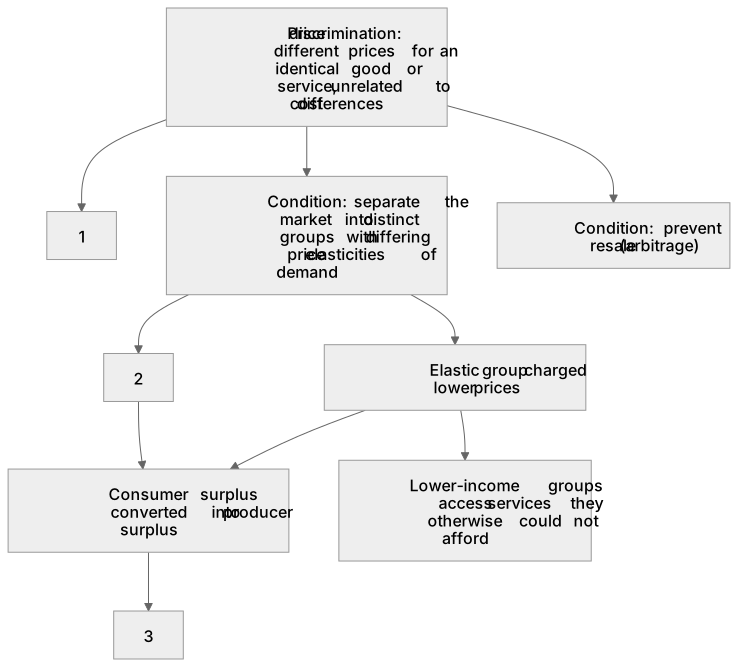
1Box 1
2Box 2
3Box 3
There is more to this lesson
The full lesson goes on to check your understanding and help you earn the marks. Create a free account to carry on, with your progress saved.
A week of Premium from your first lesson · Then the free plan continues · No card, no charge
Test your understanding of Oligopoly: d) Price discrimination
Active recall beats re-reading. Take an instant quiz now to test what you’ve learned and lock it into long-term memory.
A week of Premium from your first lesson · Then the free plan continues · No card, no charge