Pearson Edexcel · A-Level · Economics B
Course version: 9EB0 · Version from Sept 2015
A) Fiscal policy: o adjusting levels of government spending and taxation…
Full specification wording
Policy instruments: a) Fiscal policy: o adjusting levels of government spending and taxation to affect aggregate demand
Fiscal policy involves the government manipulating its levels of spending and taxation to influence aggregate demand (AD).
Checked against the Pearson Edexcel 9EB0 specification (opens in a new tab) on .
- Point 1 of 4
- 3 key terms
Study notes
From the checked teaching notes for this specification point.
The idea
Fiscal policy involves the government manipulating its levels of spending and taxation to influence aggregate demand (AD). Expansionary fiscal policy aims to stimulate AD by increasing government spending or reducing taxes, which can boost economic growth and reduce unemployment during a recession. Conversely, contractionary fiscal policy seeks to reduce AD by cutting spending or raising taxes, often to control demand-pull inflation. For instance, lowering income tax increases consumers' disposable income, leading to higher consumption (a component of AD).
What earns the marks
- Identify fiscal policy as the use of government spending and taxation to influence aggregate demand.
- Explain that expansionary fiscal policy involves increasing government spending or decreasing taxation to shift aggregate demand to the right.
- Explain that contractionary fiscal policy involves decreasing government spending or increasing taxation to shift aggregate demand to the left.
- Link changes in taxation to changes in disposable income and consumption, or corporate tax to investment.
- Recognise that government spending is a direct component of aggregate demand.
Common mistakes and how to put them right
Confusing fiscal policy with monetary policy.
Put it right: Fiscal policy is controlled by the government, not the central bank.
Assuming that an increase in taxation will increase aggregate demand.
Put it right: Higher taxes reduce disposable income and therefore reduce consumption and aggregate demand.
Forgetting that government spending is a direct component of aggregate demand, whereas taxation affects aggregate demand indirectly through consumption and investment.
Exam tips
- Use an aggregate demand and aggregate supply diagram to illustrate the impact of changes in government spending or taxation.
- Clearly distinguish between direct taxes and indirect taxes when explaining the impact on consumer spending.
- Consider the multiplier effect when discussing how an initial change in government spending can lead to a larger final impact on aggregate demand.
Try the lesson
The start of the Policy instruments: a) Fiscal policy: o adjusting levels of government spending and taxation to affect aggregate demand lesson, made from checked teaching notes for this specification point.
Have a go first
Which of the following best describes the primary mechanism of fiscal policy used to influence aggregate demand?
Listen
Fiscal policy involves the government manipulating its levels of spending and taxation to influence aggregate demand (AD). Expansionary fiscal policy aims to stimulate AD by increasing government spending or reducing taxes, which can boost economic growth and reduce unemployment during a recession. Conversely, contractionary fiscal policy seeks to reduce AD by cutting spending or raising taxes, often to control demand-pull inflation. For instance, lowering income tax increases consumers' disposable income, leading to higher consumption (a component of AD). A strong answer earns marks for these points. Identify fiscal policy as the use of government spending and taxation to influence aggregate demand. Explain that expansionary fiscal policy involves increasing government spending or decreasing taxation to shift aggregate demand to the right. Explain that contractionary fiscal policy involves decreasing government spending or increasing taxation to shift aggregate demand to the left. Link changes in taxation to changes in disposable income and consumption, or corporate tax to investment. Exam tip: Use an aggregate demand and aggregate supply diagram to illustrate the impact of changes in government spending or taxation.
See it

Key words
Say what each word means before you turn the card.
Fiscal policy
Try answering aloud or in your head before turning the card.
Government spending
Try answering aloud or in your head before turning the card.
Taxation
Try answering aloud or in your head before turning the card.
See every definition
- Fiscal policy
- Adjusting levels of government spending and taxation to affect aggregate demand.
- Government spending
- A direct component of aggregate demand that the government can increase to stimulate demand.
- Taxation
- A tool that affects aggregate demand indirectly through consumption and investment.
Label the diagram
Some boxes have lost their names. Pick the right name for each number.
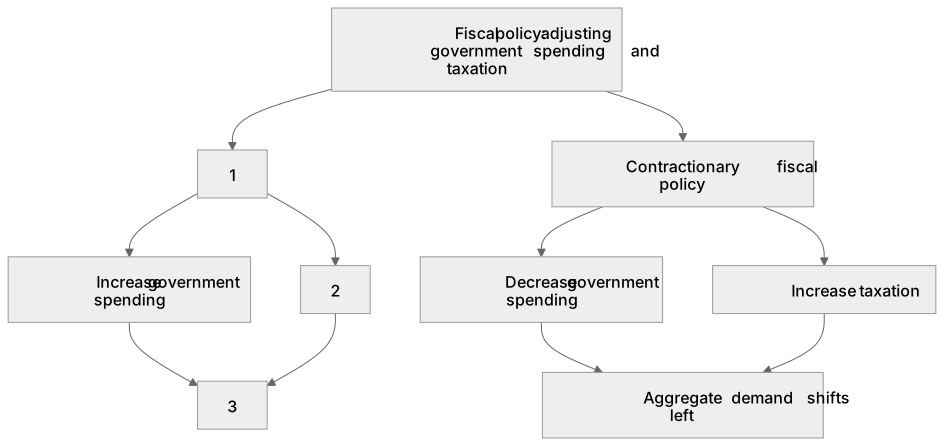
1Box 1
2Box 2
3Box 3
There is more to this lesson
The full lesson goes on to check your understanding and help you earn the marks. Create a free account to carry on, with your progress saved.
A week of Premium from your first lesson · Then the free plan continues · No card, no charge
Test your understanding of Policy instruments: a) Fiscal policy: o adjusting levels of government spending and taxation to affect aggregate demand
Active recall beats re-reading. Take an instant quiz now to test what you’ve learned and lock it into long-term memory.
A week of Premium from your first lesson · Then the free plan continues · No card, no charge