Pearson Edexcel · A-Level · Economics B
Course version: 9EB0 · Version from Sept 2015
B) Monetary policy: o adjusting interest rates to affect aggregate demand
Full specification wording
Policy instruments: b) Monetary policy: o adjusting interest rates to affect aggregate demand
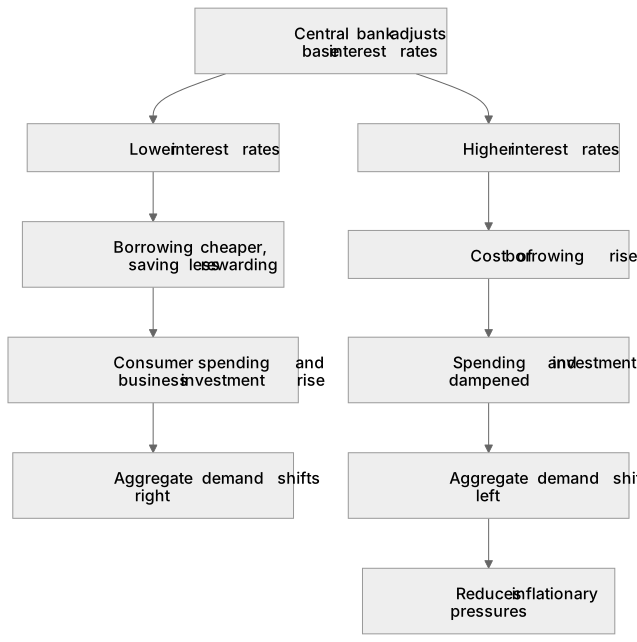
Monetary policy involves the central bank adjusting base interest rates to influence aggregate demand (AD) and achieve macroeconomic objectives like stable inflation.
Checked against the Pearson Edexcel 9EB0 specification (opens in a new tab) on .
- Point 2 of 4
Study notes
From the checked teaching notes for this specification point.
The idea
Monetary policy involves the central bank adjusting base interest rates to influence aggregate demand (AD) and achieve macroeconomic objectives like stable inflation. When the central bank lowers interest rates, borrowing becomes cheaper and saving less rewarding. This stimulates consumer spending and business investment, shifting the AD curve to the right. For example, lower mortgage rates increase households' disposable income, boosting consumption. Conversely, raising interest rates increases the cost of borrowing, which dampens spending and investment, shifting AD to the left to cool down an overheating economy and reduce inflationary pressures. The transmission mechanism explains how rate changes filter through the economy to affect AD.
What earns the marks
- Identify the central bank as the institution responsible for setting base interest rates.
- Explain that a reduction in interest rates decreases the cost of borrowing and the reward for saving.
- Link lower interest rates to increased consumer spending and business investment, increasing aggregate demand.
- Explain that higher interest rates are used to reduce aggregate demand and control demand-pull inflation.
Common mistakes and how to put them right
Confusing monetary policy with fiscal policy.
Put it right: Monetary policy involves interest rates and money supply set by the central bank, whereas fiscal policy involves government taxation and spending.
Assuming interest rate changes have an immediate effect on the economy.
Put it right: There is a time lag (often 18 to 24 months) before interest rate changes fully impact aggregate demand.
Stating that higher interest rates increase aggregate demand.
Put it right: Higher interest rates increase borrowing costs, which reduces consumption and investment, thereby decreasing aggregate demand.
Exam tips
- Always specify which components of aggregate demand (usually consumption and investment) are affected by an interest rate change.
- Use an aggregate demand and aggregate supply (AD/AS) diagram to illustrate the impact of an interest rate change on the price level and real GDP.
- Consider the impact of interest rates on the exchange rate, as higher rates can lead to a stronger currency, affecting net exports.
Try the lesson
The start of the Policy instruments: b) Monetary policy: o adjusting interest rates to affect aggregate demand lesson, made from checked teaching notes for this specification point.
Have a go first
Which of the following is the primary tool used in monetary policy to influence the level of aggregate demand in an economy?
Listen
Monetary policy involves the central bank adjusting base interest rates to influence aggregate demand (AD) and achieve macroeconomic objectives like stable inflation. When the central bank lowers interest rates, borrowing becomes cheaper and saving less rewarding. This stimulates consumer spending and business investment, shifting the AD curve to the right. For example, lower mortgage rates increase households' disposable income, boosting consumption. Conversely, raising interest rates increases the cost of borrowing, which dampens spending and investment, shifting AD to the left to cool down an overheating economy and reduce inflationary pressures. The transmission mechanism explains how rate changes filter through the economy to affect AD. A strong answer earns marks for these points. Identify the central bank as the institution responsible for setting base interest rates. Explain that a reduction in interest rates decreases the cost of borrowing and the reward for saving. Link lower interest rates to increased consumer spending and business investment, increasing aggregate demand. Explain that higher interest rates are used to reduce aggregate demand and control demand-pull inflation. A common slip: Confusing monetary policy with fiscal policy. Instead, monetary policy involves interest rates and money supply set by the central bank, whereas fiscal policy involves government taxation and spending. Exam tip: Always specify which components of aggregate demand (usually consumption and investment) are affected by an interest rate change.
See it
Label the diagram
Some boxes have lost their names. Pick the right name for each number.
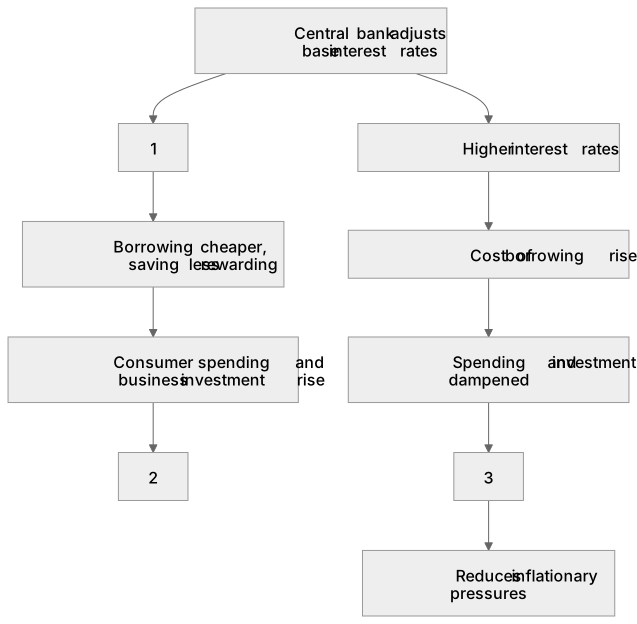
1Box 1
2Box 2
3Box 3
There is more to this lesson
The full lesson goes on to check your understanding and help you earn the marks. Create a free account to carry on, with your progress saved.
A week of Premium from your first lesson · Then the free plan continues · No card, no charge
Test your understanding of Policy instruments: b) Monetary policy: o adjusting interest rates to affect aggregate demand
Active recall beats re-reading. Take an instant quiz now to test what you’ve learned and lock it into long-term memory.
A week of Premium from your first lesson · Then the free plan continues · No card, no charge