Pearson Edexcel · A-Level · Economics B
Course version: 9EB0 · Version from Sept 2015
Policy instruments: d) Exchange rate policy: o floating rate
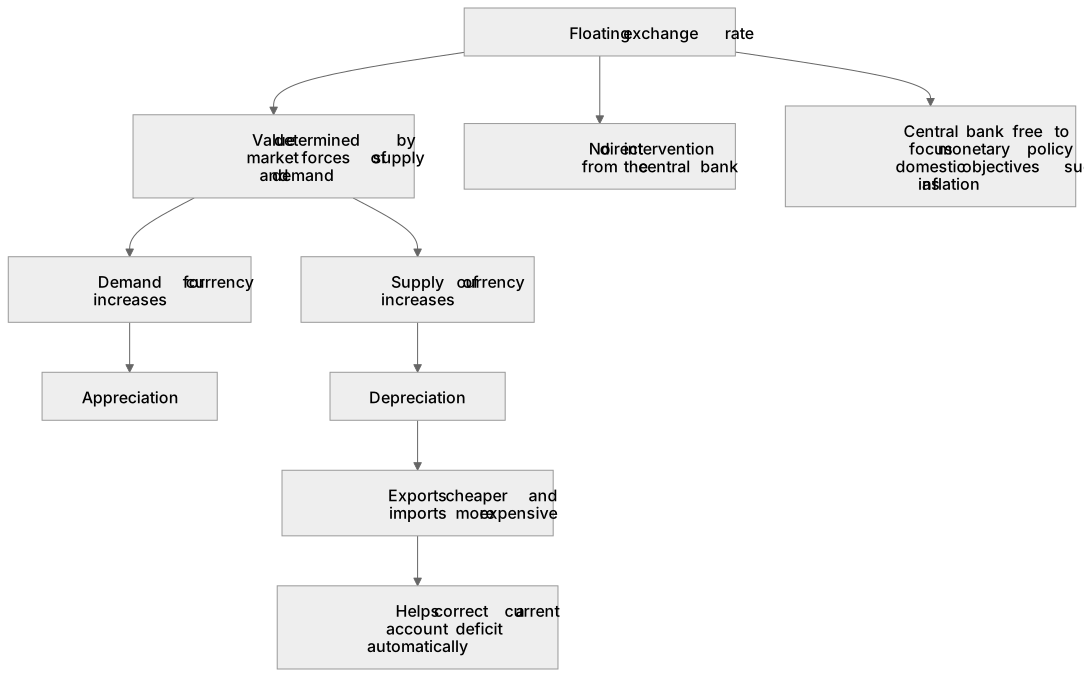
A floating exchange rate is a policy instrument where a currency's value is determined by the market forces of supply and demand, without direct intervention from the central bank.
Checked against the Pearson Edexcel 9EB0 specification (opens in a new tab) on .
- Point 4 of 4
- 4 key terms
Study notes
From the checked teaching notes for this specification point.
The idea
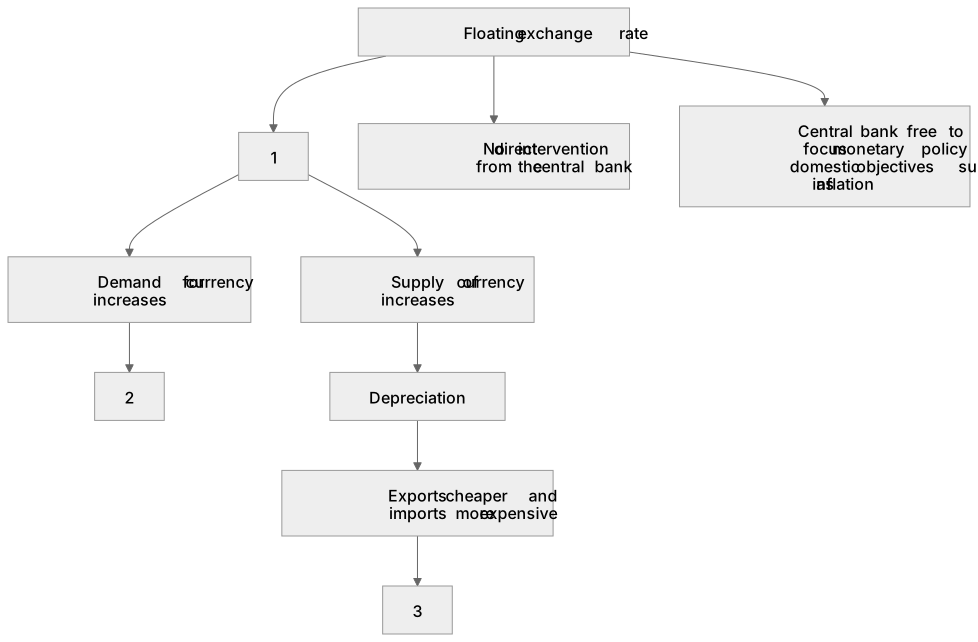
A floating exchange rate is a policy instrument where a currency's value is determined by the market forces of supply and demand, without direct intervention from the central bank. In this system, if demand for a currency increases (e.g. due to higher exports), it appreciates. If supply increases (e.g. due to higher imports), it depreciates. A key advantage is its role as an automatic stabiliser; a current account deficit increases the supply of the currency, causing depreciation. This makes exports cheaper and imports more expensive, helping to correct the deficit automatically. It also frees the central bank to focus monetary policy on domestic objectives like inflation, rather than managing the currency.
What earns the marks
- Definition of a floating exchange rate as being determined by market forces of supply and demand.
- Explanation of how a floating rate acts as an automatic stabiliser for the balance of payments.
- Identification that a floating rate allows monetary policy to be directed towards domestic targets such as inflation.
- Analysis of how external shocks can cause volatility in a floating exchange rate, creating uncertainty for international trade.
Common mistakes and how to put them right
Confusing a floating exchange rate with a managed float.
Put it right: A pure floating rate has no central bank intervention, whereas a managed float involves occasional intervention to smooth out extreme fluctuations.
Stating that a floating exchange rate guarantees a balanced current account.
Put it right: While it helps correct imbalances, other factors like the Marshall-Lerner condition and price elasticities of demand determine if the deficit actually improves.
Assuming the government sets the exchange rate in a floating system.
Put it right: The government and central bank do not set the rate; it is determined entirely by the foreign exchange market.
Exam tips
- Always link a depreciation or appreciation in a floating system back to the specific changes in supply and demand for the currency.
- Use the concept of an automatic stabiliser to evaluate the effectiveness of a floating exchange rate in correcting current account deficits.
- When evaluating exchange rate policies, contrast the flexibility of a floating rate with the certainty provided by a fixed exchange rate.
Try the lesson
The start of the Policy instruments: d) Exchange rate policy: o floating rate lesson, made from checked teaching notes for this specification point.
Have a go first
Which of the following best describes how a floating exchange rate is determined?
Listen
A floating exchange rate is a policy instrument where a currency's value is determined by the market forces of supply and demand, without direct intervention from the central bank. In this system, if demand for a currency increases (e.g. due to higher exports), it appreciates. If supply increases (e.g. due to higher imports), it depreciates. A key advantage is its role as an automatic stabiliser; a current account deficit increases the supply of the currency, causing depreciation. This makes exports cheaper and imports more expensive, helping to correct the deficit automatically. It also frees the central bank to focus monetary policy on domestic objectives like inflation, rather than managing the currency. A strong answer earns marks for these points. Definition of a floating exchange rate as being determined by market forces of supply and demand. Explanation of how a floating rate acts as an automatic stabiliser for the balance of payments. Identification that a floating rate allows monetary policy to be directed towards domestic targets such as inflation. Analysis of how external shocks can cause volatility in a floating exchange rate, creating uncertainty for international trade. A common slip: Confusing a floating exchange rate with a managed float. Instead, A pure floating rate has no central bank intervention, whereas a managed float involves occasional intervention to smooth out extreme fluctuations. Exam tip: Always link a depreciation or appreciation in a floating system back to the specific changes in supply and demand for the currency.
See it
Key words
Say what each word means before you turn the card.
Floating exchange rate
Try answering aloud or in your head before turning the card.
Market forces
Try answering aloud or in your head before turning the card.
Automatic stabiliser
Try answering aloud or in your head before turning the card.
International trade
Try answering aloud or in your head before turning the card.
See every definition
- Floating exchange rate
- A policy instrument where a currency's value is determined by the market forces of supply and demand, without direct intervention from the central bank.
- Market forces
- The supply and demand of a currency, which determine its value in a floating exchange rate system.
- Automatic stabiliser
- A role of a floating exchange rate whereby a current account deficit increases the supply of the currency, causing depreciation, which makes exports cheaper and imports more expensive and helps to correct the deficit automatically.
- International trade
- Activity for which external shocks can cause volatility in a floating exchange rate, creating uncertainty.
Label the diagram
Some boxes have lost their names. Pick the right name for each number.
1Box 1
2Box 2
3Box 3
There is more to this lesson
The full lesson goes on to check your understanding and help you earn the marks. Create a free account to carry on, with your progress saved.
A week of Premium from your first lesson · Then the free plan continues · No card, no charge
Test your understanding of Policy instruments: d) Exchange rate policy: o floating rate
Active recall beats re-reading. Take an instant quiz now to test what you’ve learned and lock it into long-term memory.
A week of Premium from your first lesson · Then the free plan continues · No card, no charge