Pearson Edexcel · A-Level · Economics B
Course version: 9EB0 · Version from Sept 2015
C) Supply-side policies: o taxes, benefits, education and training, grants…
Full specification wording
Policy instruments: c) Supply-side policies: o taxes, benefits, education and training, grants and subsidies infrastructure
Supply-side policies aim to increase the productive capacity of the economy, shifting the long-run aggregate supply (LRAS) curve to the right.
Checked against the Pearson Edexcel 9EB0 specification (opens in a new tab) on .
- Point 3 of 4
Study notes
From the checked teaching notes for this specification point.
The idea
Supply-side policies aim to increase the productive capacity of the economy, shifting the long-run aggregate supply (LRAS) curve to the right. Governments use various instruments to achieve this. Reducing income and corporation taxes incentivises individuals to work and businesses to invest. Reforming benefits encourages the unemployed to enter the labour market. Investment in education and training improves human capital, boosting labour productivity. Providing grants and subsidies helps firms develop new technologies. Finally, upgrading infrastructure, such as building new transport links or broadband networks, reduces business costs and improves geographical mobility. Together, these policies enhance economic efficiency and long-term growth.
What earns the marks
- Define supply-side policies as measures designed to increase the productive potential of the economy.
- Explain how reducing taxes and reforming benefits can increase the quantity and quality of the labour supply.
- Describe how government spending on education and training increases labour productivity and human capital.
- Explain that grants, subsidies, and infrastructure investment reduce costs for firms and encourage long-term economic growth.
Common mistakes and how to put them right
Confusing supply-side policies with demand-side policies.
Put it right: Supply-side policies focus on increasing productive capacity (LRAS), while demand-side policies focus on altering aggregate demand (AD).
Assuming supply-side policies work quickly.
Put it right: Most supply-side policies, such as education and infrastructure projects, have significant time lags before they affect the economy.
Believing that tax cuts only affect aggregate demand.
Put it right: While tax cuts can boost AD, cuts to income and corporation tax are also key supply-side policies that incentivise work and investment.
Exam tips
- Use an LRAS diagram to show the successful implementation of supply-side policies shifting the productive capacity to the right.
- Evaluate supply-side policies by discussing their cost to the government budget and the time it takes for them to become effective.
- Link specific supply-side instruments to their direct microeconomic effects, such as how infrastructure improvements lower transport costs for local businesses.
Try the lesson
The start of the Policy instruments: c) Supply-side policies: o taxes, benefits, education and training, grants and subsidies infrastructure lesson, made from checked teaching notes for this specification point.
Have a go first
Which of the following is an example of a supply-side policy designed to increase the productive capacity of an economy?
Listen
Supply-side policies aim to increase the productive capacity of the economy, shifting the long-run aggregate supply (LRAS) curve to the right. Governments use various instruments to achieve this. Reducing income and corporation taxes incentivises individuals to work and businesses to invest. Reforming benefits encourages the unemployed to enter the labour market. Investment in education and training improves human capital, boosting labour productivity. Providing grants and subsidies helps firms develop new technologies. Finally, upgrading infrastructure, such as building new transport links or broadband networks, reduces business costs and improves geographical mobility. Together, these policies enhance economic efficiency and long-term growth. A strong answer earns marks for these points. Define supply-side policies as measures designed to increase the productive potential of the economy. Explain how reducing taxes and reforming benefits can increase the quantity and quality of the labour supply. Describe how government spending on education and training increases labour productivity and human capital. Explain that grants, subsidies, and infrastructure investment reduce costs for firms and encourage long-term economic growth. A common slip: Confusing supply-side policies with demand-side policies. Instead, supply-side policies focus on increasing productive capacity (LRAS), while demand-side policies focus on altering aggregate demand (AD). Exam tip: Use an LRAS diagram to show the successful implementation of supply-side policies shifting the productive capacity to the right.
See it
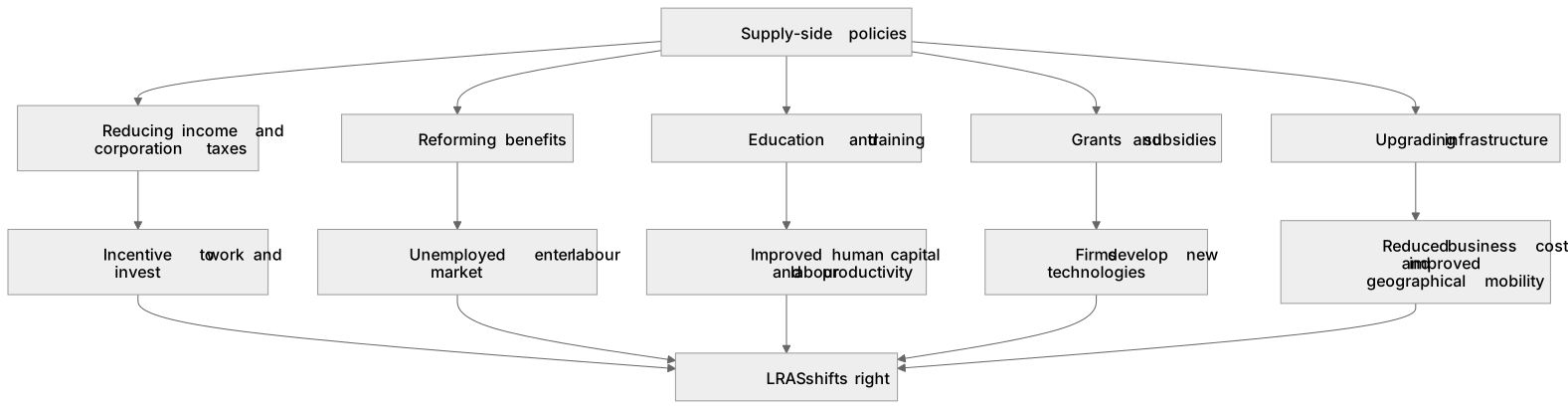
Label the diagram
Some boxes have lost their names. Pick the right name for each number.
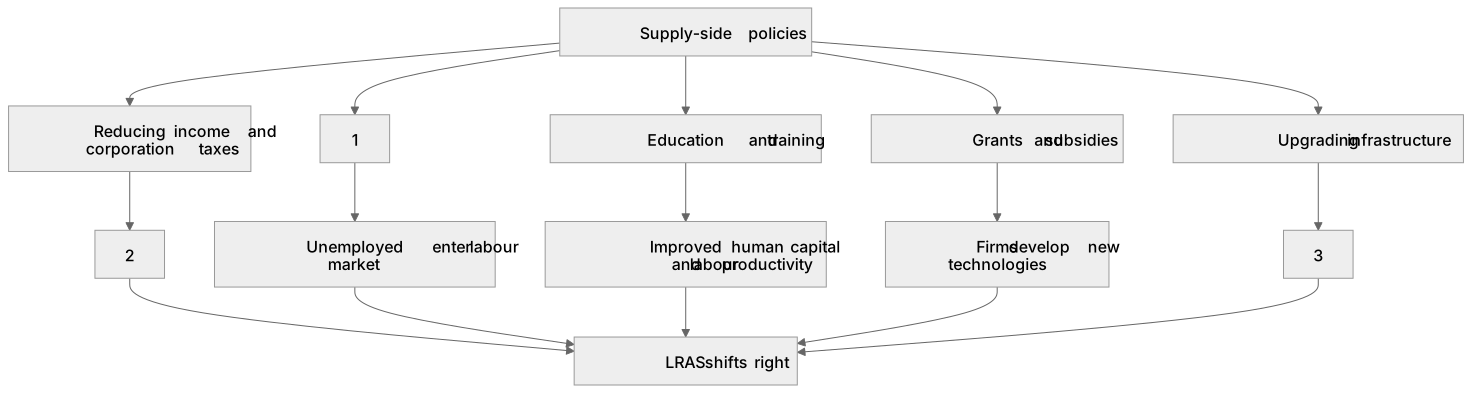
1Box 1
2Box 2
3Box 3
There is more to this lesson
The full lesson goes on to check your understanding and help you earn the marks. Create a free account to carry on, with your progress saved.
A week of Premium from your first lesson · Then the free plan continues · No card, no charge
Test your understanding of Policy instruments: c) Supply-side policies: o taxes, benefits, education and training, grants and subsidies infrastructure
Active recall beats re-reading. Take an instant quiz now to test what you’ve learned and lock it into long-term memory.
A week of Premium from your first lesson · Then the free plan continues · No card, no charge