Pearson Edexcel · A-Level · Economics B
Course version: 9EB0 · Version from Sept 2015
Possible macroeconomic objectives: a) Economic growth
Full specification wording
Possible macroeconomic objectives: a) Economic growth
Economic growth is a primary macroeconomic objective, representing an increase in an economy's productive capacity and real national output over time.
Checked against the Pearson Edexcel 9EB0 specification (opens in a new tab) on .
- Point 1 of 4
- 4 key terms
Study notes
From the checked teaching notes for this specification point.
The idea
Economic growth is a primary macroeconomic objective, representing an increase in an economy's productive capacity and real national output over time. It is typically measured by the annual percentage change in Real Gross Domestic Product (GDP). Sustained economic growth is crucial as it drives higher living standards, creates employment, and generates tax revenues for public services. For example, if a country's Real GDP grows by 2.5% in a year, the total volume of goods and services produced has increased. Policymakers must balance this objective against potential negative consequences, such as demand-pull inflation, environmental degradation, and widening income inequality, to ensure that the economic growth remains sustainable in the long term.
What earns the marks
- Define economic growth as the increase in the real value of goods and services produced in an economy over a period of time.
- Identify Real GDP as the primary measure used to assess the rate of economic growth.
- Explain the benefits of economic growth, including higher living standards, lower unemployment, and increased fiscal revenues.
- Recognise the potential conflicts between economic growth and other macroeconomic objectives, such as price stability and environmental protection.
Common mistakes and how to put them right
Confusing nominal economic growth with real economic growth.
Put it right: Specify that real economic growth accounts for inflation, whereas nominal growth does not.
Assuming economic growth automatically reduces income inequality.
Put it right: Recognise that the benefits of growth may not be distributed evenly, potentially widening the wealth gap.
Equating economic growth directly with economic development.
Put it right: Understand that while growth is an increase in output, development encompasses broader improvements in living standards and human welfare.
Exam tips
- Always use 'Real GDP' rather than just 'GDP' when defining economic growth to show you understand the impact of inflation.
- When evaluating economic growth, consider the long-term sustainability and environmental costs associated with increased production.
- Use aggregate demand and aggregate supply (AD/AS) diagrams to illustrate how economic growth can occur through shifts in either curve.
Try the lesson
The start of the Possible macroeconomic objectives: a) Economic growth lesson, made from checked teaching notes for this specification point.
Have a go first
Which of the following best describes the macroeconomic objective of economic growth?
Listen
Economic growth is a primary macroeconomic objective, representing an increase in an economy's productive capacity and real national output over time. It is typically measured by the annual percentage change in Real Gross Domestic Product (GDP). Sustained economic growth is crucial as it drives higher living standards, creates employment, and generates tax revenues for public services. For example, if a country's Real GDP grows by 2.5% in a year, the total volume of goods and services produced has increased. Policymakers must balance this objective against potential negative consequences, such as demand-pull inflation, environmental degradation, and widening income inequality, to ensure that the economic growth remains sustainable in the long term. A strong answer earns marks for these points. Define economic growth as the increase in the real value of goods and services produced in an economy over a period of time. Identify Real GDP as the primary measure used to assess the rate of economic growth. Explain the benefits of economic growth, including higher living standards, lower unemployment, and increased fiscal revenues. Recognise the potential conflicts between economic growth and other macroeconomic objectives, such as price stability and environmental protection. A common slip: Confusing nominal economic growth with real economic growth. Instead, specify that real economic growth accounts for inflation, whereas nominal growth does not. Exam tip: Always use 'Real GDP' rather than just 'GDP' when defining economic growth to show you understand the impact of inflation.
See it

Key words
Say what each word means before you turn the card.
Economic growth
Try answering aloud or in your head before turning the card.
Real Gross Domestic Product
Try answering aloud or in your head before turning the card.
Living standards
Try answering aloud or in your head before turning the card.
Policy conflicts
Try answering aloud or in your head before turning the card.
See every definition
- Economic growth
- An increase in an economy's productive capacity and real national output over time, typically measured by the annual percentage change in Real Gross Domestic Product.
- Real Gross Domestic Product
- The primary measure used to assess the rate of economic growth, accounting for inflation.
- Living standards
- A measure of welfare that sustained economic growth drives higher.
- Policy conflicts
- Tensions between economic growth and other macroeconomic objectives, such as price stability and environmental protection.
Label the diagram
Some boxes have lost their names. Pick the right name for each number.
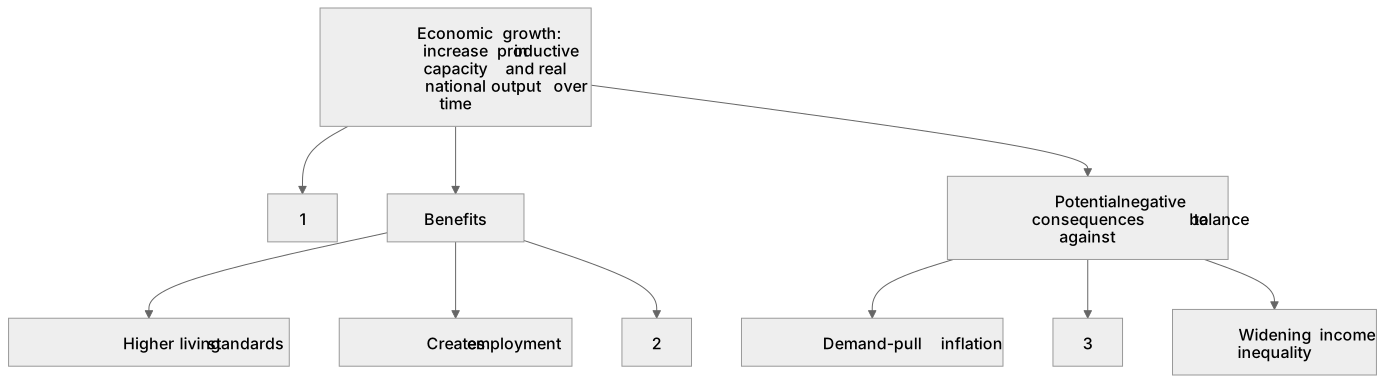
1Box 1
2Box 2
3Box 3
There is more to this lesson
The full lesson goes on to check your understanding and help you earn the marks. Create a free account to carry on, with your progress saved.
A week of Premium from your first lesson · Then the free plan continues · No card, no charge
Test your understanding of Possible macroeconomic objectives: a) Economic growth
Active recall beats re-reading. Take an instant quiz now to test what you’ve learned and lock it into long-term memory.
A week of Premium from your first lesson · Then the free plan continues · No card, no charge