Pearson Edexcel · A-Level · Economics B
Course version: 9EB0 · Version from Sept 2015
Possible macroeconomic objectives: b) Low unemployment
Full specification wording
Possible macroeconomic objectives: b) Low unemployment
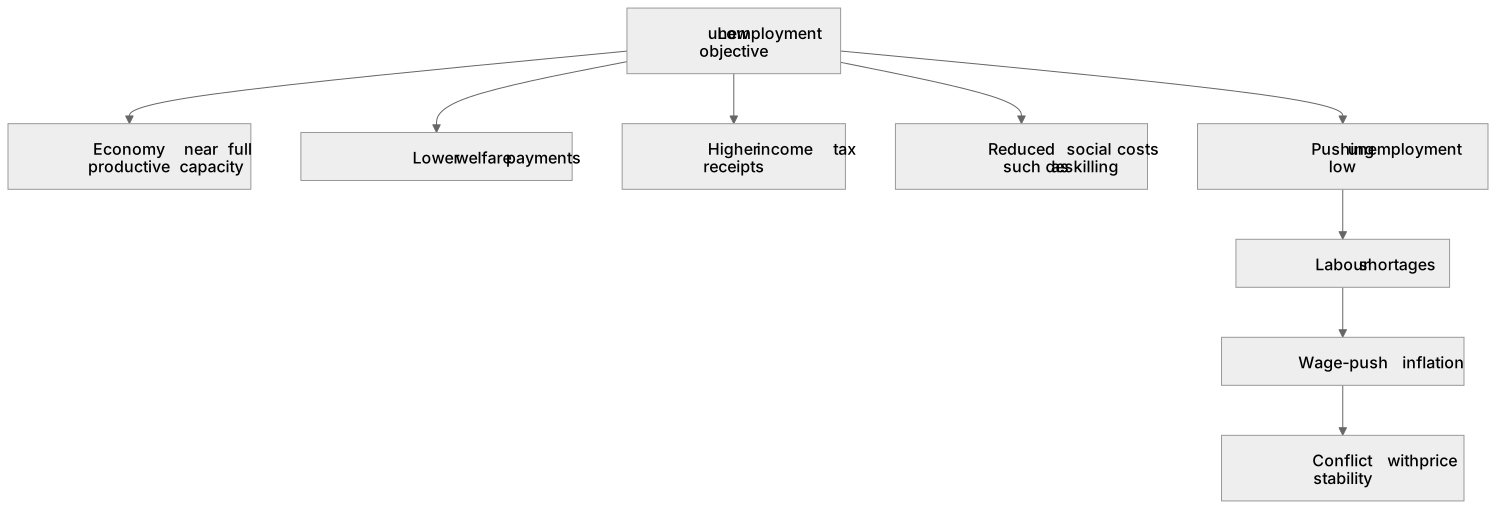
Low unemployment is a key macroeconomic objective, indicating an economy is operating near its full productive capacity.
Checked against the Pearson Edexcel 9EB0 specification (opens in a new tab) on .
- Point 2 of 4
- 3 key terms
Study notes
From the checked teaching notes for this specification point.
The idea
Low unemployment is a key macroeconomic objective, indicating an economy is operating near its full productive capacity. It represents working-age individuals actively seeking work but without a job. Achieving low unemployment reduces the government's financial burden by lowering welfare payments and increasing income tax receipts. It also prevents social costs associated with long-term joblessness, such as deskilling. For instance, aiming for an unemployment rate of 4% allows for natural frictional unemployment while avoiding cyclical unemployment. However, pushing unemployment too low can lead to labour shortages and trigger wage-push inflation, creating a direct conflict with the macroeconomic objective of maintaining price stability.
What earns the marks
- Define unemployment as the number of people of working age who are willing and able to work but cannot find employment.
- Explain the economic benefits of low unemployment, such as higher aggregate demand and improved fiscal balances.
- Identify the social benefits of low unemployment, including reduced poverty and crime rates.
- Recognise the trade-off between low unemployment and inflation, often illustrated by the Phillips Curve.
Common mistakes and how to put them right
Assuming an unemployment rate of 0% is achievable or desirable.
Put it right: Recognise that some frictional and structural unemployment will always exist in a dynamic economy.
Confusing the level of unemployment with the rate of unemployment.
Put it right: The level is the total number of unemployed people, while the rate is the percentage of the economically active population without a job.
Believing that low unemployment always leads to higher productivity.
Put it right: Understand that low unemployment might mean less productive or less skilled workers are employed, potentially lowering average productivity.
Exam tips
- Be prepared to discuss the different types of unemployment (e.g., cyclical, structural, frictional) when evaluating government policies.
- Use the concept of the Phillips Curve to evaluate the potential conflict between achieving low unemployment and maintaining low inflation.
- Remember to mention the impact of low unemployment on the government's budget, specifically regarding tax revenues and welfare expenditure.
Try the lesson
The start of the Possible macroeconomic objectives: b) Low unemployment lesson, made from checked teaching notes for this specification point.
Have a go first
Why do governments typically set low unemployment as a primary macroeconomic objective?
Listen
Low unemployment is a key macroeconomic objective, indicating an economy is operating near its full productive capacity. It represents working-age individuals actively seeking work but without a job. Achieving low unemployment reduces the government's financial burden by lowering welfare payments and increasing income tax receipts. It also prevents social costs associated with long-term joblessness, such as deskilling. For instance, aiming for an unemployment rate of 4% allows for natural frictional unemployment while avoiding cyclical unemployment. However, pushing unemployment too low can lead to labour shortages and trigger wage-push inflation, creating a direct conflict with the macroeconomic objective of maintaining price stability. A strong answer earns marks for these points. Define unemployment as the number of people of working age who are willing and able to work but cannot find employment. Explain the economic benefits of low unemployment, such as higher aggregate demand and improved fiscal balances. Identify the social benefits of low unemployment, including reduced poverty and crime rates. Recognise the trade-off between low unemployment and inflation, often illustrated by the Phillips Curve. A common slip: Assuming an unemployment rate of 0% is achievable or desirable. Instead, Recognise that some frictional and structural unemployment will always exist in a dynamic economy. Exam tip: Be prepared to discuss the different types of unemployment (e.g., cyclical, structural, frictional) when evaluating government policies.
See it
Key words
Say what each word means before you turn the card.
Low unemployment
Try answering aloud or in your head before turning the card.
Unemployment
Try answering aloud or in your head before turning the card.
Policy trade-offs
Try answering aloud or in your head before turning the card.
See every definition
- Low unemployment
- A key macroeconomic objective indicating that an economy is operating near its full productive capacity, with working-age individuals actively seeking work but without a job kept to a minimum.
- Unemployment
- The number of people of working age who are willing and able to work but cannot find employment.
- Policy trade-offs
- Direct conflicts between macroeconomic objectives, such as pushing unemployment too low leading to labour shortages and wage-push inflation, conflicting with price stability.
Label the diagram
Some boxes have lost their names. Pick the right name for each number.
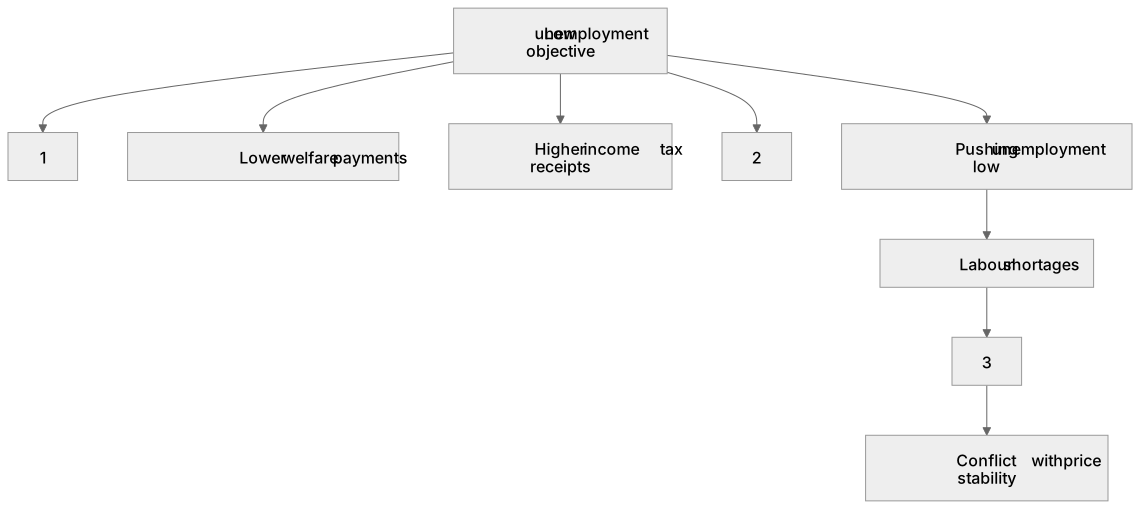
1Box 1
2Box 2
3Box 3
There is more to this lesson
The full lesson goes on to check your understanding and help you earn the marks. Create a free account to carry on, with your progress saved.
A week of Premium from your first lesson · Then the free plan continues · No card, no charge
Test your understanding of Possible macroeconomic objectives: b) Low unemployment
Active recall beats re-reading. Take an instant quiz now to test what you’ve learned and lock it into long-term memory.
A week of Premium from your first lesson · Then the free plan continues · No card, no charge