Pearson Edexcel · A-Level · Economics B
Course version: 9EB0 · Version from Sept 2015
D) Balance of payments equilibrium on current account
Full specification wording
Possible macroeconomic objectives: d) Balance of payments equilibrium on current account
Achieving a balance of payments equilibrium on the current account is a key macroeconomic objective.
Checked against the Pearson Edexcel 9EB0 specification (opens in a new tab) on .
- Point 4 of 4
- 4 key terms
Study notes
From the checked teaching notes for this specification point.
The idea
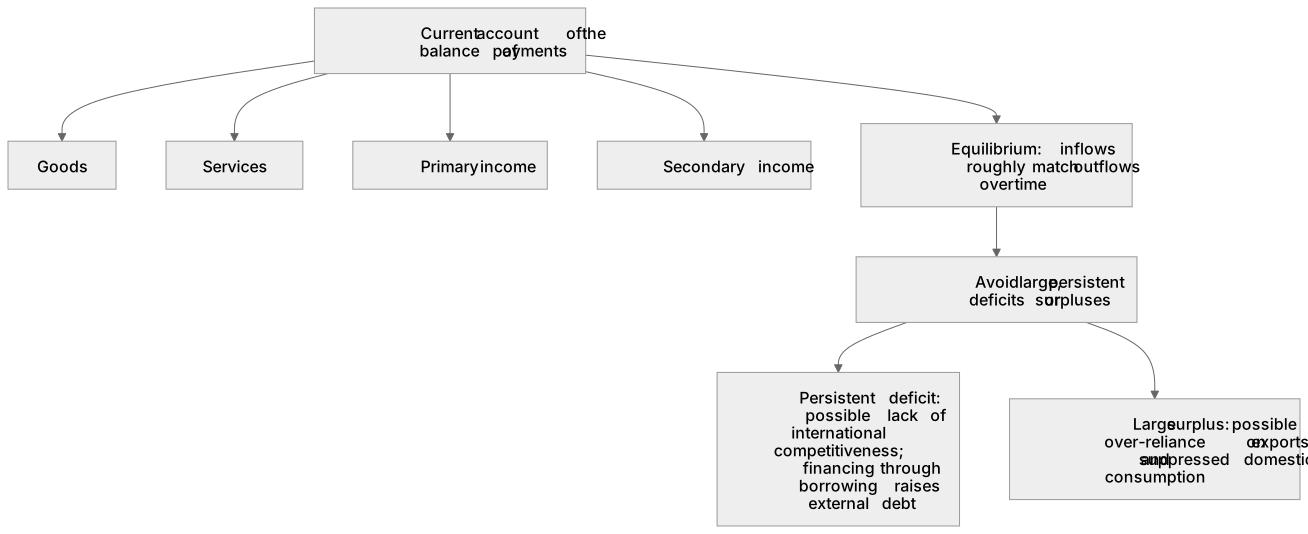
Achieving a balance of payments equilibrium on the current account is a key macroeconomic objective. The current account measures flows of goods, services, primary income, and secondary income between a country and the rest of the world. Equilibrium means inflows roughly match outflows over time, avoiding large, persistent deficits or surpluses. A persistent deficit can indicate a lack of international competitiveness and may require financing through borrowing, increasing external debt. Conversely, a large surplus might suggest an over-reliance on exports and suppressed domestic consumption.
For example: A country running a persistent trade deficit may face downward pressure on its exchange rate and long-term structural economic weaknesses.
What earns the marks
- Define the current account of the balance of payments as the record of trade in goods and services, plus primary and secondary income flows.
- Explain that equilibrium means the current account is broadly in balance, without unsustainable deficits or surpluses.
- Identify that a persistent current account deficit may indicate structural weaknesses, such as poor productivity or high relative inflation.
- Recognise that financing a large deficit requires inflows on the financial account, which can increase a nation's external debt.
- Explain that while a surplus is often viewed positively, a very large surplus can cause political friction and indicate unbalanced domestic consumption.
Common mistakes and how to put them right
Confusing the government budget deficit with the current account deficit.
Put it right: The budget deficit relates to government spending exceeding tax revenue, whereas the current account deficit relates to international trade and income flows.
Assuming a current account deficit is always bad.
Put it right: A deficit can be acceptable if it is driven by imports of capital goods that will increase future productive capacity and economic growth.
Forgetting the income components of the current account.
Put it right: The current account includes primary income (investment income) and secondary income (transfers), not just the trade in goods and services.
Exam tips
- When evaluating the significance of a current account deficit, consider its size as a percentage of GDP rather than just the absolute monetary value.
- Discuss the causes of a deficit, such as high domestic growth sucking in imports versus structural uncompetitiveness, to provide a nuanced evaluation.
- Link the current account position to other macroeconomic objectives, such as economic growth and employment, to demonstrate synoptic understanding.
Try the lesson
The start of the Possible macroeconomic objectives: d) Balance of payments equilibrium on current account lesson, made from checked teaching notes for this specification point.
Have a go first
What is meant by the macroeconomic objective of a balance of payments equilibrium on the current account?
Listen
Achieving a balance of payments equilibrium on the current account is a key macroeconomic objective. The current account measures flows of goods, services, primary income, and secondary income between a country and the rest of the world. Equilibrium means inflows roughly match outflows over time, avoiding large, persistent deficits or surpluses. A persistent deficit can indicate a lack of international competitiveness and may require financing through borrowing, increasing external debt. Conversely, a large surplus might suggest an over-reliance on exports and suppressed domestic consumption. For example, a country running a persistent trade deficit may face downward pressure on its exchange rate and long-term structural economic weaknesses. A strong answer earns marks for these points. Define the current account of the balance of payments as the record of trade in goods and services, plus primary and secondary income flows. Explain that equilibrium means the current account is broadly in balance, without unsustainable deficits or surpluses. Identify that a persistent current account deficit may indicate structural weaknesses, such as poor productivity or high relative inflation. Recognise that financing a large deficit requires inflows on the financial account, which can increase a nation's external debt. A common slip: Confusing the government budget deficit with the current account deficit. Instead, The budget deficit relates to government spending exceeding tax revenue, whereas the current account deficit relates to international trade and income flows. Exam tip: When evaluating the significance of a current account deficit, consider its size as a percentage of GDP rather than just the absolute monetary value.
See it
Key words
Say what each word means before you turn the card.
Current account
Try answering aloud or in your head before turning the card.
Equilibrium
Try answering aloud or in your head before turning the card.
Persistent current account deficit
Try answering aloud or in your head before turning the card.
Current account surplus
Try answering aloud or in your head before turning the card.
See every definition
- Current account
- The record of trade in goods and services, plus primary and secondary income flows between a country and the rest of the world.
- Equilibrium
- A position where the current account is broadly in balance, with inflows roughly matching outflows over time and no unsustainable deficits or surpluses.
- Persistent current account deficit
- A continuing shortfall that may indicate structural weaknesses, such as poor productivity or high relative inflation, and may require financing through borrowing that increases external debt.
- Current account surplus
- A position often viewed positively, but a very large one can cause political friction and indicate unbalanced domestic consumption and over-reliance on exports.
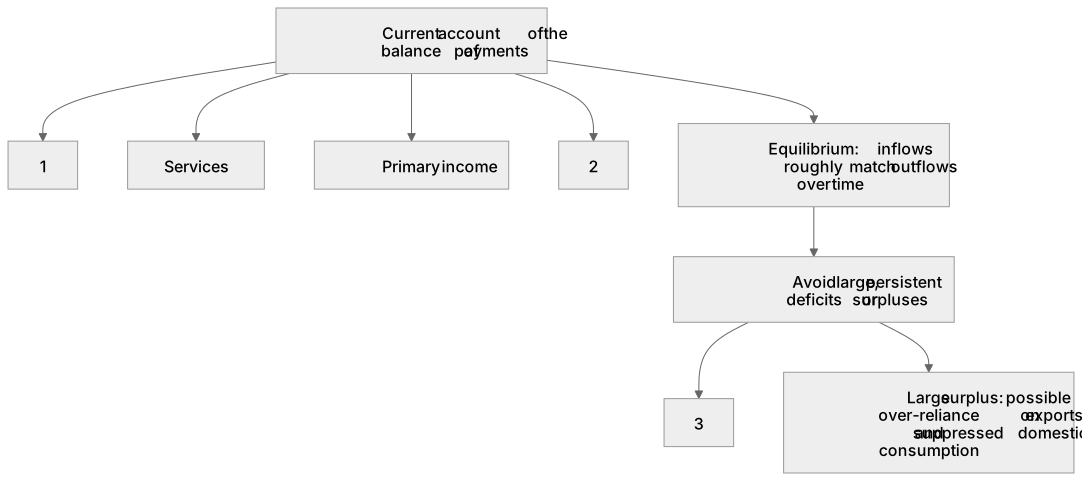
Label the diagram
Some boxes have lost their names. Pick the right name for each number.
1Box 1
2Box 2
3Box 3
There is more to this lesson
The full lesson goes on to check your understanding and help you earn the marks. Create a free account to carry on, with your progress saved.
A week of Premium from your first lesson · Then the free plan continues · No card, no charge
Test your understanding of Possible macroeconomic objectives: d) Balance of payments equilibrium on current account
Active recall beats re-reading. Take an instant quiz now to test what you’ve learned and lock it into long-term memory.
A week of Premium from your first lesson · Then the free plan continues · No card, no charge