Pearson Edexcel · A-Level · Economics B
Course version: 9EB0 · Version from Sept 2015
Possible macroeconomic objectives: c) Low and stable rate of inflation
Full specification wording
Possible macroeconomic objectives: c) Low and stable rate of inflation
A low and stable rate of inflation is a primary macroeconomic objective for most governments, as it provides certainty for consumers and businesses, encouraging investment and sustainable economic…
Checked against the Pearson Edexcel 9EB0 specification (opens in a new tab) on .
- Point 3 of 4
- 4 key terms
Study notes
From the checked teaching notes for this specification point.
The idea
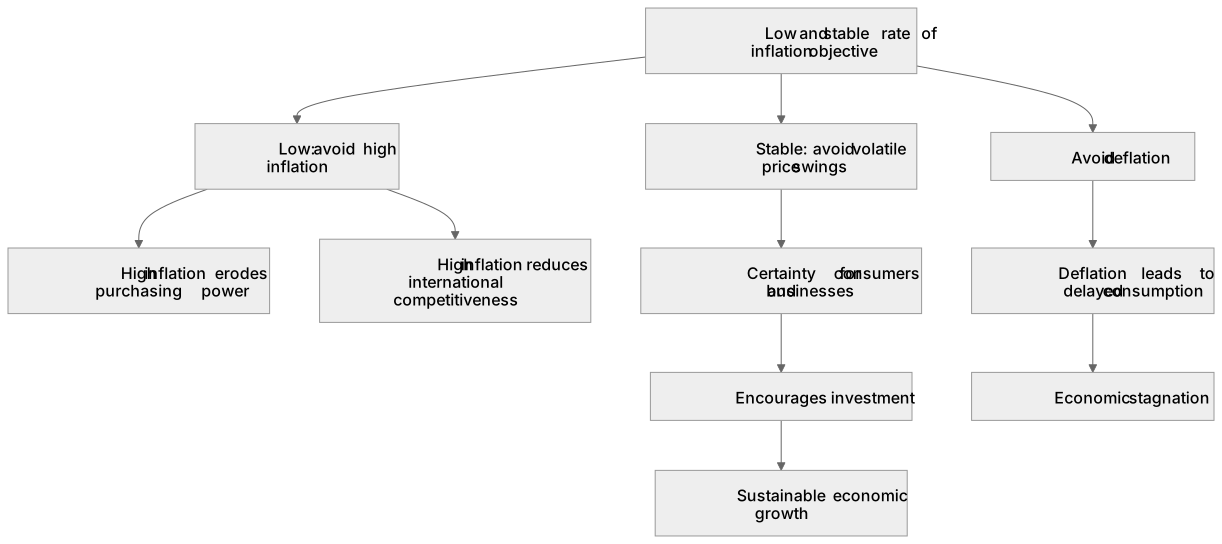
A low and stable rate of inflation is a primary macroeconomic objective for most governments, as it provides certainty for consumers and businesses, encouraging investment and sustainable economic growth. In the UK, the Bank of England targets a 2% inflation rate, measured by the Consumer Prices Index (CPI). 'Low' means avoiding the damaging effects of high inflation, such as eroded purchasing power and reduced international competitiveness. 'Stable' means avoiding volatile price swings, which make long-term planning difficult. For example, if inflation fluctuates wildly between 1% and 8%, firms may delay capital investment due to uncertainty over future costs and revenues. Deflation (negative inflation) is also avoided, as it can lead to delayed consumption and economic stagnation.
What earns the marks
- Define inflation as the sustained increase in the general price level over time.
- Explain that a low and stable rate (such as a 2% CPI target) promotes business confidence and investment.
- Identify that high inflation erodes the real value of money and reduces international competitiveness.
- Recognise that stable inflation prevents menu costs and shoe leather costs from becoming excessive.
- Explain why deflation is undesirable, as it can cause consumers to delay purchases, reducing aggregate demand.
Common mistakes and how to put them right
Confusing a fall in the rate of inflation (disinflation) with a fall in the general price level (deflation).
Put it right: Disinflation means prices are still rising but at a slower rate; deflation means prices are actually falling.
Assuming the objective is zero inflation.
Put it right: A low, positive rate is targeted to allow relative prices and wages to adjust and to avoid the risks of deflation.
Believing inflation only affects consumers.
Put it right: Inflation also significantly impacts businesses through uncertainty, menu costs, and changes in international competitiveness.
Exam tips
- Always specify whether you are discussing the rate of inflation or the general price level when analysing macroeconomic data.
- Use a specific inflation target as a concrete example when evaluating the success of macroeconomic policies.
- When evaluating, consider the trade-offs between low inflation and other objectives, such as low unemployment.
Try the lesson
The start of the Possible macroeconomic objectives: c) Low and stable rate of inflation lesson, made from checked teaching notes for this specification point.
Have a go first
Which of the following best describes the macroeconomic objective of a low and stable rate of inflation?
Listen
A low and stable rate of inflation is a primary macroeconomic objective for most governments, as it provides certainty for consumers and businesses, encouraging investment and sustainable economic growth. In the UK, the Bank of England targets a 2% inflation rate, measured by the Consumer Prices Index (CPI). Low' means avoiding the damaging effects of high inflation, such as eroded purchasing power and reduced international competitiveness. Stable' means avoiding volatile price swings, which make long-term planning difficult. For example, if inflation fluctuates wildly between 1% and 8%, firms may delay capital investment due to uncertainty over future costs and revenues. Deflation (negative inflation) is also avoided, as it can lead to delayed consumption and economic stagnation. A strong answer earns marks for these points. Define inflation as the sustained increase in the general price level over time. Explain that a low and stable rate (such as a 2% CPI target) promotes business confidence and investment. Identify that high inflation erodes the real value of money and reduces international competitiveness. Recognise that stable inflation prevents menu costs and shoe leather costs from becoming excessive. A common slip: Confusing a fall in the rate of inflation (disinflation) with a fall in the general price level (deflation). Instead, Disinflation means prices are still rising but at a slower rate; deflation means prices are actually falling. Exam tip: Always specify whether you are discussing the rate of inflation or the general price level when analysing macroeconomic data.
See it
Key words
Say what each word means before you turn the card.
Macroeconomic objectives
Try answering aloud or in your head before turning the card.
Price stability
Try answering aloud or in your head before turning the card.
Economic uncertainty
Try answering aloud or in your head before turning the card.
International competitiveness
Try answering aloud or in your head before turning the card.
See every definition
- Macroeconomic objectives
- Goals such as a low and stable rate of inflation that governments pursue for the economy as a whole.
- Price stability
- Avoiding volatile price swings, which make long-term planning difficult for consumers and businesses.
- Economic uncertainty
- A situation where firms may delay capital investment due to uncertainty over future costs and revenues.
- International competitiveness
- A position that high inflation reduces, alongside eroding the real value of money.
Label the diagram
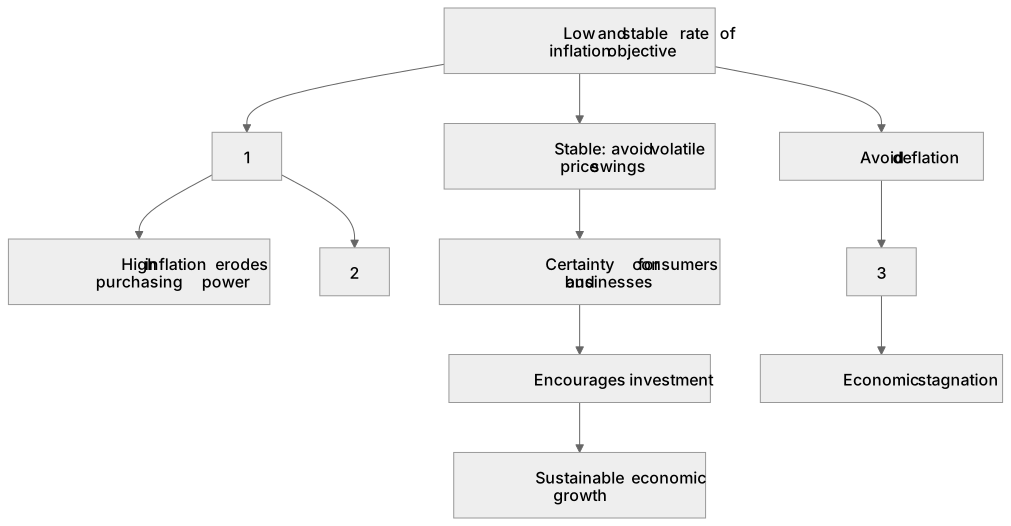
Some boxes have lost their names. Pick the right name for each number.
1Box 1
2Box 2
3Box 3
There is more to this lesson
The full lesson goes on to check your understanding and help you earn the marks. Create a free account to carry on, with your progress saved.
A week of Premium from your first lesson · Then the free plan continues · No card, no charge
Test your understanding of Possible macroeconomic objectives: c) Low and stable rate of inflation
Active recall beats re-reading. Take an instant quiz now to test what you’ve learned and lock it into long-term memory.
A week of Premium from your first lesson · Then the free plan continues · No card, no charge