Pearson Edexcel · A-Level · Economics B
Course version: 9EB0 · Version from Sept 2015
Poverty and inequality: a) Absolute and relative poverty
Full specification wording
Poverty and inequality: a) Absolute and relative poverty
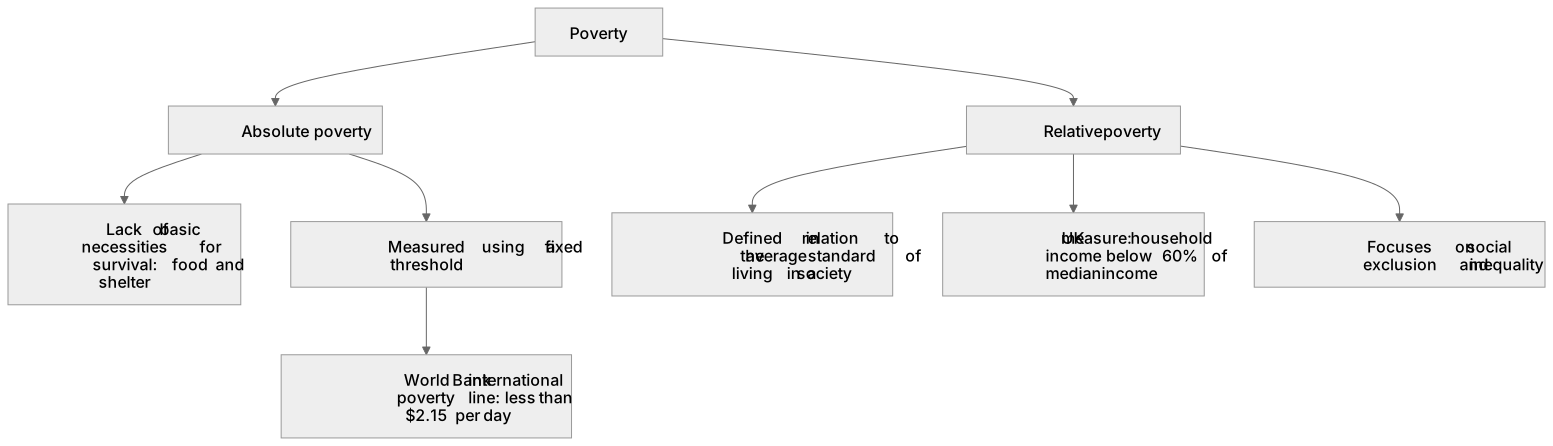
Absolute poverty occurs when individuals lack the basic necessities for survival, such as food and shelter.
Checked against the Pearson Edexcel 9EB0 specification (opens in a new tab) on .
- Point 1 of 3
- 4 key terms
Study notes
From the checked teaching notes for this specification point.
The idea
Absolute poverty occurs when individuals lack the basic necessities for survival, such as food and shelter. It is often measured using a fixed threshold, such as the World Bank's international poverty line of living on less than $2.15 per day. Relative poverty is defined in relation to the average standard of living in a specific society. In the UK, relative poverty is typically measured as living in a household with an income below 60% of the median income. While absolute poverty is more common in developing economies, relative poverty exists in all countries and focuses on social exclusion and inequality. You must be able to distinguish between these two concepts and identify which measure is most appropriate for different economic contexts.
What earns the marks
- Definition of absolute poverty as the inability to afford basic life-sustaining necessities.
- Definition of relative poverty as earning below a certain percentage of the median income for a given country.
- Recognition of the World Bank's $2.15 a day metric as a measure of absolute poverty.
- Understanding that relative poverty is a measure of income inequality within a specific society.
Common mistakes and how to put them right
Confusing absolute and relative poverty definitions.
Put it right: Absolute poverty is about survival necessities, whereas relative poverty is about comparison to the societal average.
Assuming relative poverty can be completely eradicated.
Put it right: Recognise that as long as income inequality exists, some degree of relative poverty will likely remain, as the median income shifts.
Using mean income instead of median income to define relative poverty.
Put it right: Use median income, as the mean can be skewed by a small number of very high earners.
Exam tips
- In multiple-choice questions, look carefully for the words 'median' and 'mean' when identifying the correct definition of relative poverty.
- Be prepared to calculate whether a given income falls below the relative poverty line if provided with the median income figure.
- Remember that economic growth can reduce absolute poverty while simultaneously increasing relative poverty if the gains are unequally distributed.
Try the lesson
The start of the Poverty and inequality: a) Absolute and relative poverty lesson, made from checked teaching notes for this specification point.
Have a go first
Which of the following best describes a household living in absolute poverty?
Listen
Absolute poverty occurs when individuals lack the basic necessities for survival, such as food and shelter. It is often measured using a fixed threshold, such as the World Bank's international poverty line of living on less than $2.15 per day. Relative poverty is defined in relation to the average standard of living in a specific society. In the UK, relative poverty is typically measured as living in a household with an income below 60% of the median income. While absolute poverty is more common in developing economies, relative poverty exists in all countries and focuses on social exclusion and inequality. You must be able to distinguish between these two concepts and identify which measure is most appropriate for different economic contexts. A strong answer earns marks for these points. Definition of absolute poverty as the inability to afford basic life-sustaining necessities. Definition of relative poverty as earning below a certain percentage of the median income for a given country. Recognition of the World Bank's $2.15 a day metric as a measure of absolute poverty. Understanding that relative poverty is a measure of income inequality within a specific society. A common slip: Confusing absolute and relative poverty definitions. Instead, absolute poverty is about survival necessities, whereas relative poverty is about comparison to the societal average. Exam tip: In multiple-choice questions, look carefully for the words 'median' and 'mean' when identifying the correct definition of relative poverty.
See it
Key words
Say what each word means before you turn the card.
Absolute poverty
Try answering aloud or in your head before turning the card.
Relative poverty
Try answering aloud or in your head before turning the card.
International poverty line
Try answering aloud or in your head before turning the card.
Median income
Try answering aloud or in your head before turning the card.
See every definition
- Absolute poverty
- Occurs when individuals lack the basic necessities for survival, such as food and shelter, and is often measured using a fixed threshold.
- Relative poverty
- Defined in relation to the average standard of living in a specific society, typically measured as living in a household with an income below 60% of the median income.
- International poverty line
- A fixed threshold used to measure absolute poverty, such as the World Bank's line of living on less than $2.15 per day.
- Median income
- The income figure used to define relative poverty, as opposed to the mean, which can be skewed by a small number of very high earners.
Label the diagram
Some boxes have lost their names. Pick the right name for each number.
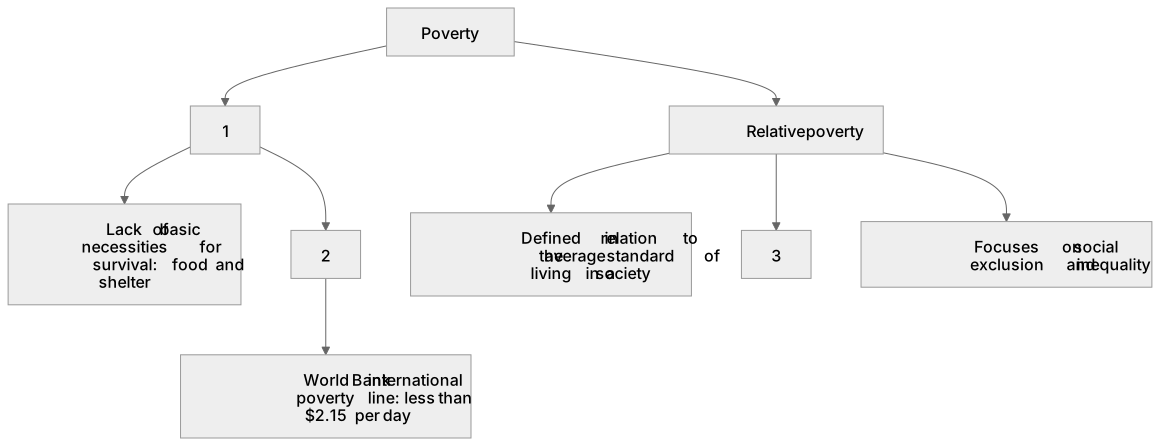
1Box 1
2Box 2
3Box 3
There is more to this lesson
The full lesson goes on to check your understanding and help you earn the marks. Create a free account to carry on, with your progress saved.
A week of Premium from your first lesson · Then the free plan continues · No card, no charge
Test your understanding of Poverty and inequality: a) Absolute and relative poverty
Active recall beats re-reading. Take an instant quiz now to test what you’ve learned and lock it into long-term memory.
A week of Premium from your first lesson · Then the free plan continues · No card, no charge