Pearson Edexcel · A-Level · Economics B
Course version: 9EB0 · Version from Sept 2015
B) Measures of poverty: o national measures o international measures
Full specification wording
Poverty and inequality: b) Measures of poverty: o national measures o international measures
Poverty can be measured at both national and international levels.
Checked against the Pearson Edexcel 9EB0 specification (opens in a new tab) on .
- Point 2 of 3
- 3 key terms
Study notes
From the checked teaching notes for this specification point.
The idea
Poverty can be measured at both national and international levels. National measures often focus on relative poverty, defining it as a percentage of the median household income (e.g., in the UK, households earning below 60% of the median income are considered to be in relative poverty). This reflects the ability to participate in a specific society's standard of living. International measures typically focus on absolute poverty, using a standardised threshold such as the World Bank's poverty line (e.g., living on less than $2.15 per day at purchasing power parity). This allows for cross-country comparisons of severe deprivation, regardless of the specific nation's overall wealth.
What earns the marks
- Define national measures of poverty, typically using a relative poverty line based on a percentage of median income.
- Define international measures of poverty, typically using an absolute poverty line such as the World Bank's daily income threshold.
- Explain how national measures account for the specific cost of living and societal norms within a single country.
- Explain how international measures use purchasing power parity (PPP) to enable valid comparisons of absolute deprivation across different countries.
Common mistakes and how to put them right
Confusing absolute and relative poverty measures.
Put it right: Absolute poverty is a fixed international threshold (e.g. $2.15 a day), whereas relative poverty is a national measure based on median income.
Assuming national poverty lines are the same globally.
Put it right: National measures vary significantly because they are based on the specific median income of each individual country.
Forgetting that international poverty lines are adjusted for purchasing power.
Put it right: International measures like the World Bank poverty line use purchasing power parity (PPP) exchange rates, not market exchange rates.
Exam tips
- When evaluating poverty measures, consider the limitations of using a single international monetary threshold that may ignore access to public services.
- Be prepared to calculate or interpret relative poverty if given data on a country's median income and the percentage threshold used.
- Use the concept of purchasing power parity (PPP) when explaining how international poverty lines are standardised across different currencies.
Try the lesson
The start of the Poverty and inequality: b) Measures of poverty: o national measures o international measures lesson, made from checked teaching notes for this specification point.
Have a go first
Which of the following is the most commonly used international measure of absolute poverty?
Listen
Poverty can be measured at both national and international levels. National measures often focus on relative poverty, defining it as a percentage of the median household income (e.g., in the UK, households earning below 60% of the median income are considered to be in relative poverty). This reflects the ability to participate in a specific society's standard of living. International measures typically focus on absolute poverty, using a standardised threshold such as the World Bank's poverty line (e.g., living on less than $2.15 per day at purchasing power parity). This allows for cross-country comparisons of severe deprivation, regardless of the specific nation's overall wealth. A strong answer earns marks for these points. Define national measures of poverty, typically using a relative poverty line based on a percentage of median income. Define international measures of poverty, typically using an absolute poverty line such as the World Bank's daily income threshold. Explain how national measures account for the specific cost of living and societal norms within a single country. Explain how international measures use purchasing power parity (PPP) to enable valid comparisons of absolute deprivation across different countries. A common slip: Confusing absolute and relative poverty measures. Instead, absolute poverty is a fixed international threshold (e.g. $2.15 a day), whereas relative poverty is a national measure based on median income. Exam tip: When evaluating poverty measures, consider the limitations of using a single international monetary threshold that may ignore access to public services.
See it

Key words
Say what each word means before you turn the card.
Relative poverty
Try answering aloud or in your head before turning the card.
Absolute poverty
Try answering aloud or in your head before turning the card.
Purchasing power parity
Try answering aloud or in your head before turning the card.
See every definition
- Relative poverty
- A national measure defining poverty as a percentage of the median household income, reflecting the ability to participate in a specific society's standard of living.
- Absolute poverty
- An international measure using a standardised threshold such as the World Bank's poverty line, allowing cross-country comparisons of severe deprivation regardless of a nation's overall wealth.
- Purchasing power parity
- An adjustment used by international measures so that a standardised threshold enables valid comparisons of absolute deprivation across different countries.
Label the diagram
Some boxes have lost their names. Pick the right name for each number.
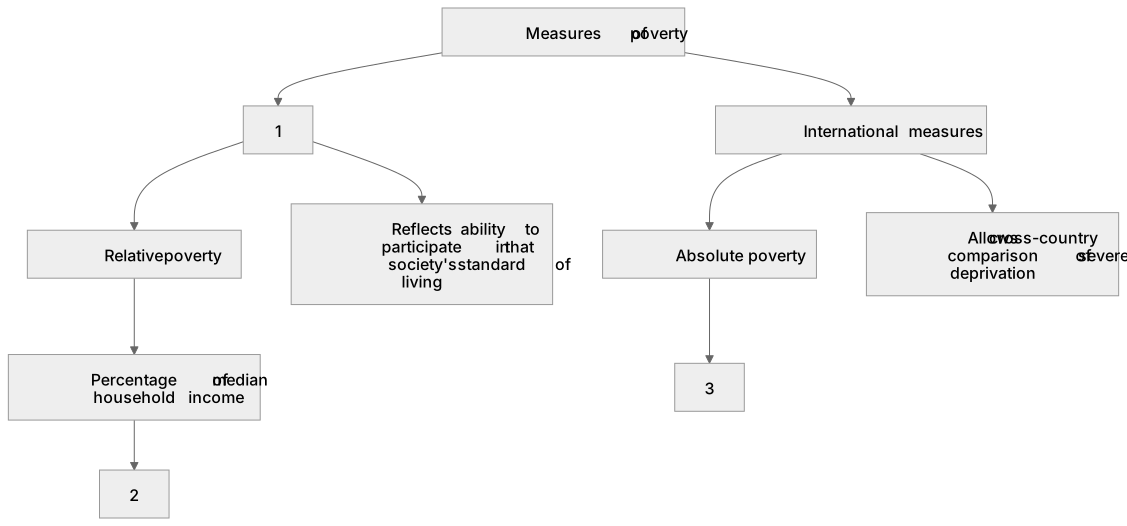
1Box 1
2Box 2
3Box 3
There is more to this lesson
The full lesson goes on to check your understanding and help you earn the marks. Create a free account to carry on, with your progress saved.
A week of Premium from your first lesson · Then the free plan continues · No card, no charge
Test your understanding of Poverty and inequality: b) Measures of poverty: o national measures o international measures
Active recall beats re-reading. Take an instant quiz now to test what you’ve learned and lock it into long-term memory.
A week of Premium from your first lesson · Then the free plan continues · No card, no charge