Pearson Edexcel · A-Level · Economics B
Course version: 9EB0 · Version from Sept 2015
A) Equilibrium price and quantity and how they are determined
Full specification wording
Price determination: a) Equilibrium price and quantity and how they are determined
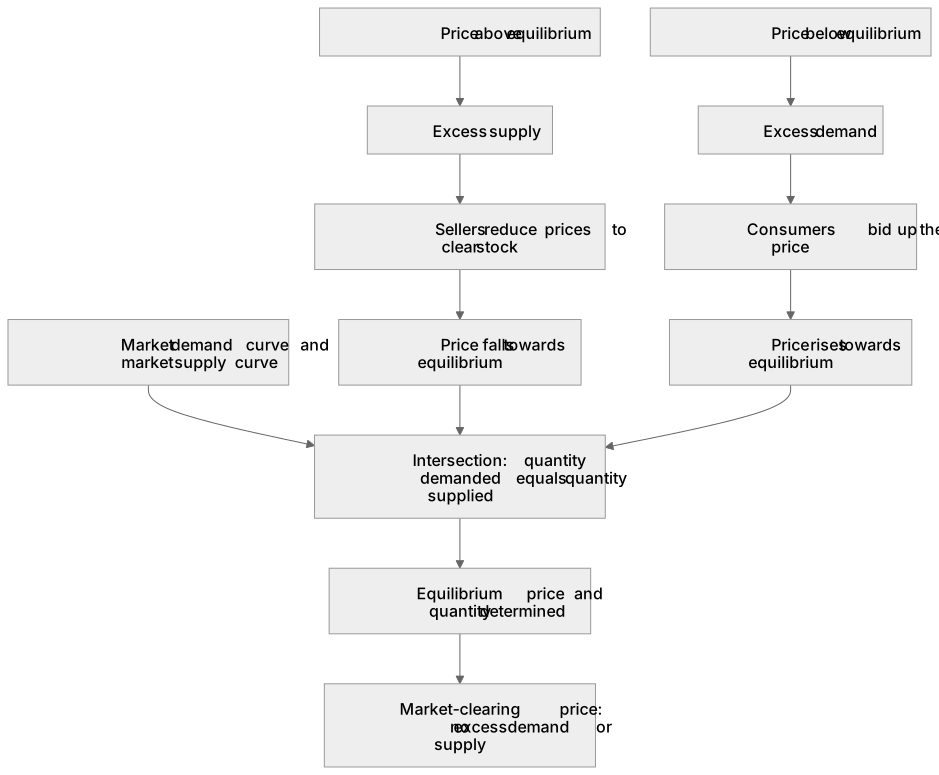
Equilibrium price and quantity are determined where the market demand curve intersects the market supply curve.
Checked against the Pearson Edexcel 9EB0 specification (opens in a new tab) on .
- Point 1 of 5
- 4 key terms
Study notes
From the checked teaching notes for this specification point.
The idea
Equilibrium price and quantity are determined where the market demand curve intersects the market supply curve. At this point, the quantity consumers are willing to buy exactly equals the quantity producers are willing to sell, leaving no excess demand or supply. This is the market-clearing price. For example, if the price of coffee is above equilibrium, producers supply more than consumers demand, creating a surplus. Market forces push the price down as sellers reduce prices to clear stock. Conversely, if the price is below equilibrium, a shortage occurs, and consumers bid up the price. This interaction of supply and demand ensures the market naturally gravitates towards the equilibrium point, determining both price and quantity.
What earns the marks
- Define equilibrium as the point where quantity demanded equals quantity supplied.
- Identify the equilibrium price and quantity from a given supply and demand schedule or diagram.
- Explain the mechanism by which excess supply leads to a downward pressure on price.
- Explain the mechanism by which excess demand leads to an upward pressure on price.
Common mistakes and how to put them right
Confusing equilibrium with a state where supply and demand curves shift.
Put it right: Equilibrium is a point on the existing curves, while shifts create a new equilibrium.
Stating that a surplus causes demand to increase.
Put it right: A surplus causes the price to fall, which leads to an extension in quantity demanded, not a shift in the demand curve.
Assuming the market is always in equilibrium.
Put it right: Markets frequently experience temporary disequilibrium due to sudden price changes or external shocks before adjusting.
Exam tips
- When asked to find equilibrium on a graph, always look for the exact intersection point and read across to the price axis and down to the quantity axis.
- Use the terms 'excess demand' and 'excess supply' rather than 'shortage' and 'surplus' to demonstrate precise economic vocabulary.
- Remember that price acts as a signal and an incentive to both buyers and sellers to restore equilibrium.
Try the lesson
The start of the Price determination: a) Equilibrium price and quantity and how they are determined lesson, made from checked teaching notes for this specification point.
Have a go first
In a free market, how are the equilibrium price and equilibrium quantity determined?
Listen
Equilibrium price and quantity are determined where the market demand curve intersects the market supply curve. At this point, the quantity consumers are willing to buy exactly equals the quantity producers are willing to sell, leaving no excess demand or supply. This is the market-clearing price. For example, if the price of coffee is above equilibrium, producers supply more than consumers demand, creating a surplus. Market forces push the price down as sellers reduce prices to clear stock. Conversely, if the price is below equilibrium, a shortage occurs, and consumers bid up the price. This interaction of supply and demand ensures the market naturally gravitates towards the equilibrium point, determining both price and quantity. A strong answer earns marks for these points. Define equilibrium as the point where quantity demanded equals quantity supplied. Identify the equilibrium price and quantity from a given supply and demand schedule or diagram. Explain the mechanism by which excess supply leads to a downward pressure on price. Explain the mechanism by which excess demand leads to an upward pressure on price. A common slip: Confusing equilibrium with a state where supply and demand curves shift. Instead, equilibrium is a point on the existing curves, while shifts create a new equilibrium. Exam tip: When asked to find equilibrium on a graph, always look for the exact intersection point and read across to the price axis and down to the quantity axis.
See it
Key words
Say what each word means before you turn the card.
Market equilibrium
Try answering aloud or in your head before turning the card.
Market-clearing price
Try answering aloud or in your head before turning the card.
Excess supply
Try answering aloud or in your head before turning the card.
Excess demand
Try answering aloud or in your head before turning the card.
See every definition
- Market equilibrium
- The point where the market demand curve intersects the market supply curve, so the quantity consumers are willing to buy exactly equals the quantity producers are willing to sell.
- Market-clearing price
- The price at equilibrium, at which there is no excess demand or supply because the quantities consumers buy and producers sell are equal.
- Excess supply
- A situation where producers supply more than consumers demand, which pushes the price down as sellers reduce prices to clear stock.
- Excess demand
- A situation where the price is below equilibrium and a shortage occurs, so consumers bid the price up.
Label the diagram
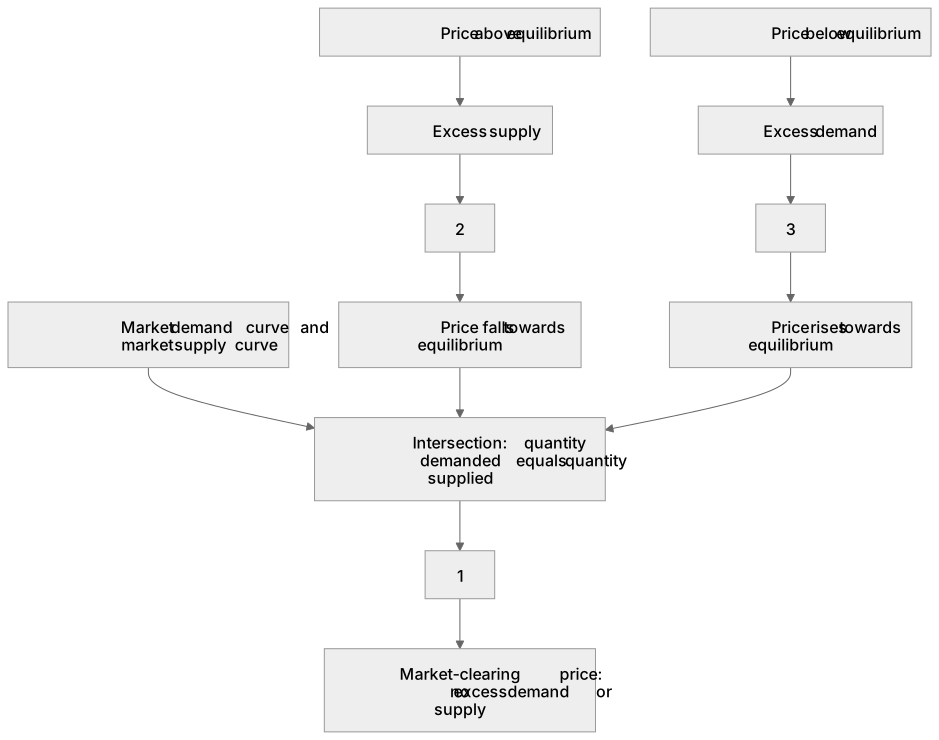
Some boxes have lost their names. Pick the right name for each number.
1Box 1
2Box 2
3Box 3
There is more to this lesson
The full lesson goes on to check your understanding and help you earn the marks. Create a free account to carry on, with your progress saved.
A week of Premium from your first lesson · Then the free plan continues · No card, no charge
Test your understanding of Price determination: a) Equilibrium price and quantity and how they are determined
Active recall beats re-reading. Take an instant quiz now to test what you’ve learned and lock it into long-term memory.
A week of Premium from your first lesson · Then the free plan continues · No card, no charge