Pearson Edexcel · A-Level · Economics B
Course version: 9EB0 · Version from Sept 2015
A) The significance of price elasticity of demand to firms (in both niche…
Full specification wording
Price elasticity of demand (PED): a) The significance of price elasticity of demand to firms (in both niche and mass markets) in terms of implications for pricing
Price elasticity of demand (PED) measures the responsiveness of quantity demanded to a change in price.
Checked against the Pearson Edexcel 9EB0 specification (opens in a new tab) on .
- Point 1 of 5
- 3 key terms
Study notes
From the checked teaching notes for this specification point.
The idea
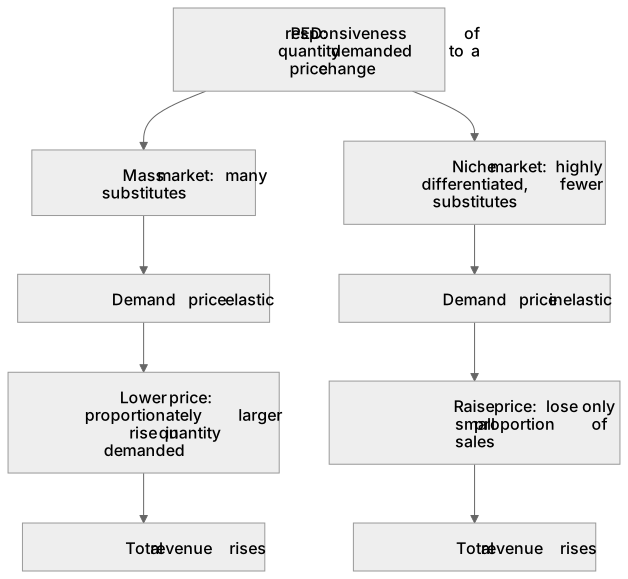
Price elasticity of demand (PED) measures the responsiveness of quantity demanded to a change in price. Its significance to firms lies in its implications for pricing strategies and total revenue. In mass markets, where products often have many substitutes, demand tends to be price elastic. Here, a firm lowering prices sees a proportionately larger increase in quantity demanded, boosting total revenue. Conversely, in niche markets, products are highly differentiated with fewer substitutes, making demand price inelastic. A firm in a niche market can increase prices without losing a significant proportion of sales, thereby increasing total revenue. Understanding PED allows firms to optimise pricing to maximise revenue.
What earns the marks
- Defines PED as the responsiveness of quantity demanded to a change in price.
- Explains that mass market products typically face price elastic demand due to the availability of close substitutes.
- Explains that niche market products typically face price inelastic demand due to high differentiation and a lack of substitutes.
- Concludes that firms with price elastic demand should lower prices to increase total revenue, while firms with price inelastic demand should raise prices.
Common mistakes and how to put them right
Confusing elastic and inelastic demand.
Put it right: Elastic demand means consumers are highly responsive to price changes.
Assuming that a price increase always leads to higher revenue.
Put it right: This is only true if demand is price inelastic.
Believing that niche markets always have elastic demand.
Put it right: Niche markets usually have inelastic demand because the product is specialised and lacks substitutes.
Exam tips
- Always link the PED of a product to the firm's total revenue when discussing pricing decisions.
- Use the characteristics of niche and mass markets to justify whether demand is likely to be price elastic or inelastic.
- When evaluating pricing strategies, consider that PED can change over time as new competitors enter the market.
Try the lesson
The start of the Price elasticity of demand (PED): a) The significance of price elasticity of demand to firms (in both niche and mass markets) in terms of implications for pricing lesson, made from checked teaching notes for this specification point.
Have a go first
A firm sells a product for which the price elasticity of demand is 0.4. If the firm wants to increase its total revenue, what should it do to the price?
Listen
Price elasticity of demand (PED) measures the responsiveness of quantity demanded to a change in price. Its significance to firms lies in its implications for pricing strategies and total revenue. In mass markets, where products often have many substitutes, demand tends to be price elastic. Here, a firm lowering prices sees a proportionately larger increase in quantity demanded, boosting total revenue. Conversely, in niche markets, products are highly differentiated with fewer substitutes, making demand price inelastic. A firm in a niche market can increase prices without losing a significant proportion of sales, thereby increasing total revenue. Understanding PED allows firms to optimise pricing to maximise revenue. A strong answer earns marks for these points. Defines PED as the responsiveness of quantity demanded to a change in price. Explains that mass market products typically face price elastic demand due to the availability of close substitutes. Explains that niche market products typically face price inelastic demand due to high differentiation and a lack of substitutes. Concludes that firms with price elastic demand should lower prices to increase total revenue, while firms with price inelastic demand should raise prices. Exam tip: Always link the PED of a product to the firm's total revenue when discussing pricing decisions.
See it
Key words
Say what each word means before you turn the card.
Price elasticity of demand
Try answering aloud or in your head before turning the card.
Pricing strategies
Try answering aloud or in your head before turning the card.
Total revenue
Try answering aloud or in your head before turning the card.
See every definition
- Price elasticity of demand
- The responsiveness of quantity demanded to a change in price.
- Pricing strategies
- The plans firms make for setting prices, which PED affects through its implications for pricing.
- Total revenue
- The income a firm receives from sales, which changes when prices change depending on PED.
There is more to this lesson
The full lesson goes on to check your understanding and help you earn the marks. Create a free account to carry on, with your progress saved.
A week of Premium from your first lesson · Then the free plan continues · No card, no charge
Test your understanding of Price elasticity of demand (PED): a) The significance of price elasticity of demand to firms (in both niche and mass markets) in terms of implications for pricing
Active recall beats re-reading. Take an instant quiz now to test what you’ve learned and lock it into long-term memory.
A week of Premium from your first lesson · Then the free plan continues · No card, no charge