Pearson Edexcel · A-Level · Economics B
Course version: 9EB0 · Version from Sept 2015
B) Calculation of price elasticity of demand
Full specification wording
Price elasticity of demand (PED): b) Calculation of price elasticity of demand
The calculation of price elasticity of demand (PED) requires dividing the percentage change in quantity demanded by the percentage change in price.
Checked against the Pearson Edexcel 9EB0 specification (opens in a new tab) on .
- Point 2 of 5
- 2 key terms
Study notes
From the checked teaching notes for this specification point.
The idea
The calculation of price elasticity of demand (PED) requires dividing the percentage change in quantity demanded by the percentage change in price. The formula is: PED = %ΔQD / %ΔP. To find the percentage change for either variable, use the formula: ((New Value - Original Value) / Original Value) × 100. Because price and quantity demanded usually move in opposite directions according to the law of demand, the resulting PED value is typically negative. For example, if a 10% increase in price leads to a 20% fall in quantity demanded, the PED is calculated as -20% / 10% = -2. Accurate calculation requires careful attention to the direction of change for both price and quantity.
What earns the marks
- States the formula for PED as the percentage change in quantity demanded divided by the percentage change in price.
- Calculates the percentage change in price using the formula: ((New Price - Original Price) / Original Price) × 100.
- Calculates the percentage change in quantity demanded using the formula: ((New Quantity - Original Quantity) / Original Quantity) × 100.
- Computes the final PED value by accurately dividing the percentage change in quantity by the percentage change in price, retaining the correct sign.
Common mistakes and how to put them right
Inverting the PED formula by dividing the percentage change in price by the percentage change in quantity demanded.
Put it right: Put quantity on top.
Forgetting to calculate the percentage change and instead using raw numerical changes in price and quantity.
Ignoring the negative sign in the calculation.
Put it right: The mathematical result of a normal demand curve calculation is negative.
Exam tips
- Write down the full PED formula before attempting any calculation to ensure you do not invert the numerator and denominator.
- Double-check your percentage change calculations, ensuring you divide by the original value, not the new value.
- Always include the negative sign in your final calculated PED value unless explicitly instructed otherwise, as it reflects the inverse relationship.
Try the lesson
The start of the Price elasticity of demand (PED): b) Calculation of price elasticity of demand lesson, made from checked teaching notes for this specification point.
Have a go first
A firm increases the price of its product from £40 to £44. As a result, the quantity demanded falls from 500 units to 350 units. Calculate the price elasticity of demand (PED) using the original values to find the percentage changes.
Listen
The calculation of price elasticity of demand (PED) requires dividing the percentage change in quantity demanded by the percentage change in price. The formula is: PED = %ΔQD / %ΔP. To find the percentage change for either variable, use the formula: ((New Value - Original Value) / Original Value) × 100. Because price and quantity demanded usually move in opposite directions according to the law of demand, the resulting PED value is typically negative. For example, if a 10% increase in price leads to a 20% fall in quantity demanded, the PED is calculated as -20% / 10% = -2. Accurate calculation requires careful attention to the direction of change for both price and quantity. A strong answer earns marks for these points. States the formula for PED as the percentage change in quantity demanded divided by the percentage change in price. Calculates the percentage change in price using the formula: ((New Price - Original Price) / Original Price) × 100. Calculates the percentage change in quantity demanded using the formula: ((New Quantity - Original Quantity) / Original Quantity) × 100. Computes the final PED value by accurately dividing the percentage change in quantity by the percentage change in price, retaining the correct sign. Exam tip: Write down the full PED formula before attempting any calculation to ensure you do not invert the numerator and denominator.
See it
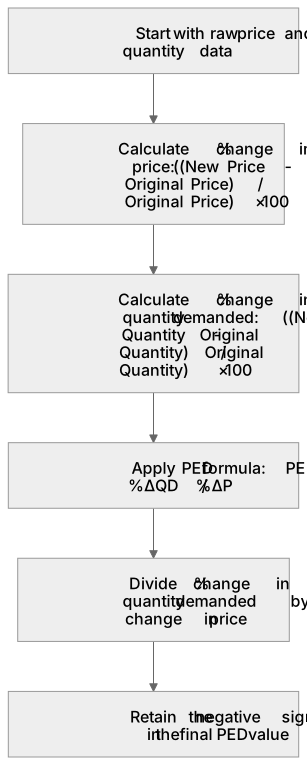
Put it in order
Put these steps in the order they happen.
- 1. Calculate % change in quantity demanded: ((New Quantity - Original Quantity) / Original Quantity) × 100
- 2. Calculate % change in price: ((New Price - Original Price) / Original Price) × 100
- 3. Start with raw price and quantity data
- 4. Retain the negative sign in the final PED value
- 5. Divide % change in quantity demanded by % change in price
- 6. Apply PED formula: PED = %ΔQD / %ΔP
Key words
Say what each word means before you turn the card.
Price elasticity of demand
Try answering aloud or in your head before turning the card.
Percentage changes
Try answering aloud or in your head before turning the card.
See every definition
- Price elasticity of demand
- Calculated by dividing the percentage change in quantity demanded by the percentage change in price.
- Percentage changes
- Found using the formula ((New Value - Original Value) / Original Value) × 100, dividing by the original value rather than the new value.
Label the diagram
Some boxes have lost their names. Pick the right name for each number.
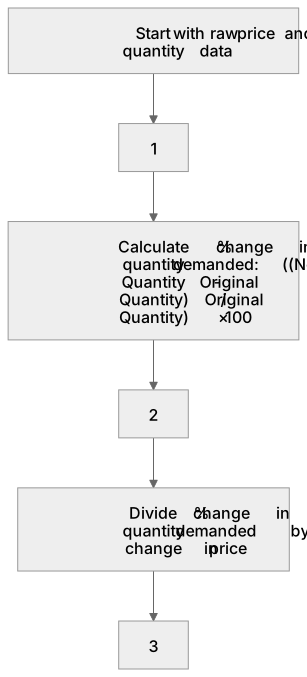
1Box 1
2Box 2
3Box 3
There is more to this lesson
The full lesson goes on to check your understanding and help you earn the marks. Create a free account to carry on, with your progress saved.
A week of Premium from your first lesson · Then the free plan continues · No card, no charge
Test your understanding of Price elasticity of demand (PED): b) Calculation of price elasticity of demand
Active recall beats re-reading. Take an instant quiz now to test what you’ve learned and lock it into long-term memory.
A week of Premium from your first lesson · Then the free plan continues · No card, no charge