Pearson Edexcel · A-Level · Economics B
Course version: 9EB0 · Version from Sept 2015
C) Interpretation of numerical values of price elasticity of demand
Full specification wording
Price elasticity of demand (PED): c) Interpretation of numerical values of price elasticity of demand
Price elasticity of demand (PED) measures the responsiveness of quantity demanded to a change in price.
Checked against the Pearson Edexcel 9EB0 specification (opens in a new tab) on .
- Point 3 of 5
- 4 key terms
Study notes
From the checked teaching notes for this specification point.
The idea
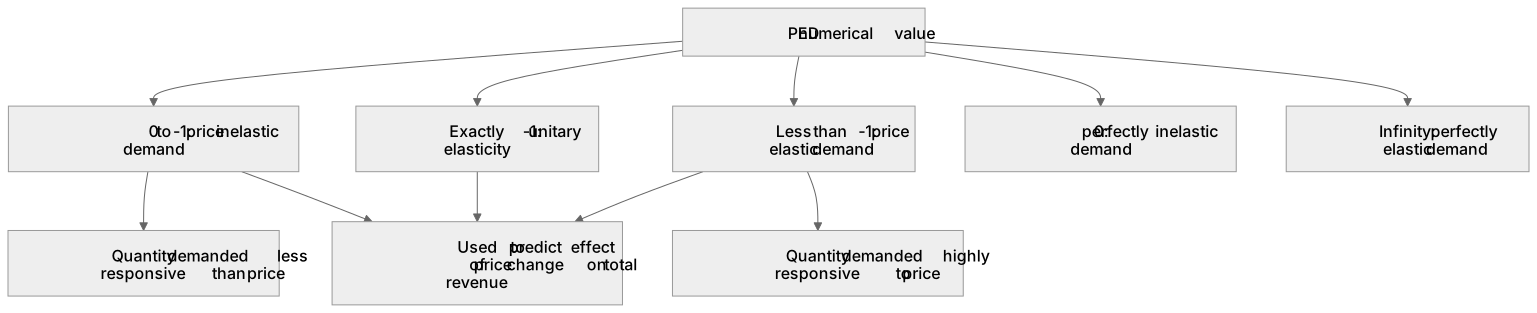
Price elasticity of demand (PED) measures the responsiveness of quantity demanded to a change in price. The numerical value of PED is always negative due to the inverse relationship between price and quantity demanded, though the minus sign is often ignored. A PED value between 0 and -1 indicates price inelastic demand, where the percentage change in quantity demanded is less than the percentage change in price (e.g. -0.5). A value less than -1 (e.g. -2.0) indicates price elastic demand, where quantity demanded is highly responsive to price changes. A value of exactly -1 represents unitary elasticity. Interpreting these values allows businesses to predict the impact of price changes on total revenue.
What earns the marks
- Identify that a PED value between 0 and -1 signifies price inelastic demand.
- Identify that a PED value less than -1 (e.g. -1.5) signifies price elastic demand.
- Recognise that a PED of exactly -1 indicates unitary price elasticity.
- Explain that a PED of 0 means perfectly inelastic demand, where quantity demanded does not change when price changes.
- Explain that perfectly elastic demand is represented by a PED of infinity.
Common mistakes and how to put them right
Assuming a positive PED value is normal for most goods.
Put it right: PED is normally negative due to the law of demand; positive values only apply to exceptional cases like Veblen or Giffen goods.
Confusing elastic and inelastic numerical ranges, such as thinking -0.5 is elastic.
Put it right: Values between 0 and -1 are inelastic, while values less than -1 (further from zero) are elastic.
Ignoring the percentage aspect and interpreting the PED value as an absolute change in units.
Put it right: PED values represent the ratio of percentage changes, not absolute unit changes.
Exam tips
- Always state whether the demand is elastic or inelastic when given a numerical PED value in an exam question.
- Remember that although the minus sign is often omitted in textbooks, you should recognise that a PED of 2 actually means -2 and is therefore elastic.
- Use the numerical value to determine the effect on total revenue; for example, if PED is -0.4 (inelastic), a price increase will raise total revenue.
Try the lesson
The start of the Price elasticity of demand (PED): c) Interpretation of numerical values of price elasticity of demand lesson, made from checked teaching notes for this specification point.
Have a go first
A product has a price elasticity of demand of -0.4. How should this numerical value be interpreted?
Listen
Price elasticity of demand (PED) measures the responsiveness of quantity demanded to a change in price. The numerical value of PED is always negative due to the inverse relationship between price and quantity demanded, though the minus sign is often ignored. A PED value between 0 and -1 indicates price inelastic demand, where the percentage change in quantity demanded is less than the percentage change in price (e.g. -0.5). A value less than -1 (e.g. -2.0) indicates price elastic demand, where quantity demanded is highly responsive to price changes. A value of exactly -1 represents unitary elasticity. Interpreting these values allows businesses to predict the impact of price changes on total revenue. A strong answer earns marks for these points. Identify that a PED value between 0 and -1 signifies price inelastic demand. Identify that a PED value less than -1 (e.g. -1.5) signifies price elastic demand. Recognise that a PED of exactly -1 indicates unitary price elasticity. Explain that a PED of 0 means perfectly inelastic demand, where quantity demanded does not change when price changes. A common slip: Assuming a positive PED value is normal for most goods. Instead, PED is normally negative due to the law of demand; positive values only apply to exceptional cases like Veblen or Giffen goods. Exam tip: Always state whether the demand is elastic or inelastic when given a numerical PED value in an exam question.
See it
Key words
Say what each word means before you turn the card.
Price elasticity of demand
Try answering aloud or in your head before turning the card.
Price inelastic demand
Try answering aloud or in your head before turning the card.
Price elastic demand
Try answering aloud or in your head before turning the card.
Unitary elasticity
Try answering aloud or in your head before turning the card.
See every definition
- Price elasticity of demand
- Measures the responsiveness of quantity demanded to a change in price, with a numerical value always negative due to the inverse relationship between price and quantity demanded.
- Price inelastic demand
- A PED value between 0 and -1, where the percentage change in quantity demanded is less than the percentage change in price.
- Price elastic demand
- A value less than -1, where quantity demanded is highly responsive to price changes.
- Unitary elasticity
- A value of exactly -1, representing unitary elasticity.
Label the diagram
Some boxes have lost their names. Pick the right name for each number.
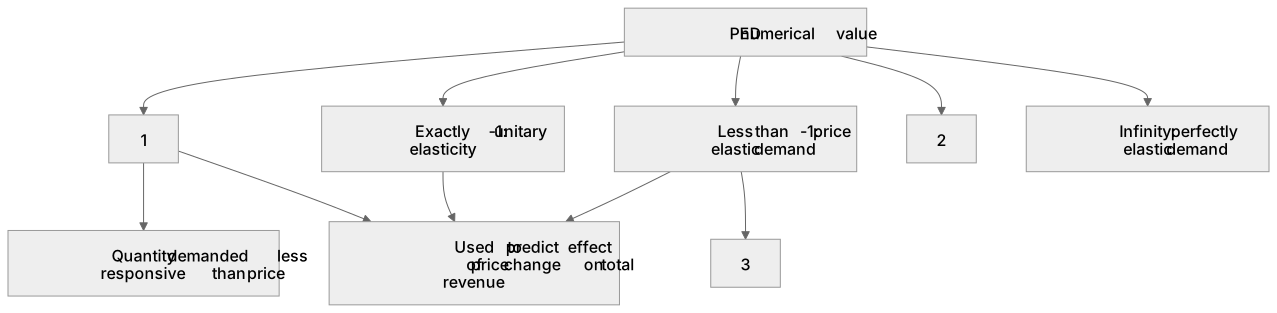
1Box 1
2Box 2
3Box 3
There is more to this lesson
The full lesson goes on to check your understanding and help you earn the marks. Create a free account to carry on, with your progress saved.
A week of Premium from your first lesson · Then the free plan continues · No card, no charge
Test your understanding of Price elasticity of demand (PED): c) Interpretation of numerical values of price elasticity of demand
Active recall beats re-reading. Take an instant quiz now to test what you’ve learned and lock it into long-term memory.
A week of Premium from your first lesson · Then the free plan continues · No card, no charge