Pearson Edexcel · A-Level · Economics B
Course version: 9EB0 · Version from Sept 2015
A) The distinction between allocative efficiency and productive efficiency
Full specification wording
Productive and allocative efficiency: a) The distinction between allocative efficiency and productive efficiency
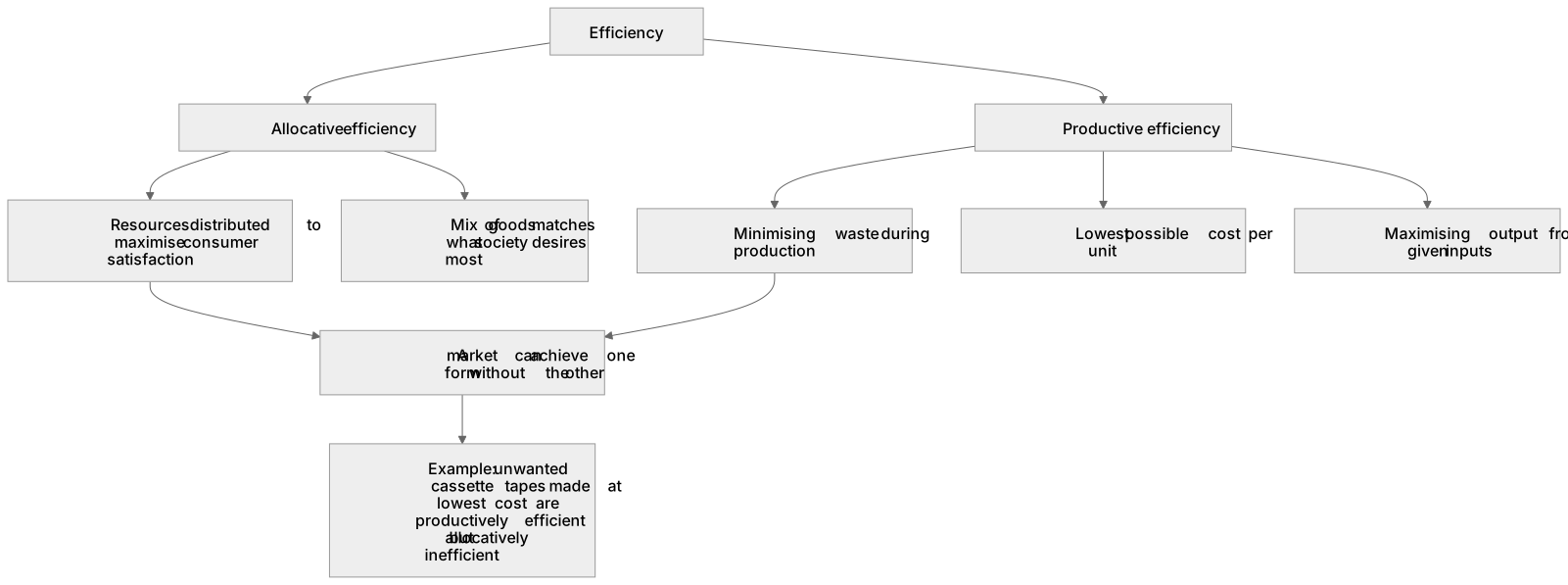
Allocative efficiency occurs when resources are distributed to maximise consumer satisfaction, meaning the mix of goods produced matches what society desires most.
Checked against the Pearson Edexcel 9EB0 specification (opens in a new tab) on .
- Point 1 of 5
- 2 key terms
Study notes
From the checked teaching notes for this specification point.
The idea
Allocative efficiency occurs when resources are distributed to maximise consumer satisfaction, meaning the mix of goods produced matches what society desires most. Productive efficiency focuses on minimising waste during production. It is achieved when a firm operates at the lowest possible cost per unit, maximising output from given inputs. For example, a factory might be productively efficient by manufacturing unwanted cassette tapes at the lowest possible cost, but it would be allocatively inefficient because consumers no longer demand them. Distinguishing between these concepts is crucial for evaluating market performance, as a market can achieve one form of efficiency without the other.
What earns the marks
- Define allocative efficiency as producing the optimal combination of goods that society desires and values most.
- Define productive efficiency as producing goods and services at the lowest possible cost per unit.
- Explain that productive efficiency involves maximising output from a given set of inputs and minimising waste.
- Distinguish between the two by noting a firm can be productively efficient without being allocatively efficient if it produces goods that consumers do not want.
Common mistakes and how to put them right
Confusing the two terms.
Put it right: 'productive' relates to the cost of production and waste minimisation, while 'allocative' relates to consumer demand and resource allocation.
Assuming productive efficiency guarantees allocative efficiency.
Put it right: A firm can produce unwanted goods very cheaply; this is productively efficient but allocatively inefficient.
Overcomplicating with cost curves.
Put it right: Focus on the core concepts of lowest unit cost and meeting consumer desires, as formal cost curve diagrams are not required.
Exam tips
- Focus on clear definitions: productive efficiency is about lowest unit cost, and allocative efficiency is about meeting consumer demand.
- When evaluating market structures, explicitly state whether they achieve both, one, or neither type of efficiency.
- Use a clear example, such as producing obsolete technology efficiently, to illustrate the distinction between the two concepts.
Try the lesson
The start of the Productive and allocative efficiency: a) The distinction between allocative efficiency and productive efficiency lesson, made from checked teaching notes for this specification point.
Have a go first
What is the fundamental distinction between productive efficiency and allocative efficiency?
Listen
Allocative efficiency occurs when resources are distributed to maximise consumer satisfaction, meaning the mix of goods produced matches what society desires most. Productive efficiency focuses on minimising waste during production. It is achieved when a firm operates at the lowest possible cost per unit, maximising output from given inputs. For example, a factory might be productively efficient by manufacturing unwanted cassette tapes at the lowest possible cost, but it would be allocatively inefficient because consumers no longer demand them. Distinguishing between these concepts is crucial for evaluating market performance, as a market can achieve one form of efficiency without the other. A strong answer earns marks for these points. Define allocative efficiency as producing the optimal combination of goods that society desires and values most. Define productive efficiency as producing goods and services at the lowest possible cost per unit. Explain that productive efficiency involves maximising output from a given set of inputs and minimising waste. Distinguish between the two by noting a firm can be productively efficient without being allocatively efficient if it produces goods that consumers do not want. A common slip: Confusing the two terms: Students often swap the definitions. Instead, 'productive' relates to the cost of production and waste minimisation, while 'allocative' relates to consumer demand and resource allocation. Exam tip: Focus on clear definitions: productive efficiency is about lowest unit cost, and allocative efficiency is about meeting consumer demand.
See it
Key words
Say what each word means before you turn the card.
Allocative efficiency
Try answering aloud or in your head before turning the card.
Productive efficiency
Try answering aloud or in your head before turning the card.
See every definition
- Allocative efficiency
- Occurs when resources are distributed to maximise consumer satisfaction, meaning the mix of goods produced matches what society desires most.
- Productive efficiency
- Achieved when a firm operates at the lowest possible cost per unit, maximising output from given inputs and minimising waste during production.
Label the diagram
Some boxes have lost their names. Pick the right name for each number.
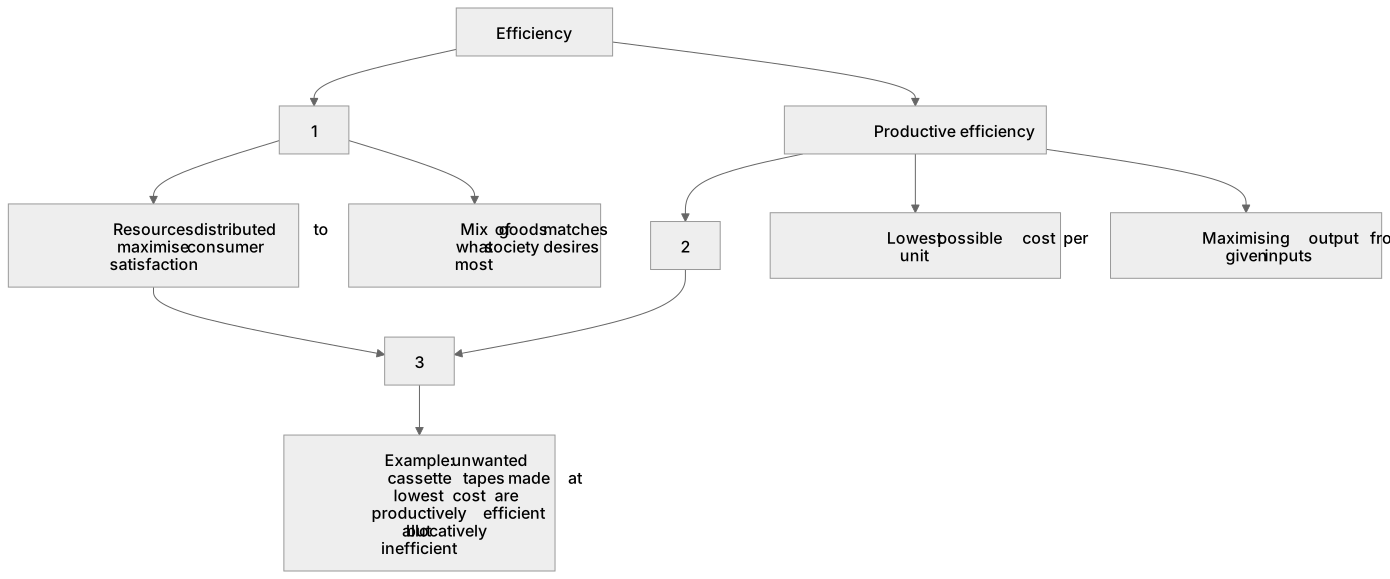
1Box 1
2Box 2
3Box 3
There is more to this lesson
The full lesson goes on to check your understanding and help you earn the marks. Create a free account to carry on, with your progress saved.
A week of Premium from your first lesson · Then the free plan continues · No card, no charge
Test your understanding of Productive and allocative efficiency: a) The distinction between allocative efficiency and productive efficiency
Active recall beats re-reading. Take an instant quiz now to test what you’ve learned and lock it into long-term memory.
A week of Premium from your first lesson · Then the free plan continues · No card, no charge