Pearson Edexcel · A-Level · Economics B
Course version: 9EB0 · Version from Sept 2015
B) The significance of the margin; opportunity costs, trade- offs and…
Full specification wording
Productive and allocative efficiency: b) The significance of the margin; opportunity costs, trade- offs and allocative efficiency
Economic decisions are made at the margin, meaning individuals and firms evaluate the costs and benefits of producing or consuming one additional unit.
Checked against the Pearson Edexcel 9EB0 specification (opens in a new tab) on .
- Point 2 of 5
- 4 key terms
Study notes
From the checked teaching notes for this specification point.
The idea
Economic decisions are made at the margin, meaning individuals and firms evaluate the costs and benefits of producing or consuming one additional unit. The significance of the margin lies in optimising resource allocation. Every marginal decision involves trade-offs and opportunity costs—the value of the next best alternative forgone. For instance, a farmer deciding whether to plant an extra hectare of wheat must weigh the additional revenue against the extra cost, sacrificing the opportunity to plant barley. Allocative efficiency is achieved when the additional benefit to society of consuming a good matches the extra cost of producing it. If marginal benefit exceeds marginal cost, society benefits from producing more.
What earns the marks
- Explain that decisions made at the margin involve analysing the effect of a small change, such as producing or consuming one extra unit.
- Define opportunity cost as the value of the next best alternative forgone when making a choice.
- Describe how trade-offs occur when resources are limited, forcing economic agents to choose between competing alternatives.
- Link the margin to allocative efficiency by explaining that optimal allocation occurs when the marginal benefit of consumption aligns with the marginal cost of production.
Common mistakes and how to put them right
Ignoring the concept of the margin.
Put it right: Focus on the cost or benefit of the additional unit when analysing economic decision-making.
Misdefining opportunity cost: Students sometimes define it as all alternatives forgone.
Put it right: Opportunity cost is strictly the value of the next best alternative forgone, not a sum of all possible alternatives.
Disconnecting opportunity cost from allocative efficiency.
Put it right: Explain that allocative efficiency minimises opportunity cost by ensuring resources are used where they are most valued by society.
Exam tips
- In multiple-choice questions, look for options that specifically mention 'additional' or 'extra' units when identifying marginal concepts.
- Use the concept of opportunity cost to explain why trade-offs are necessary in any scenario involving scarce resources.
- When discussing allocative efficiency, explicitly state that it is achieved when the marginal benefit to society matches the marginal cost.
Try the lesson
The start of the Productive and allocative efficiency: b) The significance of the margin; opportunity costs, trade- offs and allocative efficiency lesson, made from checked teaching notes for this specification point.
Have a go first
How does the concept of the margin relate to opportunity cost when a consumer decides to purchase one additional unit of a good?
Listen
Economic decisions are made at the margin, meaning individuals and firms evaluate the costs and benefits of producing or consuming one additional unit. The significance of the margin lies in optimising resource allocation. Every marginal decision involves trade-offs and opportunity costs—the value of the next best alternative forgone. For instance, a farmer deciding whether to plant an extra hectare of wheat must weigh the additional revenue against the extra cost, sacrificing the opportunity to plant barley. Allocative efficiency is achieved when the additional benefit to society of consuming a good matches the extra cost of producing it. If marginal benefit exceeds marginal cost, society benefits from producing more. A strong answer earns marks for these points. Explain that decisions made at the margin involve analysing the effect of a small change, such as producing or consuming one extra unit. Define opportunity cost as the value of the next best alternative forgone when making a choice. Describe how trade-offs occur when resources are limited, forcing economic agents to choose between competing alternatives. Link the margin to allocative efficiency by explaining that optimal allocation occurs when the marginal benefit of consumption aligns with the marginal cost of production. A common slip: Ignoring the concept of the margin: Students often discuss total costs and benefits rather than marginal ones. Instead, focus on the cost or benefit of the additional unit when analysing economic decision-making. Exam tip: In multiple-choice questions, look for options that specifically mention 'additional' or 'extra' units when identifying marginal concepts.
See it
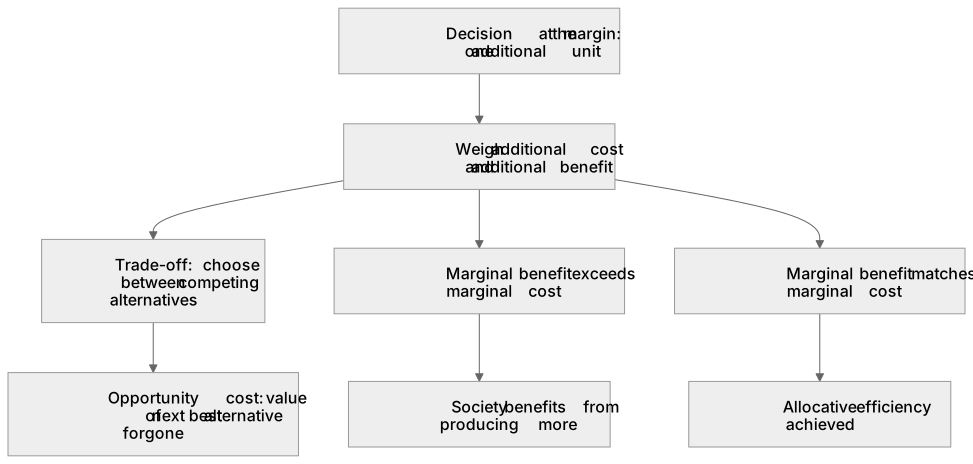
Key words
Say what each word means before you turn the card.
Margin
Try answering aloud or in your head before turning the card.
Opportunity cost
Try answering aloud or in your head before turning the card.
Trade-offs
Try answering aloud or in your head before turning the card.
Allocative efficiency
Try answering aloud or in your head before turning the card.
See every definition
- Margin
- The point at which individuals and firms evaluate the costs and benefits of producing or consuming one additional unit.
- Opportunity cost
- The value of the next best alternative forgone when making a choice.
- Trade-offs
- Occur when resources are limited, forcing economic agents to choose between competing alternatives.
- Allocative efficiency
- Achieved when the additional benefit to society of consuming a good matches the extra cost of producing it.
Label the diagram
Some boxes have lost their names. Pick the right name for each number.
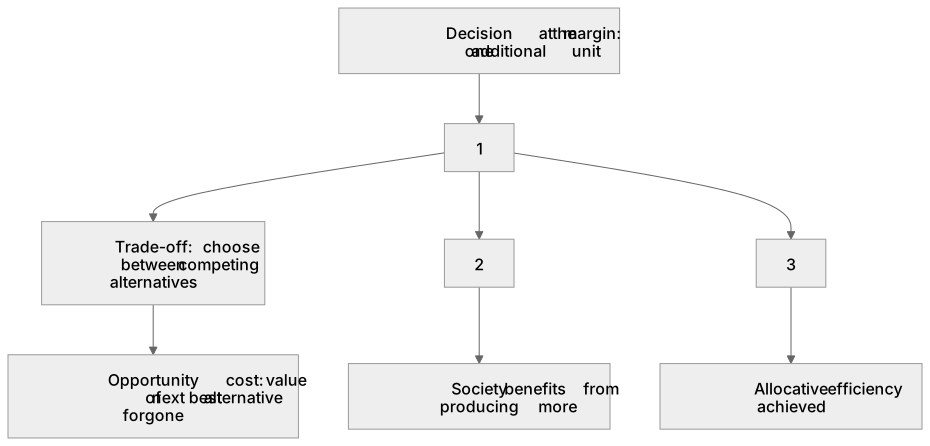
1Box 1
2Box 2
3Box 3
There is more to this lesson
The full lesson goes on to check your understanding and help you earn the marks. Create a free account to carry on, with your progress saved.
A week of Premium from your first lesson · Then the free plan continues · No card, no charge
Test your understanding of Productive and allocative efficiency: b) The significance of the margin; opportunity costs, trade- offs and allocative efficiency
Active recall beats re-reading. Take an instant quiz now to test what you’ve learned and lock it into long-term memory.
A week of Premium from your first lesson · Then the free plan continues · No card, no charge