Pearson Edexcel · A-Level · Economics B
Course version: 9EB0 · Version from Sept 2015
D) Matching the structure of production to the pattern of consumer…
Full specification wording
Productive and allocative efficiency: d) Matching the structure of production to the pattern of consumer preferences (market orientation)
Allocative efficiency is achieved when a firm's structure of production perfectly matches the pattern of consumer preferences, meaning resources are used to produce exactly what people want.
Checked against the Pearson Edexcel 9EB0 specification (opens in a new tab) on .
- Point 4 of 5
- 3 key terms
Study notes
From the checked teaching notes for this specification point.
The idea
Allocative efficiency is achieved when a firm's structure of production perfectly matches the pattern of consumer preferences, meaning resources are used to produce exactly what people want. This requires a strong market orientation, where businesses actively research and respond to consumer trends rather than just pushing existing products. For example, if consumers increasingly prefer plant-based foods, a market-oriented supermarket will shift its supply chain and shelf space away from meat towards vegan alternatives. By aligning production with these changing preferences, firms avoid unsold inventory and maximise consumer welfare, ensuring that the marginal cost of production equals the marginal utility derived by consumers.
What earns the marks
- Define market orientation as a business approach that prioritises identifying and fulfilling consumer needs and preferences.
- Explain that matching the structure of production to consumer preferences leads to allocative efficiency.
- Analyse how market research is used to detect shifts in consumer demand, allowing firms to adjust their output accordingly.
- Evaluate the benefits of market orientation, such as reduced risk of unsold stock and increased customer loyalty, against the costs of continuous market research.
Common mistakes and how to put them right
Confusing market orientation with product orientation.
Put it right: Market orientation focuses on consumer wants, whereas product orientation focuses on the production process itself.
Equating allocative efficiency with productive efficiency.
Put it right: Allocative efficiency is about producing the right goods for consumers, not just producing goods at the lowest cost.
Assuming consumer preferences are static.
Put it right: Preferences change over time, requiring firms to continuously adapt their production structures.
Exam tips
- Use the concept of allocative efficiency to explain why market orientation is crucial for long-term business survival.
- Provide examples of dynamic markets, such as fast fashion or technology, where matching production to rapidly changing consumer preferences is vital.
- Contrast market orientation with product orientation to highlight the risks of ignoring consumer demand patterns.
Try the lesson
The start of the Productive and allocative efficiency: d) Matching the structure of production to the pattern of consumer preferences (market orientation) lesson, made from checked teaching notes for this specification point.
Have a go first
A furniture company decides to stop producing large dining tables and instead manufactures compact desks, reflecting a rise in home-working. Which economic concept does this strategic change best illustrate?
Listen
Allocative efficiency is achieved when a firm's structure of production perfectly matches the pattern of consumer preferences, meaning resources are used to produce exactly what people want. This requires a strong market orientation, where businesses actively research and respond to consumer trends rather than just pushing existing products. For example, if consumers increasingly prefer plant-based foods, a market-oriented supermarket will shift its supply chain and shelf space away from meat towards vegan alternatives. By aligning production with these changing preferences, firms avoid unsold inventory and maximise consumer welfare, ensuring that the marginal cost of production equals the marginal utility derived by consumers. A strong answer earns marks for these points. Define market orientation as a business approach that prioritises identifying and fulfilling consumer needs and preferences. Explain that matching the structure of production to consumer preferences leads to allocative efficiency. Analyse how market research is used to detect shifts in consumer demand, allowing firms to adjust their output accordingly. Evaluate the benefits of market orientation, such as reduced risk of unsold stock and increased customer loyalty, against the costs of continuous market research. Exam tip: Use the concept of allocative efficiency to explain why market orientation is crucial for long-term business survival.
See it
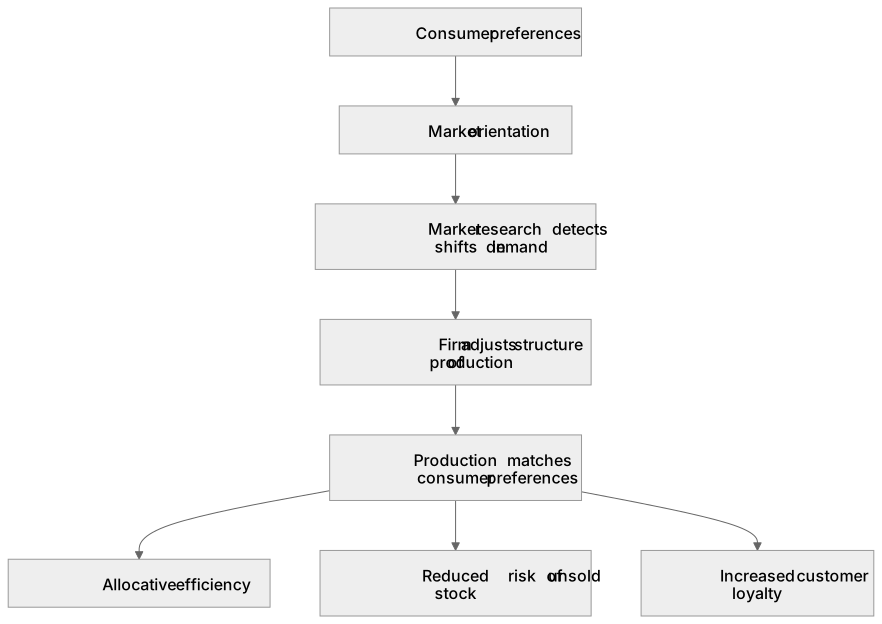
Key words
Say what each word means before you turn the card.
Allocative efficiency
Try answering aloud or in your head before turning the card.
Market orientation
Try answering aloud or in your head before turning the card.
Consumer preferences
Try answering aloud or in your head before turning the card.
See every definition
- Allocative efficiency
- Achieved when a firm's structure of production perfectly matches the pattern of consumer preferences, meaning resources are used to produce exactly what people want.
- Market orientation
- A business approach that prioritises identifying and fulfilling consumer needs and preferences, with businesses actively researching and responding to consumer trends rather than just pushing existing products.
- Consumer preferences
- The pattern of what people want, which changes over time and requires firms to continuously adapt their production structures.
Label the diagram
Some boxes have lost their names. Pick the right name for each number.
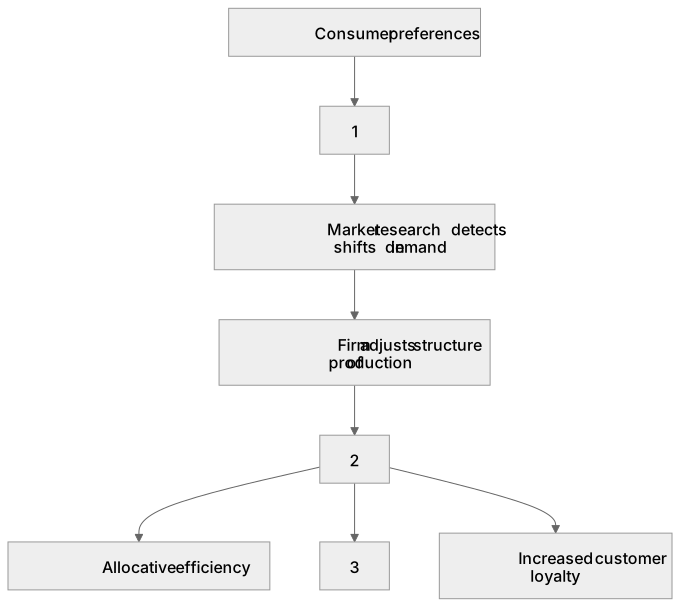
1Box 1
2Box 2
3Box 3
There is more to this lesson
The full lesson goes on to check your understanding and help you earn the marks. Create a free account to carry on, with your progress saved.
A week of Premium from your first lesson · Then the free plan continues · No card, no charge
Test your understanding of Productive and allocative efficiency: d) Matching the structure of production to the pattern of consumer preferences (market orientation)
Active recall beats re-reading. Take an instant quiz now to test what you’ve learned and lock it into long-term memory.
A week of Premium from your first lesson · Then the free plan continues · No card, no charge