Pearson Edexcel · A-Level · Economics B
Course version: 9EB0 · Version from Sept 2015
E) How markets interact with one another
Full specification wording
Productive and allocative efficiency: e) How markets interact with one another
Markets do not operate in isolation; changes in one market ripple through to others, affecting resource allocation.
Checked against the Pearson Edexcel 9EB0 specification (opens in a new tab) on .
- Point 5 of 5
- 2 key terms
Study notes
From the checked teaching notes for this specification point.
The idea
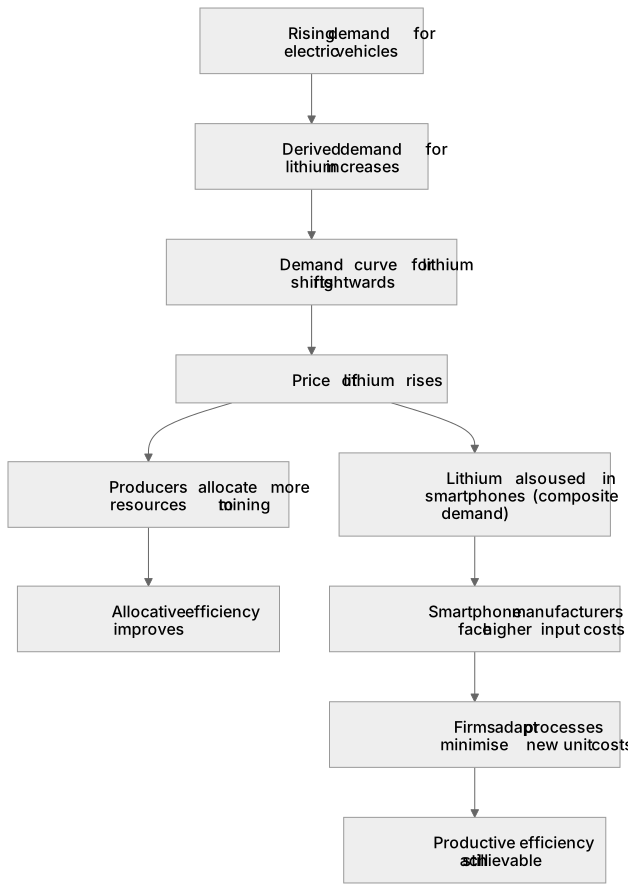
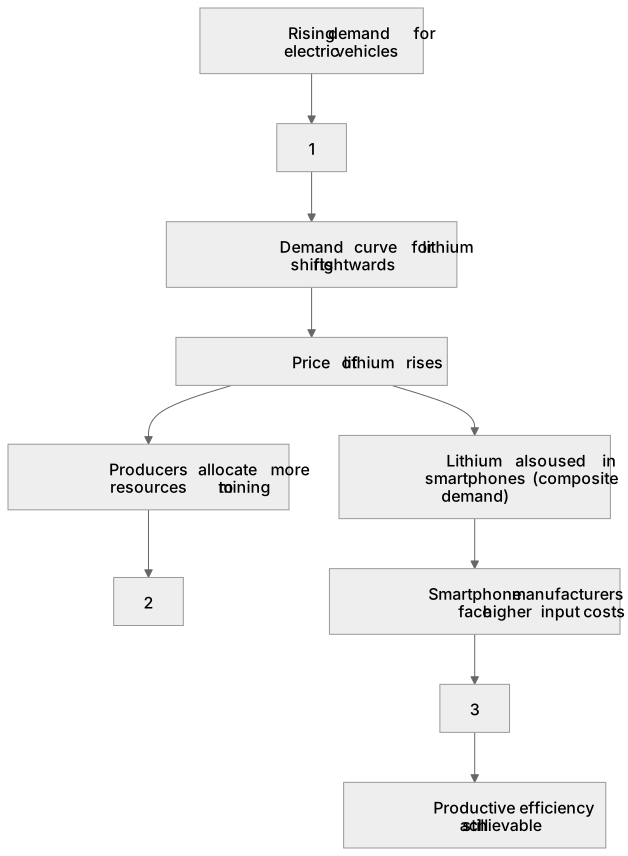
Markets do not operate in isolation; changes in one market ripple through to others, affecting resource allocation. This interaction occurs via derived demand, joint supply, composite demand, and substitute or complementary goods. For example, rising demand for electric vehicles increases the derived demand for lithium. This shifts the demand curve for lithium rightwards, raising its price and signalling producers to allocate more resources to mining, improving allocative efficiency. If lithium is also used in smartphones (composite demand), those manufacturers face higher input costs. However, they can still achieve productive efficiency by adapting processes to minimise new unit costs, showing how interconnected markets force adaptation.
What earns the marks
- Identify the specific type of market interaction, such as derived demand, composite demand, or joint supply.
- Explain how a change in price or quantity in one market shifts the demand or supply curve in a related market.
- Analyse the impact on allocative efficiency, demonstrating how resources move towards markets with higher consumer demand.
- Explain that while market interactions can raise input costs, firms can still strive for productive efficiency by minimising their new cost per unit.
Common mistakes and how to put them right
Confusing derived demand with composite demand.
Put it right: Derived demand occurs when a good is demanded for its use in producing another good, whereas composite demand occurs when a good has multiple alternative uses.
Assuming that higher input costs automatically cause productive inefficiency.
Put it right: Higher input costs raise the overall cost per unit, but a firm remains productively efficient if it operates at the lowest possible cost given those new input prices.
Forgetting to link market interactions back to efficiency.
Put it right: Explicitly state how the interaction affects allocative efficiency rather than just describing the price change.
Exam tips
- Always draw two side-by-side supply and demand diagrams to clearly illustrate how a shift in one market affects the equilibrium in another.
- Use specific examples, such as the housing market and the labour market for construction workers, to demonstrate derived demand in action.
- Remember that an increase in unit costs due to changing input prices does not inherently mean a loss of productive efficiency.
Try the lesson
The start of the Productive and allocative efficiency: e) How markets interact with one another lesson, made from checked teaching notes for this specification point.
Have a go first
Which of the following best describes how the market for steel interacts with the market for cars?
Listen
Markets do not operate in isolation; changes in one market ripple through to others, affecting resource allocation. This interaction occurs via derived demand, joint supply, composite demand, and substitute or complementary goods. For example, rising demand for electric vehicles increases the derived demand for lithium. This shifts the demand curve for lithium rightwards, raising its price and signalling producers to allocate more resources to mining, improving allocative efficiency. If lithium is also used in smartphones (composite demand), those manufacturers face higher input costs. However, they can still achieve productive efficiency by adapting processes to minimise new unit costs, showing how interconnected markets force adaptation. A strong answer earns marks for these points. Identify the specific type of market interaction, such as derived demand, composite demand, or joint supply. Explain how a change in price or quantity in one market shifts the demand or supply curve in a related market. Analyse the impact on allocative efficiency, demonstrating how resources move towards markets with higher consumer demand. Explain that while market interactions can raise input costs, firms can still strive for productive efficiency by minimising their new cost per unit. A common slip: Confusing derived demand with composite demand. Instead, Derived demand occurs when a good is demanded for its use in producing another good, whereas composite demand occurs when a good has multiple alternative uses. Exam tip: Always draw two side-by-side supply and demand diagrams to clearly illustrate how a shift in one market affects the equilibrium in another.
See it
Key words
Say what each word means before you turn the card.
Resource allocation
Try answering aloud or in your head before turning the card.
Market interrelationships
Try answering aloud or in your head before turning the card.
See every definition
- Resource allocation
- The movement of resources towards markets with higher consumer demand, which market interactions can affect.
- Market interrelationships
- The way markets do not operate in isolation, so that changes in one market ripple through to others via derived demand, joint supply, composite demand, and substitute or complementary goods.
Label the diagram
Some boxes have lost their names. Pick the right name for each number.
1Box 1
2Box 2
3Box 3
There is more to this lesson
The full lesson goes on to check your understanding and help you earn the marks. Create a free account to carry on, with your progress saved.
A week of Premium from your first lesson · Then the free plan continues · No card, no charge
Test your understanding of Productive and allocative efficiency: e) How markets interact with one another
Active recall beats re-reading. Take an instant quiz now to test what you’ve learned and lock it into long-term memory.
A week of Premium from your first lesson · Then the free plan continues · No card, no charge