Pearson Edexcel · A-Level · Economics B
Course version: 9EB0 · Version from Sept 2015
A) Productivity (output per unit of input in a given time period): o…
Full specification wording
Productivity: a) Productivity (output per unit of input in a given time period): o factors influencing productivity o link between productivity and competitiveness o productivity and wages o productivity and economic growth
Productivity measures output per unit of input in a given time period, such as units produced per worker per hour.
Checked against the Pearson Edexcel 9EB0 specification (opens in a new tab) on .
- Point 1 of 2
- 4 key terms
Study notes
From the checked teaching notes for this specification point.
The idea
Productivity measures output per unit of input in a given time period, such as units produced per worker per hour. Factors influencing productivity include investment in capital equipment, technological advancements, and the education and training of the workforce. Higher productivity lowers average costs, directly improving a firm's international competitiveness by allowing lower prices or higher profit margins. Furthermore, increased productivity enables firms to pay higher real wages without triggering inflation, as workers generate more value. On a macroeconomic scale, rising productivity shifts the long-run aggregate supply curve outwards, driving sustainable economic growth and improving living standards.
What earns the marks
- Define productivity as output per unit of input over a specific time period.
- Identify factors such as capital investment, technology, and human capital that increase productivity.
- Explain that higher productivity reduces unit costs, enhancing a firm's price competitiveness.
- Link productivity gains to the ability of firms to increase real wages without increasing unit labour costs.
- Illustrate how productivity improvements lead to long-run economic growth by shifting the long-run aggregate supply curve to the right.
Common mistakes and how to put them right
Confusing productivity with production.
Put it right: Production is the total volume of output, whereas productivity is the rate of output per unit of input.
Assuming higher wages automatically lead to higher productivity.
Put it right: While efficiency wage theory suggests this is possible, the standard economic link is that higher productivity justifies and enables higher real wages.
Believing that increased productivity always leads to job losses.
Put it right: While capital substitution can cause structural unemployment, higher productivity often creates economic growth and new jobs in other sectors.
Exam tips
- Always specify the time period when defining productivity, such as output per worker per hour.
- Use aggregate supply and demand diagrams to demonstrate the impact of productivity on economic growth and the price level.
- When discussing competitiveness, explicitly link productivity to lower unit costs and the resulting ability to lower export prices.
Try the lesson
The start of the Productivity: a) Productivity (output per unit of input in a given time period): o factors influencing productivity o link between productivity and competitiveness o productivity and wages o productivity and economic growth lesson, made from checked teaching notes for this specification point.
Have a go first
Which of the following changes is most likely to lead to a direct increase in labour productivity within a manufacturing firm?
Listen
Productivity measures output per unit of input in a given time period, such as units produced per worker per hour. Factors influencing productivity include investment in capital equipment, technological advancements, and the education and training of the workforce. Higher productivity lowers average costs, directly improving a firm's international competitiveness by allowing lower prices or higher profit margins. Furthermore, increased productivity enables firms to pay higher real wages without triggering inflation, as workers generate more value. On a macroeconomic scale, rising productivity shifts the long-run aggregate supply curve outwards, driving sustainable economic growth and improving living standards. A strong answer earns marks for these points. Define productivity as output per unit of input over a specific time period. Identify factors such as capital investment, technology, and human capital that increase productivity. Explain that higher productivity reduces unit costs, enhancing a firm's price competitiveness. Link productivity gains to the ability of firms to increase real wages without increasing unit labour costs. A common slip: Confusing productivity with production. Instead, Production is the total volume of output, whereas productivity is the rate of output per unit of input. Exam tip: Always specify the time period when defining productivity, such as output per worker per hour.
See it
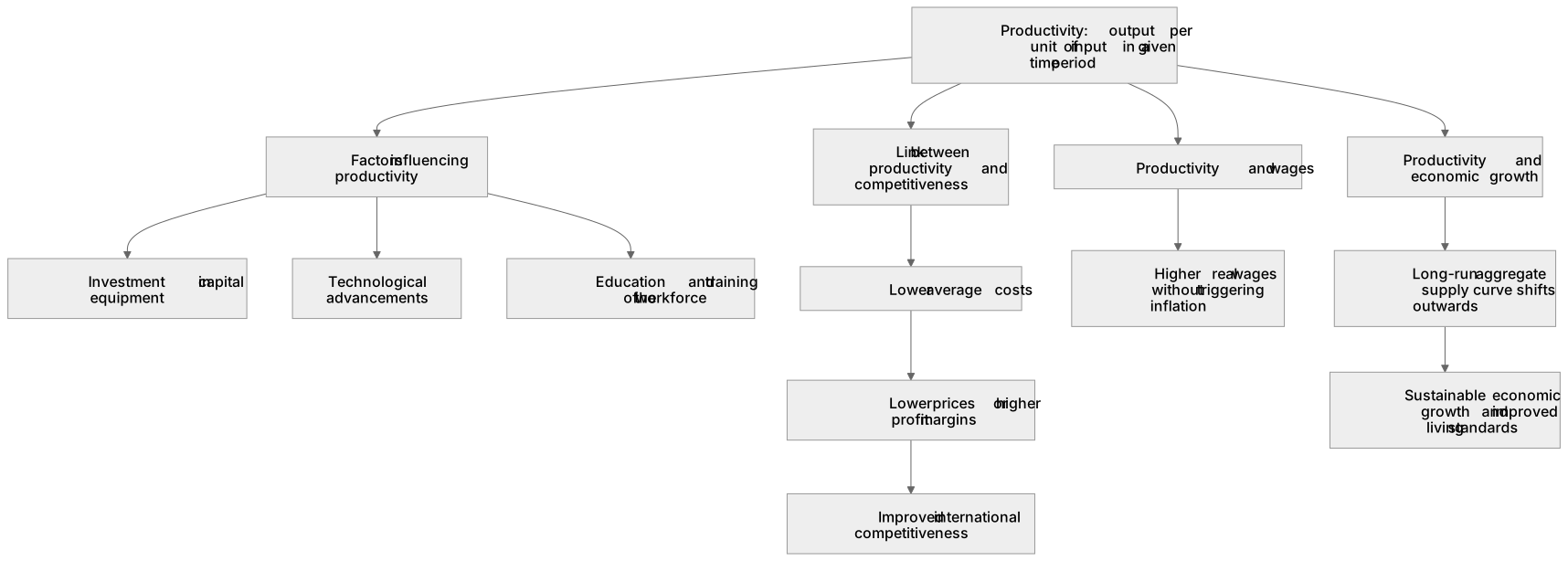
Key words
Say what each word means before you turn the card.
Productivity
Try answering aloud or in your head before turning the card.
Competitiveness
Try answering aloud or in your head before turning the card.
Economic growth
Try answering aloud or in your head before turning the card.
Human capital
Try answering aloud or in your head before turning the card.
See every definition
- Productivity
- Output per unit of input in a given time period, such as units produced per worker per hour.
- Competitiveness
- A firm's international position, improved when higher productivity lowers average costs and allows lower prices or higher profit margins.
- Economic growth
- Sustainable growth driven by rising productivity shifting the long-run aggregate supply curve outwards, improving living standards.
- Human capital
- The education and training of the workforce, which is a factor influencing productivity.
Label the diagram
Some boxes have lost their names. Pick the right name for each number.
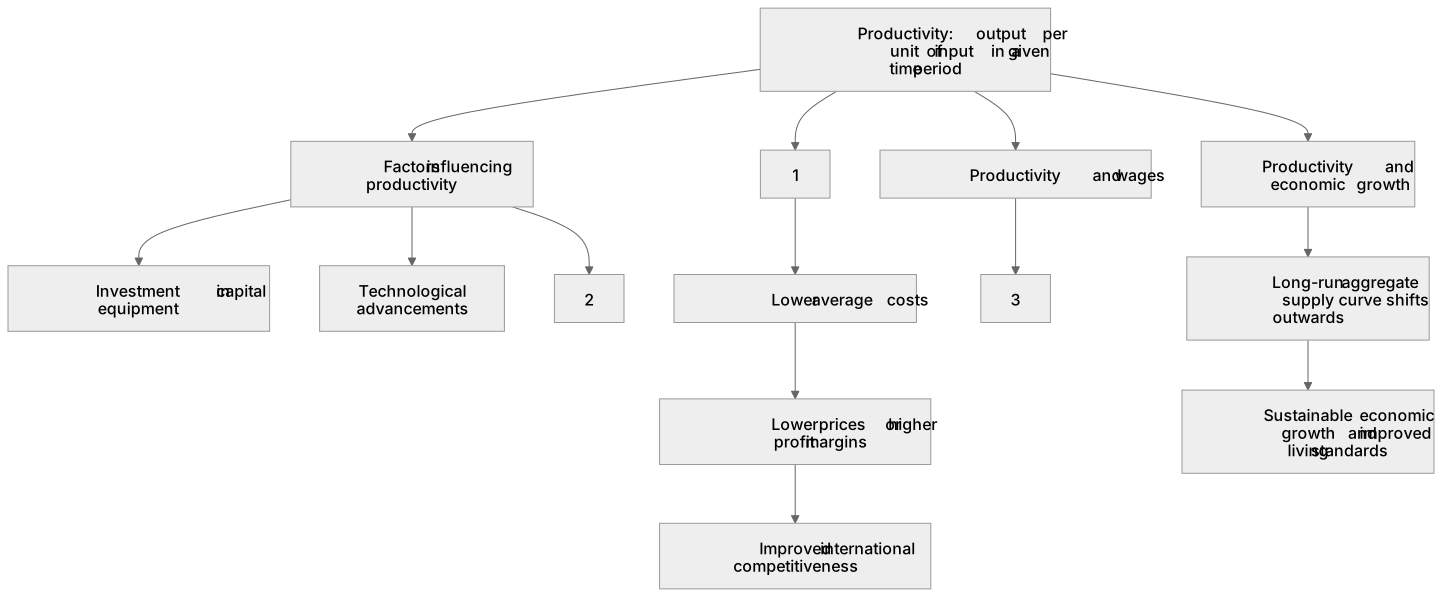
1Box 1
2Box 2
3Box 3
There is more to this lesson
The full lesson goes on to check your understanding and help you earn the marks. Create a free account to carry on, with your progress saved.
A week of Premium from your first lesson · Then the free plan continues · No card, no charge
Test your understanding of Productivity: a) Productivity (output per unit of input in a given time period): o factors influencing productivity o link between productivity and competitiveness o productivity and wages o productivity and economic growth
Active recall beats re-reading. Take an instant quiz now to test what you’ve learned and lock it into long-term memory.
A week of Premium from your first lesson · Then the free plan continues · No card, no charge