Pearson Edexcel · A-Level · Economics B
Course version: 9EB0 · Version from Sept 2015
Productivity: b) Distinction between labour and capital intensive production
Production methods can be classified by their relative reliance on different factors of production.
Checked against the Pearson Edexcel 9EB0 specification (opens in a new tab) on .
- Point 2 of 2
- 4 key terms
Study notes
From the checked teaching notes for this specification point.
The idea
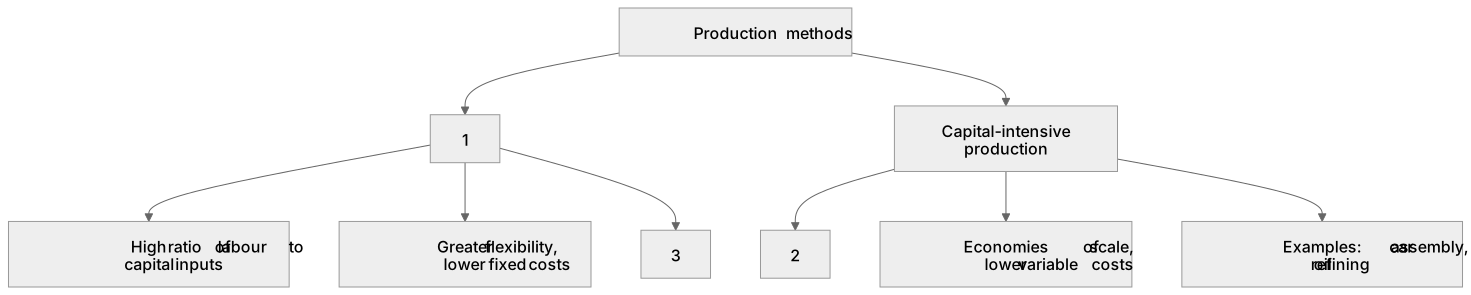
Production methods can be classified by their relative reliance on different factors of production. Labour-intensive production relies heavily on human workforce relative to machinery, common in services like hospitality or bespoke manufacturing where personal interaction or craftsmanship is essential. Conversely, capital-intensive production uses a high proportion of machinery and automated technology relative to human labour, typical in mass manufacturing such as car assembly or oil refining. The distinction is crucial because capital-intensive methods often require high initial investment but achieve lower unit costs at scale, whereas labour-intensive methods offer greater flexibility but may face higher variable costs.
What earns the marks
- Define labour-intensive production as a process using a high ratio of labour to capital inputs.
- Define capital-intensive production as a process using a high ratio of capital machinery to labour inputs.
- Explain that capital-intensive production typically benefits from economies of scale and lower variable costs.
- Explain that labour-intensive production often provides greater flexibility and lower fixed costs.
- Provide examples of each, such as automated car manufacturing for capital-intensive and bespoke tailoring for labour-intensive.
Common mistakes and how to put them right
Stating that capital-intensive means no labour is used.
Put it right: Capital-intensive means a higher proportion of capital relative to labour, not the complete absence of a workforce.
Assuming labour-intensive production is always inefficient.
Put it right: Labour-intensive methods can be highly efficient and necessary for bespoke products, luxury goods, or personal services.
Confusing capital in production with financial capital.
Put it right: In this context, capital refers to physical machinery, equipment, and technology used in the production process, not money.
Exam tips
- Use specific industry examples to illustrate the difference between labour and capital-intensive production.
- Discuss how a firm might transition from labour to capital-intensive production as it grows and seeks economies of scale.
- Consider the impact of wage rates and interest rates on a firm's choice between labour and capital-intensive methods.
Try the lesson
The start of the Productivity: b) Distinction between labour and capital intensive production lesson, made from checked teaching notes for this specification point.
Have a go first
Which of the following characteristics is the primary defining feature of a capital-intensive production process?
Listen
Production methods can be classified by their relative reliance on different factors of production. Labour-intensive production relies heavily on human workforce relative to machinery, common in services like hospitality or bespoke manufacturing where personal interaction or craftsmanship is essential. Conversely, capital-intensive production uses a high proportion of machinery and automated technology relative to human labour, typical in mass manufacturing such as car assembly or oil refining. The distinction is crucial because capital-intensive methods often require high initial investment but achieve lower unit costs at scale, whereas labour-intensive methods offer greater flexibility but may face higher variable costs. A strong answer earns marks for these points. Define labour-intensive production as a process using a high ratio of labour to capital inputs. Define capital-intensive production as a process using a high ratio of capital machinery to labour inputs. Explain that capital-intensive production typically benefits from economies of scale and lower variable costs. Explain that labour-intensive production often provides greater flexibility and lower fixed costs. A common slip: Stating that capital-intensive means no labour is used. Instead, Capital-intensive means a higher proportion of capital relative to labour, not the complete absence of a workforce. Exam tip: Use specific industry examples to illustrate the difference between labour and capital-intensive production.
See it

Key words
Say what each word means before you turn the card.
Labour-intensive production
Try answering aloud or in your head before turning the card.
Capital-intensive production
Try answering aloud or in your head before turning the card.
Economies of scale
Try answering aloud or in your head before turning the card.
Capital
Try answering aloud or in your head before turning the card.
See every definition
- Labour-intensive production
- A process using a high ratio of labour to capital inputs, relying heavily on human workforce relative to machinery.
- Capital-intensive production
- A process using a high ratio of capital machinery to labour inputs, with a high proportion of machinery and automated technology relative to human labour.
- Economies of scale
- Benefits that capital-intensive production typically achieves, leading to lower unit costs at scale.
- Capital
- Physical machinery, equipment and technology used in the production process, not money.
Label the diagram
Some boxes have lost their names. Pick the right name for each number.
1Box 1
2Box 2
3Box 3
There is more to this lesson
The full lesson goes on to check your understanding and help you earn the marks. Create a free account to carry on, with your progress saved.
A week of Premium from your first lesson · Then the free plan continues · No card, no charge
Test your understanding of Productivity: b) Distinction between labour and capital intensive production
Active recall beats re-reading. Take an instant quiz now to test what you’ve learned and lock it into long-term memory.
A week of Premium from your first lesson · Then the free plan continues · No card, no charge