Pearson Edexcel · A-Level · Economics B
Course version: 9EB0 · Version from Sept 2015
A) Profit as an incentive in a competitive market: market entry and exit
Full specification wording
Profit and loss: a) Profit as an incentive in a competitive market: market entry and exit
Profit acts as a crucial signal and incentive in competitive markets, guiding resource allocation.
Checked against the Pearson Edexcel 9EB0 specification (opens in a new tab) on .
- Point 1 of 4
- 3 key terms
Study notes
From the checked teaching notes for this specification point.
The idea
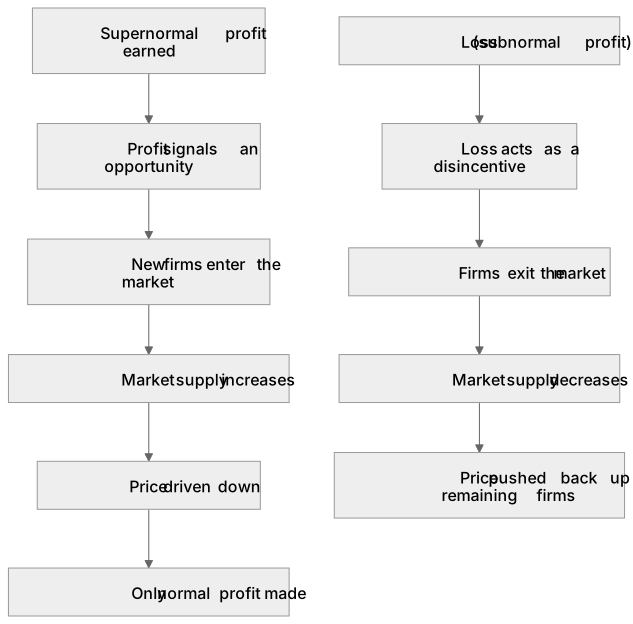
Profit acts as a crucial signal and incentive in competitive markets, guiding resource allocation. When existing firms in a market earn supernormal profit, this signals an opportunity, incentivising new firms to enter the market. For example, if a new trend in vegan baking yields high profits, new bakeries will enter, increasing supply and driving down prices until only normal profit is made. Conversely, if firms make a loss (subnormal profit), this acts as a disincentive, prompting firms to exit the market. This exit reduces market supply, which can push prices back up for the remaining firms. This dynamic process of market entry and exit ensures that resources are allocated efficiently to where consumer demand is strongest.
What earns the marks
- Identify that supernormal profit acts as a signal for new firms to enter a competitive market.
- Explain that market entry increases total market supply, which puts downward pressure on the market price.
- Recognise that sustained losses act as a signal for existing firms to exit the market.
- Explain that market exit decreases total market supply, which can lead to an increase in the market price for surviving firms.
Common mistakes and how to put them right
Assuming that high profits are permanent.
Put it right: In reality, high profits attract new entrants which eventually drives prices and profits down.
Confusing the incentive to enter with barriers to entry.
Put it right by noting that competitive markets assume low barriers to entry, allowing the incentive to function.
Believing that market exit happens immediately when a loss is made.
Put it right: Firms may stay in the market in the short run if they can cover their variable costs.
Exam tips
- Always link the concept of profit to its role as a signalling mechanism for resource allocation.
- When discussing market entry, explicitly state the chain of reasoning: profit incentive leads to entry, which increases supply and reduces price.
- Use the terms 'supernormal profit' and 'subnormal profit' (or loss) to demonstrate precise economic vocabulary.
Try the lesson
The start of the Profit and loss: a) Profit as an incentive in a competitive market: market entry and exit lesson, made from checked teaching notes for this specification point.
Have a go first
In a highly competitive market, what is the primary function of supernormal profit?
Listen
Profit acts as a crucial signal and incentive in competitive markets, guiding resource allocation. When existing firms in a market earn supernormal profit, this signals an opportunity, incentivising new firms to enter the market. For example, if a new trend in vegan baking yields high profits, new bakeries will enter, increasing supply and driving down prices until only normal profit is made. Conversely, if firms make a loss (subnormal profit), this acts as a disincentive, prompting firms to exit the market. This exit reduces market supply, which can push prices back up for the remaining firms. This dynamic process of market entry and exit ensures that resources are allocated efficiently to where consumer demand is strongest. A strong answer earns marks for these points. Identify that supernormal profit acts as a signal for new firms to enter a competitive market. Explain that market entry increases total market supply, which puts downward pressure on the market price. Recognise that sustained losses act as a signal for existing firms to exit the market. Explain that market exit decreases total market supply, which can lead to an increase in the market price for surviving firms. A common slip: Confusing the incentive to enter with barriers to entry. Instead, noting that competitive markets assume low barriers to entry, allowing the incentive to function. Exam tip: Always link the concept of profit to its role as a signalling mechanism for resource allocation.
See it
Key words
Say what each word means before you turn the card.
Market entry
Try answering aloud or in your head before turning the card.
Market exit
Try answering aloud or in your head before turning the card.
Supernormal profit
Try answering aloud or in your head before turning the card.
See every definition
- Market entry
- New firms entering a market in response to supernormal profit, which increases supply and drives down prices until only normal profit is made.
- Market exit
- Firms leaving a market in response to a loss (subnormal profit), which reduces market supply and can push prices back up for the remaining firms.
- Supernormal profit
- Profit earned by existing firms in a market that signals an opportunity, incentivising new firms to enter.
Label the diagram
Some boxes have lost their names. Pick the right name for each number.

1Box 1
2Box 2
3Box 3
There is more to this lesson
The full lesson goes on to check your understanding and help you earn the marks. Create a free account to carry on, with your progress saved.
A week of Premium from your first lesson · Then the free plan continues · No card, no charge
Test your understanding of Profit and loss: a) Profit as an incentive in a competitive market: market entry and exit
Active recall beats re-reading. Take an instant quiz now to test what you’ve learned and lock it into long-term memory.
A week of Premium from your first lesson · Then the free plan continues · No card, no charge