Pearson Edexcel · A-Level · Economics B
Course version: 9EB0 · Version from Sept 2015
A) The distinction between income and wealth
Full specification wording
Re-distribution of income and wealth: a) The distinction between income and wealth
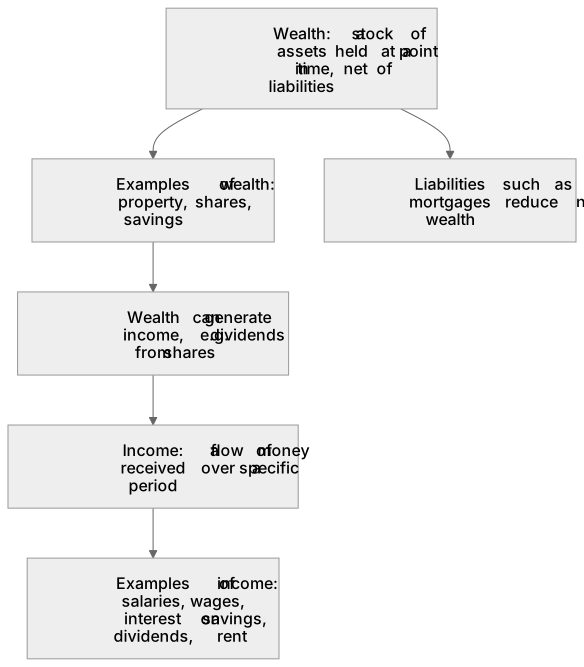
Income is a flow concept, representing the money received by an individual or household over a specific period.
Checked against the Pearson Edexcel 9EB0 specification (opens in a new tab) on .
- Point 1 of 3
- 2 key terms
Study notes
From the checked teaching notes for this specification point.
The idea
Income is a flow concept, representing the money received by an individual or household over a specific period. Examples include monthly salaries, weekly wages, interest on savings, and annual dividends. In contrast, wealth is a stock concept, measuring the total net value of assets owned at a specific point in time, such as property, shares, and savings, minus any liabilities like mortgages. The distinction is vital: a high-earning professional might have high income but low wealth due to significant debt, whereas a retiree might have low income but substantial wealth from owning a home outright. Understanding this distinction is essential for evaluating economic inequality and the differing impacts of re-distribution policies.
What earns the marks
- Define income as a flow of money received over a specific period of time.
- Define wealth as a stock of assets held at a specific point in time, net of liabilities.
- Distinguish between the two concepts using concrete examples, such as wages (income) and property (wealth).
- Explain the relationship between the two, noting that wealth can generate income (e.g. dividends from shares).
Common mistakes and how to put them right
Using the terms income and wealth interchangeably.
Put it right: Specify income as a flow over time and wealth as a stock at a given moment.
Assuming that high income guarantees high wealth.
Put it right: High income earners may have high consumption and significant debt, resulting in low net wealth.
Categorising rent received as wealth.
Put it right: Rent is a flow of income generated from the stock of wealth held in property.
Exam tips
- Use the terms 'stock' and 'flow' explicitly when distinguishing between wealth and income to demonstrate precise economic understanding.
- When evaluating inequality, explicitly distinguish between income inequality and wealth inequality, as they require different policy responses.
- Remember that policies designed to redistribute income, such as progressive income taxation, may not effectively redistribute accumulated wealth.
Try the lesson
The start of the Re-distribution of income and wealth: a) The distinction between income and wealth lesson, made from checked teaching notes for this specification point.
Have a go first
Which of the following best describes the economic distinction between income and wealth?
Listen
Income is a flow concept, representing the money received by an individual or household over a specific period. Examples include monthly salaries, weekly wages, interest on savings, and annual dividends. In contrast, wealth is a stock concept, measuring the total net value of assets owned at a specific point in time, such as property, shares, and savings, minus any liabilities like mortgages. The distinction is vital: a high-earning professional might have high income but low wealth due to significant debt, whereas a retiree might have low income but substantial wealth from owning a home outright. Understanding this distinction is essential for evaluating economic inequality and the differing impacts of re-distribution policies. A strong answer earns marks for these points. Define income as a flow of money received over a specific period of time. Define wealth as a stock of assets held at a specific point in time, net of liabilities. Distinguish between the two concepts using concrete examples, such as wages (income) and property (wealth). Explain the relationship between the two, noting that wealth can generate income (e.g. dividends from shares). A common slip: Using the terms income and wealth interchangeably. Instead, specify income as a flow over time and wealth as a stock at a given moment. Exam tip: Use the terms 'stock' and 'flow' explicitly when distinguishing between wealth and income to demonstrate precise economic understanding.
See it
Key words
Say what each word means before you turn the card.
Income
Try answering aloud or in your head before turning the card.
Wealth
Try answering aloud or in your head before turning the card.
See every definition
- Income
- A flow concept, representing the money received by an individual or household over a specific period.
- Wealth
- A stock concept, measuring the total net value of assets owned at a specific point in time, minus any liabilities.
Label the diagram
Some boxes have lost their names. Pick the right name for each number.
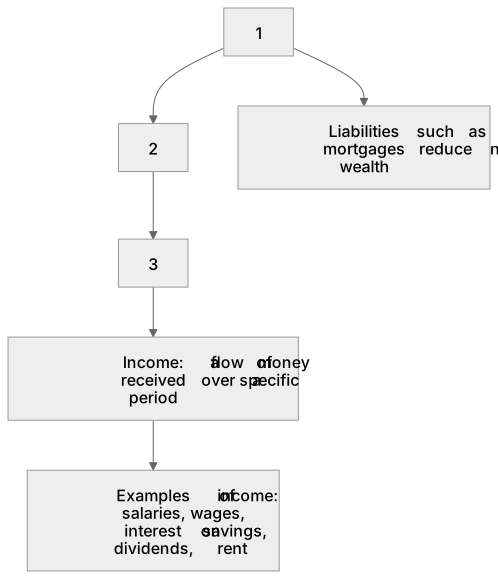
1Box 1
2Box 2
3Box 3
There is more to this lesson
The full lesson goes on to check your understanding and help you earn the marks. Create a free account to carry on, with your progress saved.
A week of Premium from your first lesson · Then the free plan continues · No card, no charge
Test your understanding of Re-distribution of income and wealth: a) The distinction between income and wealth
Active recall beats re-reading. Take an instant quiz now to test what you’ve learned and lock it into long-term memory.
A week of Premium from your first lesson · Then the free plan continues · No card, no charge