Pearson Edexcel · A-Level · Economics B
Course version: 9EB0 · Version from Sept 2015
Re-distribution of income and wealth: b) Incentives and the poverty trap
Full specification wording
Re-distribution of income and wealth: b) Incentives and the poverty trap
The poverty trap occurs when individuals on low incomes face a disincentive to work longer hours or seek higher-paying jobs.
Checked against the Pearson Edexcel 9EB0 specification (opens in a new tab) on .
- Point 2 of 3
- 4 key terms
Study notes
From the checked teaching notes for this specification point.
The idea
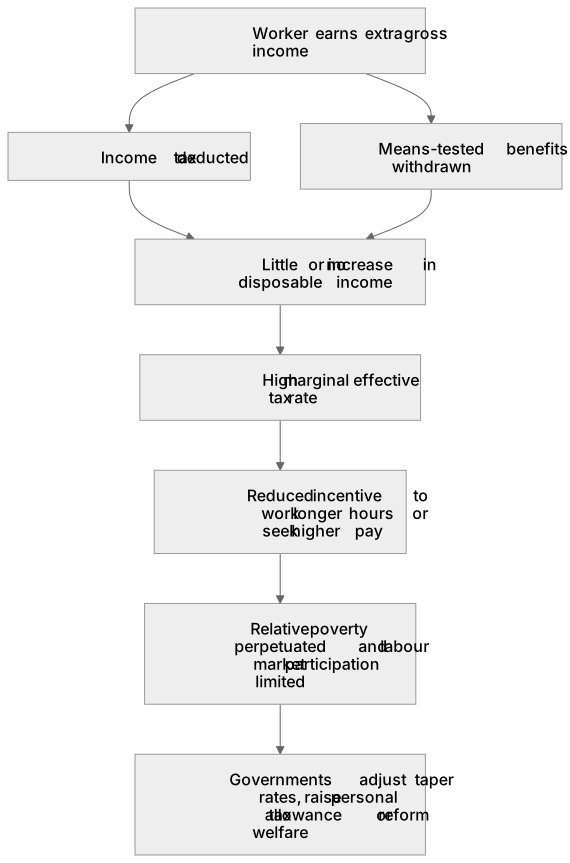
The poverty trap occurs when individuals on low incomes face a disincentive to work longer hours or seek higher-paying jobs. This happens because the combination of income tax and the withdrawal of means-tested benefits results in little or no increase in disposable income, creating a high marginal effective tax rate. For example, if a worker earns an extra £100 but loses £65 in benefits and pays £20 in tax, their net gain is only £15, severely reducing the incentive to earn more. This situation perpetuates relative poverty and limits labour market participation. Governments attempt to mitigate the poverty trap by adjusting benefit withdrawal taper rates, increasing the personal tax allowance, or reforming welfare systems.
What earns the marks
- Define the poverty trap as a situation where an increase in gross income leads to little or no increase in disposable income.
- Explain that the poverty trap is caused by the simultaneous deduction of income tax and the withdrawal of means-tested benefits.
- Calculate or identify the marginal effective tax rate to demonstrate the disincentive to work longer hours.
- Evaluate government policies designed to reduce the poverty trap, such as altering the taper rate of universal credit or other benefits.
Common mistakes and how to put them right
Confusing the poverty trap with the unemployment trap.
Put it right: The poverty trap affects those already in low-paid work seeking to increase hours, whereas the unemployment trap affects those out of work deciding whether to accept a job.
Stating that individuals in the poverty trap lose all their income.
Put it right: They lose a significant proportion of their additional income, not their total income.
Assuming that increasing the minimum wage automatically solves the poverty trap.
Put it right: Higher wages may still be offset by benefit withdrawals and taxation unless the tax and benefit system is reformed.
Exam tips
- Use a numerical example to illustrate the poverty trap, showing the net effect of earning additional gross income on disposable income.
- Clearly distinguish between means-tested benefits, which contribute to the poverty trap, and universal benefits, which do not.
- Discuss the trade-off between providing an adequate safety net and maintaining incentives to work when evaluating welfare policies.
Try the lesson
The start of the Re-distribution of income and wealth: b) Incentives and the poverty trap lesson, made from checked teaching notes for this specification point.
Have a go first
Which of the following best defines the economic concept of the poverty trap?
Listen
The poverty trap occurs when individuals on low incomes face a disincentive to work longer hours or seek higher-paying jobs. This happens because the combination of income tax and the withdrawal of means-tested benefits results in little or no increase in disposable income, creating a high marginal effective tax rate. For example, if a worker earns an extra £100 but loses £65 in benefits and pays £20 in tax, their net gain is only £15, severely reducing the incentive to earn more. This situation perpetuates relative poverty and limits labour market participation. Governments attempt to mitigate the poverty trap by adjusting benefit withdrawal taper rates, increasing the personal tax allowance, or reforming welfare systems. A strong answer earns marks for these points. Define the poverty trap as a situation where an increase in gross income leads to little or no increase in disposable income. Explain that the poverty trap is caused by the simultaneous deduction of income tax and the withdrawal of means-tested benefits. Calculate or identify the marginal effective tax rate to demonstrate the disincentive to work longer hours. Evaluate government policies designed to reduce the poverty trap, such as altering the taper rate of universal credit or other benefits. A common slip: Confusing the poverty trap with the unemployment trap. Instead, the poverty trap affects those already in low-paid work seeking to increase hours, whereas the unemployment trap affects those out of work deciding whether to accept a job. Exam tip: Use a numerical example to illustrate the poverty trap, showing the net effect of earning additional gross income on disposable income.
See it
Key words
Say what each word means before you turn the card.
Incentives to work
Try answering aloud or in your head before turning the card.
Taxation and benefits
Try answering aloud or in your head before turning the card.
Labour market participation
Try answering aloud or in your head before turning the card.
Relative poverty
Try answering aloud or in your head before turning the card.
See every definition
- Incentives to work
- The motivation to work longer hours or seek higher-paying jobs, which is reduced when extra earnings bring little or no increase in disposable income.
- Taxation and benefits
- The simultaneous deduction of income tax and the withdrawal of means-tested benefits, which together can leave little or no increase in disposable income.
- Labour market participation
- Involvement in work, which the poverty trap limits because earning more brings little or no gain in disposable income.
- Relative poverty
- A situation perpetuated by the poverty trap, in which those on low incomes face a disincentive to earn more.
Label the diagram
Some boxes have lost their names. Pick the right name for each number.
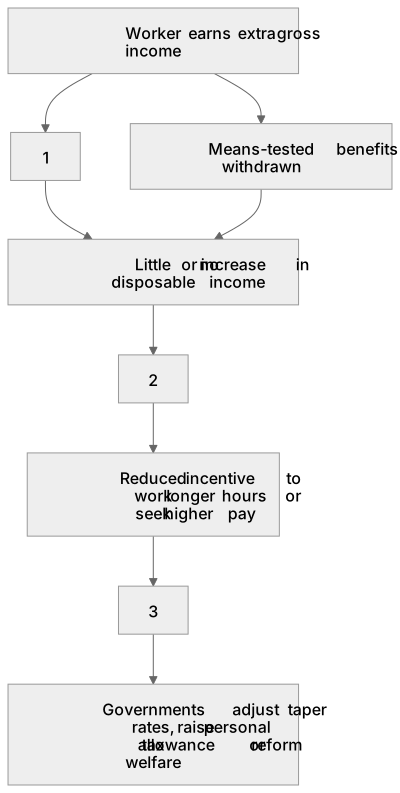
1Box 1
2Box 2
3Box 3
There is more to this lesson
The full lesson goes on to check your understanding and help you earn the marks. Create a free account to carry on, with your progress saved.
A week of Premium from your first lesson · Then the free plan continues · No card, no charge
Test your understanding of Re-distribution of income and wealth: b) Incentives and the poverty trap
Active recall beats re-reading. Take an instant quiz now to test what you’ve learned and lock it into long-term memory.
A week of Premium from your first lesson · Then the free plan continues · No card, no charge