Pearson Edexcel · A-Level · Economics B
Course version: 9EB0 · Version from Sept 2015
C) Taxation and the provision of services
Full specification wording
Re-distribution of income and wealth: c) Taxation and the provision of services
Governments use taxation and the provision of services to redistribute income and wealth, reducing inequality.
Checked against the Pearson Edexcel 9EB0 specification (opens in a new tab) on .
- Point 3 of 3
- 4 key terms
Study notes
From the checked teaching notes for this specification point.
The idea
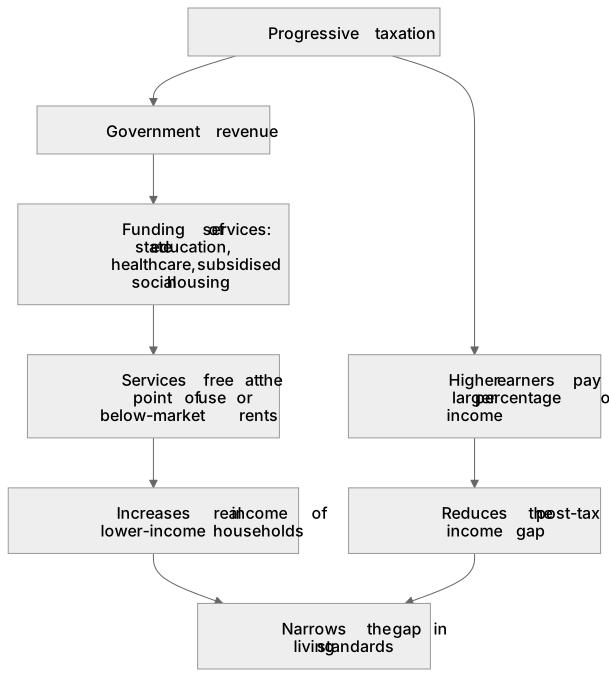
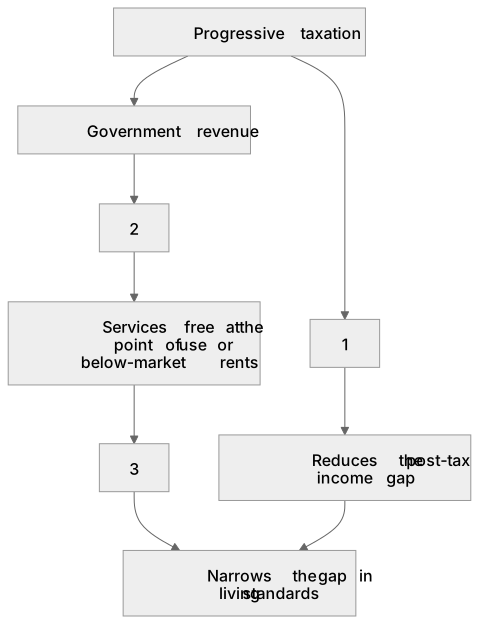
Governments use taxation and the provision of services to redistribute income and wealth, reducing inequality. Progressive taxation, such as income tax where higher earners pay a larger percentage of their income, directly reduces the post-tax income gap. The revenue generated funds essential services like state education, healthcare, and subsidised social housing. By providing services like healthcare free at the point of use, or housing at below-market rents, the government effectively increases the real income of lower-income households who would otherwise struggle to afford them.
For example: Funding the NHS ensures that healthcare access is not determined by wealth, narrowing the gap in living standards.
What earns the marks
- Identify progressive taxation as a mechanism that takes a larger proportion of income from high earners to reduce income inequality.
- Explain how government revenue is used to fund public and merit goods, such as healthcare and education.
- Evaluate the impact of providing state services on the real income and living standards of low-income households.
- Analyse the potential disincentive effects of high marginal tax rates on labour supply and enterprise.
Common mistakes and how to put them right
Confusing income and wealth.
Put it right: Income is a flow of money over time, whereas wealth is a stock of assets at a given point in time.
Assuming all taxes are progressive.
Put it right: Indirect taxes like VAT are regressive and can widen income inequality.
Stating that providing services redistributes wealth directly.
Put it right: It primarily redistributes real income and living standards, though it can affect wealth accumulation over generations.
Exam tips
- Always distinguish between income inequality and wealth inequality when evaluating government policies.
- Use specific examples of progressive taxes and state-provided services to support your analysis of redistribution.
- Consider the macroeconomic trade-offs, such as the potential negative impact of high taxation on economic growth.
Try the lesson
The start of the Re-distribution of income and wealth: c) Taxation and the provision of services lesson, made from checked teaching notes for this specification point.
Have a go first
How does the combination of progressive taxation and the state provision of public services typically affect the distribution of income?
Listen
Governments use taxation and the provision of services to redistribute income and wealth, reducing inequality. Progressive taxation, such as income tax where higher earners pay a larger percentage of their income, directly reduces the post-tax income gap. The revenue generated funds essential services like state education, healthcare, and subsidised social housing. By providing services like healthcare free at the point of use, or housing at below-market rents, the government effectively increases the real income of lower-income households who would otherwise struggle to afford them. For example, funding the NHS ensures that healthcare access is not determined by wealth, narrowing the gap in living standards. A strong answer earns marks for these points. Identify progressive taxation as a mechanism that takes a larger proportion of income from high earners to reduce income inequality. Explain how government revenue is used to fund public and merit goods, such as healthcare and education. Evaluate the impact of providing state services on the real income and living standards of low-income households. Analyse the potential disincentive effects of high marginal tax rates on labour supply and enterprise. A common slip: Confusing income and wealth. Instead, income is a flow of money over time, whereas wealth is a stock of assets at a given point in time. Exam tip: Always distinguish between income inequality and wealth inequality when evaluating government policies.
See it
Key words
Say what each word means before you turn the card.
Income inequality
Try answering aloud or in your head before turning the card.
Wealth distribution
Try answering aloud or in your head before turning the card.
Progressive taxation
Try answering aloud or in your head before turning the card.
Government intervention
Try answering aloud or in your head before turning the card.
See every definition
- Income inequality
- A flow of money over time that is unevenly spread, which progressive taxation can reduce by taking a larger proportion from high earners.
- Wealth distribution
- A stock of assets at a given point in time, which state services primarily affect only indirectly through real income and living standards.
- Progressive taxation
- A mechanism such as income tax where higher earners pay a larger percentage of their income, directly reducing the post-tax income gap.
- Government intervention
- The use of taxation and the provision of services to redistribute income and wealth, reducing inequality.
Label the diagram
Some boxes have lost their names. Pick the right name for each number.
1Box 1
2Box 2
3Box 3
There is more to this lesson
The full lesson goes on to check your understanding and help you earn the marks. Create a free account to carry on, with your progress saved.
A week of Premium from your first lesson · Then the free plan continues · No card, no charge
Test your understanding of Re-distribution of income and wealth: c) Taxation and the provision of services
Active recall beats re-reading. Take an instant quiz now to test what you’ve learned and lock it into long-term memory.
A week of Premium from your first lesson · Then the free plan continues · No card, no charge