Pearson Edexcel · A-Level · Economics B
Course version: 9EB0 · Version from Sept 2015
B) International aid and improvements in welfare; non- governmental…
Full specification wording
Reducing poverty: b) International aid and improvements in welfare; non- governmental organisations (NGOs)
International aid involves transferring resources between countries to assist economic development and poverty reduction, taking forms like bilateral, multilateral, or tied aid.
Checked against the Pearson Edexcel 9EB0 specification (opens in a new tab) on .
- Point 2 of 3
- 3 key terms
Study notes
From the checked teaching notes for this specification point.
The idea
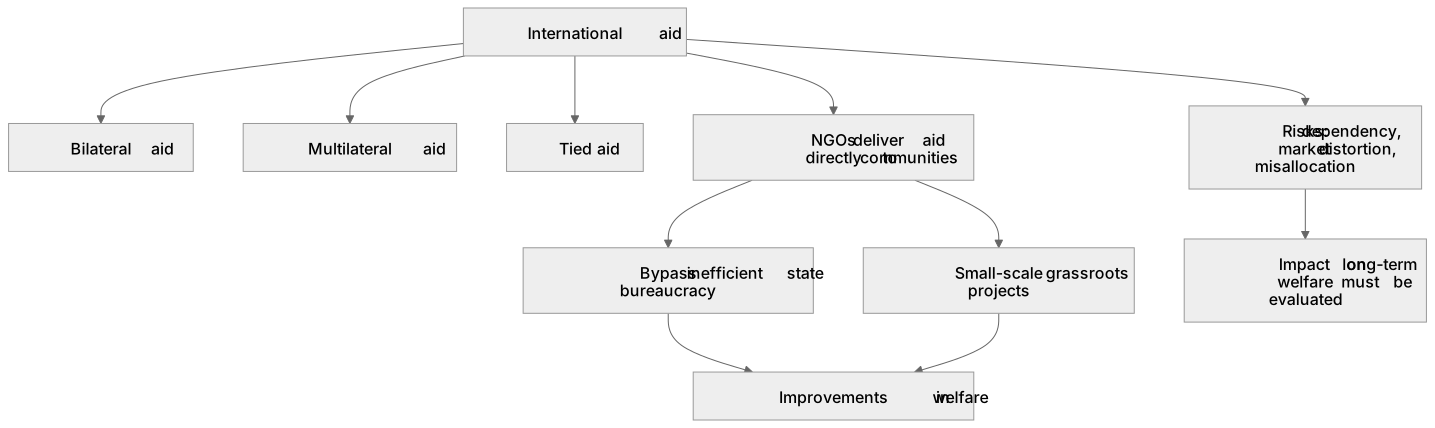
International aid involves transferring resources between countries to assist economic development and poverty reduction, taking forms like bilateral, multilateral, or tied aid. Improvements in welfare occur when aid effectively targets healthcare, education, and infrastructure. Non-governmental organisations (NGOs), such as Oxfam, play a crucial role in delivering aid directly to communities, often bypassing inefficient state bureaucracy. NGOs are typically effective at implementing small-scale, grassroots projects that directly improve local welfare. However, international aid can sometimes create dependency, distort local markets, or be misallocated, meaning its true impact on long-term welfare improvements must be carefully evaluated.
What earns the marks
- Define international aid as the voluntary transfer of resources from one country or organisation to another.
- Explain how aid can improve welfare by funding essential services like healthcare, education, and infrastructure.
- Identify the role of NGOs in providing targeted, grassroots assistance and emergency relief directly to communities.
- Analyse the advantages of NGOs, such as their ability to bypass corrupt governments and focus on specific local needs.
- Evaluate the limitations of international aid, including the risk of dependency, corruption, and market distortion.
Common mistakes and how to put them right
Assuming all international aid successfully improves welfare.
Put it right: Acknowledge that aid can be mismanaged, tied to conditions, or create dependency, limiting welfare improvements.
Confusing NGOs with government agencies.
Put it right: Define NGOs as independent, non-profit organisations that operate separately from national governments.
Overlooking the negative impacts of tied aid.
Put it right: Explain that tied aid requires the recipient to buy goods from the donor, which may not be the most cost-effective way to improve welfare.
Exam tips
- Use specific examples of NGOs, such as Oxfam or WaterAid, to illustrate how they improve local welfare.
- Contrast the effectiveness of large-scale government aid with small-scale NGO projects when evaluating poverty reduction.
- Discuss the concept of aid dependency as a key evaluative point against the long-term benefits of international aid.
Try the lesson
The start of the Reducing poverty: b) International aid and improvements in welfare; non- governmental organisations (NGOs) lesson, made from checked teaching notes for this specification point.
Have a go first
What is a primary characteristic of non-governmental organisations (NGOs) when providing international aid to developing countries?
Listen
International aid involves transferring resources between countries to assist economic development and poverty reduction, taking forms like bilateral, multilateral, or tied aid. Improvements in welfare occur when aid effectively targets healthcare, education, and infrastructure. Non-governmental organisations (NGOs), such as Oxfam, play a crucial role in delivering aid directly to communities, often bypassing inefficient state bureaucracy. NGOs are typically effective at implementing small-scale, grassroots projects that directly improve local welfare. However, international aid can sometimes create dependency, distort local markets, or be misallocated, meaning its true impact on long-term welfare improvements must be carefully evaluated. A strong answer earns marks for these points. Define international aid as the voluntary transfer of resources from one country or organisation to another. Explain how aid can improve welfare by funding essential services like healthcare, education, and infrastructure. Identify the role of NGOs in providing targeted, grassroots assistance and emergency relief directly to communities. Analyse the advantages of NGOs, such as their ability to bypass corrupt governments and focus on specific local needs. A common slip: Assuming all international aid successfully improves welfare. Instead, Acknowledge that aid can be mismanaged, tied to conditions, or create dependency, limiting welfare improvements. Exam tip: Use specific examples of NGOs, such as Oxfam or WaterAid, to illustrate how they improve local welfare.
See it
Key words
Say what each word means before you turn the card.
International aid
Try answering aloud or in your head before turning the card.
Welfare improvement
Try answering aloud or in your head before turning the card.
Non-governmental organisations
Try answering aloud or in your head before turning the card.
See every definition
- International aid
- The voluntary transfer of resources from one country or organisation to another to assist economic development and poverty reduction.
- Welfare improvement
- A rise in welfare that occurs when aid effectively targets healthcare, education, and infrastructure.
- Non-governmental organisations
- Independent, non-profit organisations that operate separately from national governments and deliver aid directly to communities.
Label the diagram
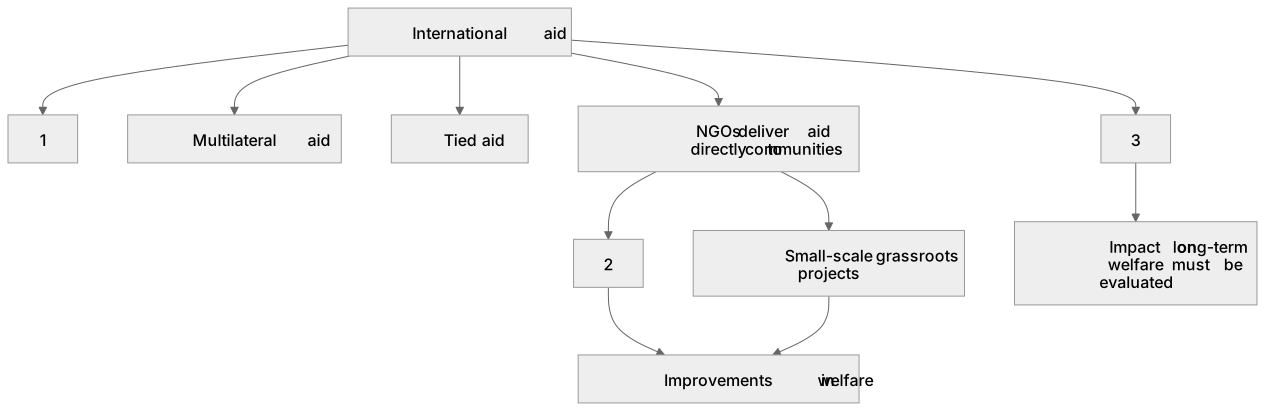
Some boxes have lost their names. Pick the right name for each number.
1Box 1
2Box 2
3Box 3
There is more to this lesson
The full lesson goes on to check your understanding and help you earn the marks. Create a free account to carry on, with your progress saved.
A week of Premium from your first lesson · Then the free plan continues · No card, no charge
Test your understanding of Reducing poverty: b) International aid and improvements in welfare; non- governmental organisations (NGOs)
Active recall beats re-reading. Take an instant quiz now to test what you’ve learned and lock it into long-term memory.
A week of Premium from your first lesson · Then the free plan continues · No card, no charge