Pearson Edexcel · A-Level · Economics B
Course version: 9EB0 · Version from Sept 2015
Reducing poverty: c) Poverty reduction policies
Poverty reduction policies aim to decrease absolute and relative poverty levels.
Checked against the Pearson Edexcel 9EB0 specification (opens in a new tab) on .
- Point 3 of 3
- 4 key terms
Study notes
From the checked teaching notes for this specification point.
The idea
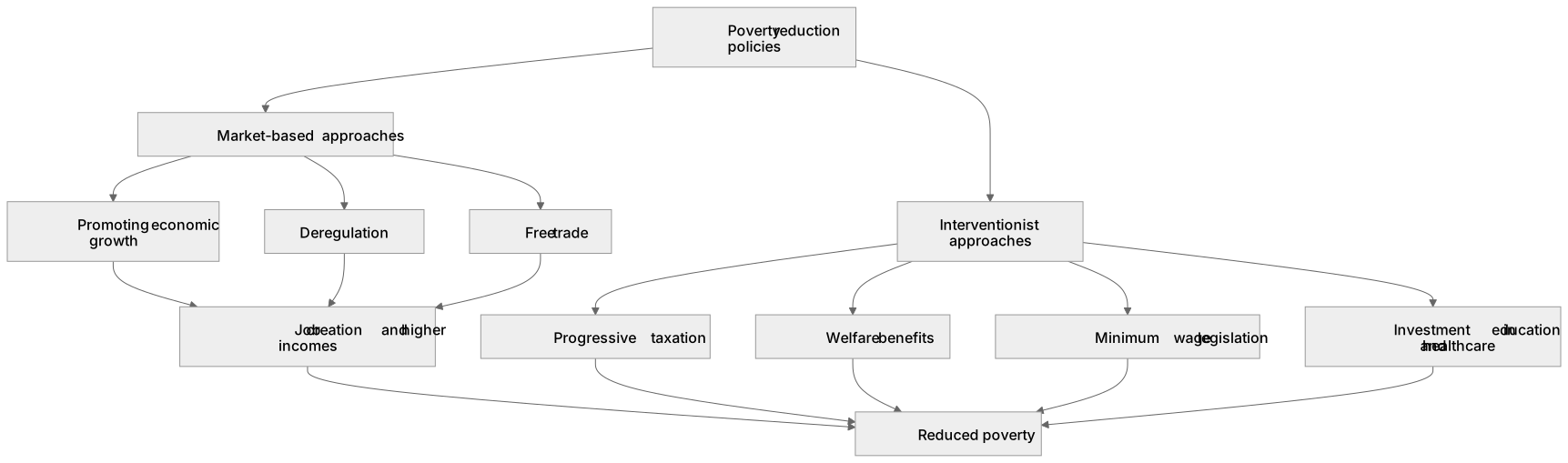
Poverty reduction policies aim to decrease absolute and relative poverty levels. Interventions are categorised into market-based and interventionist approaches. Market-based policies focus on promoting economic growth, deregulation, and free trade to create jobs and increase incomes. Interventionist policies involve direct government action, such as progressive taxation, welfare benefits, minimum wage legislation, and investment in education and healthcare. For example, increasing the national minimum wage directly boosts the incomes of the lowest earners, reducing relative poverty. However, such policies may lead to unintended consequences, like unemployment. Evaluating effectiveness requires weighing trade-offs.
What earns the marks
- Progressive taxation reduces relative poverty by taking a larger percentage of income from high earners to fund public services and welfare.
- Welfare payments, such as universal credit or state pensions, provide a safety net that directly increases the disposable income of the poorest households.
- Minimum wage legislation aims to increase the earnings of low-paid workers, though it may risk increasing unemployment if set above the equilibrium wage.
- Investment in education and healthcare represents a long-term interventionist policy to improve human capital and earning potential.
- Market-based policies, such as deregulation and tax cuts, aim to stimulate economic growth and job creation, indirectly reducing poverty through the trickle-down effect.
Common mistakes and how to put them right
Confusing absolute and relative poverty.
Put it right: Absolute poverty refers to lacking basic needs, while relative poverty is earning below a certain percentage of median income.
Assuming all economic growth automatically reduces poverty.
Put it right: Growth must be inclusive, otherwise income inequality may worsen, leaving relative poverty unchanged.
Stating that minimum wages always cause unemployment.
Put it right: The impact depends on the elasticity of demand for labour and the structure of the labour market, such as monopsony power.
Exam tips
- Always link the chosen policy back to whether it primarily targets absolute or relative poverty.
- Use real-world examples of poverty reduction policies, such as changes to the National Living Wage, to support your analysis.
- When evaluating, consider the time lag of policies; education investment takes years to impact poverty, whereas welfare changes are immediate.
Try the lesson
The start of the Reducing poverty: c) Poverty reduction policies lesson, made from checked teaching notes for this specification point.
Have a go first
Which of the following government policies is most likely to directly reduce absolute poverty in a developing economy?
Listen
Poverty reduction policies aim to decrease absolute and relative poverty levels. Interventions are categorised into market-based and interventionist approaches. Market-based policies focus on promoting economic growth, deregulation, and free trade to create jobs and increase incomes. Interventionist policies involve direct government action, such as progressive taxation, welfare benefits, minimum wage legislation, and investment in education and healthcare. For example, increasing the national minimum wage directly boosts the incomes of the lowest earners, reducing relative poverty. However, such policies may lead to unintended consequences, like unemployment. Evaluating effectiveness requires weighing trade-offs. A strong answer earns marks for these points. Progressive taxation reduces relative poverty by taking a larger percentage of income from high earners to fund public services and welfare. Welfare payments, such as universal credit or state pensions, provide a safety net that directly increases the disposable income of the poorest households. Minimum wage legislation aims to increase the earnings of low-paid workers, though it may risk increasing unemployment if set above the equilibrium wage. Investment in education and healthcare represents a long-term interventionist policy to improve human capital and earning potential. A common slip: Confusing absolute and relative poverty. Instead, absolute poverty refers to lacking basic needs, while relative poverty is earning below a certain percentage of median income. Exam tip: Always link the chosen policy back to whether it primarily targets absolute or relative poverty.
See it
Key words
Say what each word means before you turn the card.
Government intervention
Try answering aloud or in your head before turning the card.
Income distribution
Try answering aloud or in your head before turning the card.
Economic growth
Try answering aloud or in your head before turning the card.
Labour markets
Try answering aloud or in your head before turning the card.
See every definition
- Government intervention
- Direct government action, such as progressive taxation, welfare benefits, minimum wage legislation, and investment in education and healthcare, used to reduce poverty.
- Income distribution
- The way income is spread across the population, which poverty reduction policies aim to affect through mechanisms such as progressive taxation and welfare payments.
- Economic growth
- A market-based aim promoted through deregulation and free trade to create jobs and increase incomes, indirectly reducing poverty through the trickle-down effect.
- Labour markets
- The structure of the market for labour, whose elasticity of demand and monopsony power determine whether minimum wages cause unemployment.
Label the diagram
Some boxes have lost their names. Pick the right name for each number.
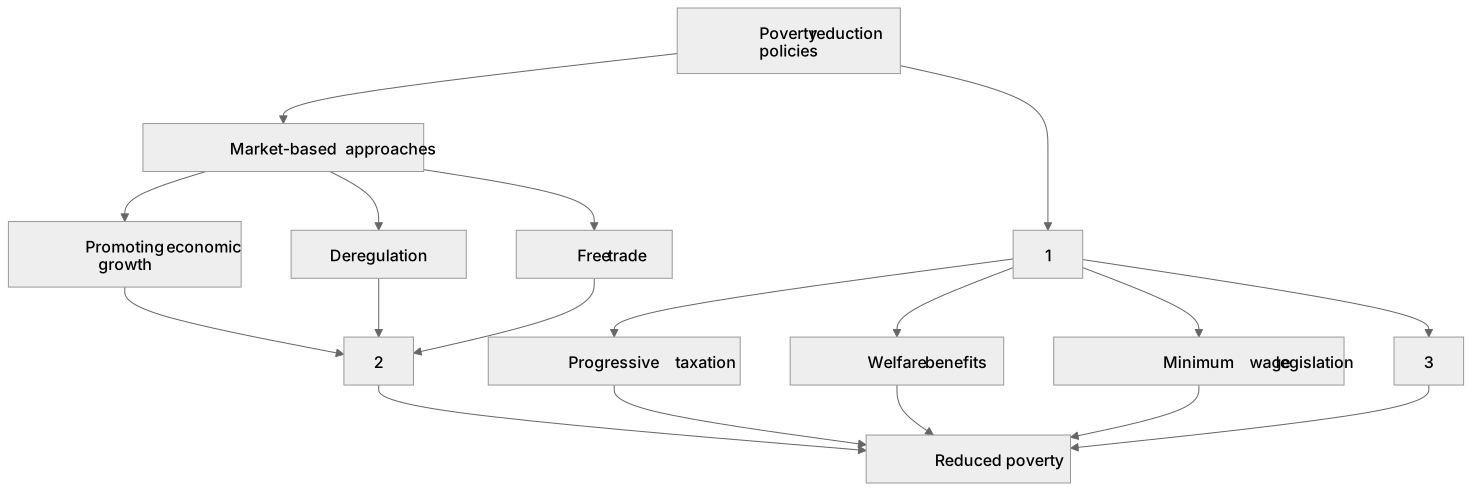
1Box 1
2Box 2
3Box 3
There is more to this lesson
The full lesson goes on to check your understanding and help you earn the marks. Create a free account to carry on, with your progress saved.
A week of Premium from your first lesson · Then the free plan continues · No card, no charge
Test your understanding of Reducing poverty: c) Poverty reduction policies
Active recall beats re-reading. Take an instant quiz now to test what you’ve learned and lock it into long-term memory.
A week of Premium from your first lesson · Then the free plan continues · No card, no charge