Pearson Edexcel · A-Level · Economics B
Course version: 9EB0 · Version from Sept 2015
A) Competitive advantage through innovation
Full specification wording
Research and development (R&D) and innovation: a) Competitive advantage through innovation
Innovation is a key driver of competitive advantage, allowing firms to differentiate their products or lower their production costs relative to rivals.
Checked against the Pearson Edexcel 9EB0 specification (opens in a new tab) on .
- Point 1 of 5
- 3 key terms
Study notes
From the checked teaching notes for this specification point.
The idea
Innovation is a key driver of competitive advantage, allowing firms to differentiate their products or lower their production costs relative to rivals. Product innovation involves creating new or improved goods, which can increase consumer demand and allow the firm to charge a premium price. Process innovation focuses on improving production methods, leading to lower average costs and higher profit margins. For example, a technology firm developing a smartphone with a unique folding screen achieves a competitive advantage through product innovation, making its offering distinct. By investing in research and development, firms can sustain this advantage, build brand loyalty, and create barriers to entry for new competitors.
What earns the marks
- Define competitive advantage as a condition that allows a firm to generate more sales or margins than its rivals.
- Distinguish between product innovation, which adds new features, and process innovation, which improves efficiency.
- Explain how product innovation leads to differentiation and price-setting power.
- Explain how process innovation reduces unit costs, improving profit margins.
- Identify that successful innovation can act as a barrier to entry, protecting market share.
Common mistakes and how to put them right
Confusing product innovation with process innovation.
Put it right: Product innovation changes the good itself, while process innovation changes how it is made.
Assuming innovation always guarantees a competitive advantage.
Put it right: It must be valued by consumers or significantly reduce costs to be effective.
Believing that only large firms can innovate.
Put it right: Small firms can also achieve competitive advantage through agile and niche innovations.
Exam tips
- Use specific examples of product or process innovation when explaining how a firm gains an edge over competitors.
- Link innovation directly to its impact on either revenue via differentiation or costs via efficiency.
- Consider the risks of innovation, such as high research and development costs failing to yield a commercially viable product.
Try the lesson
The start of the Research and development (R&D) and innovation: a) Competitive advantage through innovation lesson, made from checked teaching notes for this specification point.
Have a go first
Which of the following best describes how process innovation typically creates a competitive advantage for a manufacturing firm?
Listen
Innovation is a key driver of competitive advantage, allowing firms to differentiate their products or lower their production costs relative to rivals. Product innovation involves creating new or improved goods, which can increase consumer demand and allow the firm to charge a premium price. Process innovation focuses on improving production methods, leading to lower average costs and higher profit margins. For example, a technology firm developing a smartphone with a unique folding screen achieves a competitive advantage through product innovation, making its offering distinct. By investing in research and development, firms can sustain this advantage, build brand loyalty, and create barriers to entry for new competitors. A strong answer earns marks for these points. Define competitive advantage as a condition that allows a firm to generate more sales or margins than its rivals. Distinguish between product innovation, which adds new features, and process innovation, which improves efficiency. Explain how product innovation leads to differentiation and price-setting power. Explain how process innovation reduces unit costs, improving profit margins. Exam tip: Use specific examples of product or process innovation when explaining how a firm gains an edge over competitors.
See it
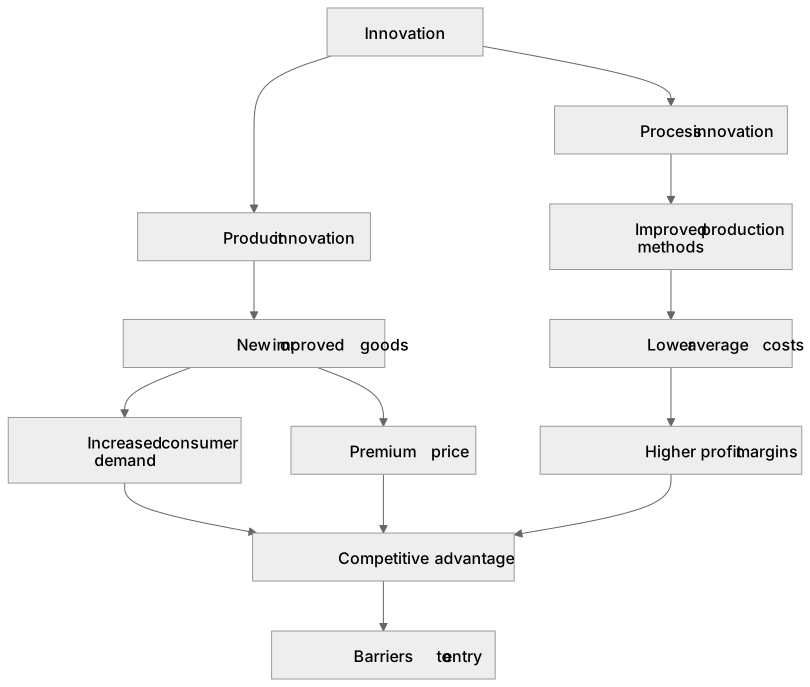
Key words
Say what each word means before you turn the card.
Competitive advantage
Try answering aloud or in your head before turning the card.
Product innovation
Try answering aloud or in your head before turning the card.
Process innovation
Try answering aloud or in your head before turning the card.
See every definition
- Competitive advantage
- A condition that allows a firm to generate more sales or margins than its rivals.
- Product innovation
- Creating new or improved goods, which can increase consumer demand and allow the firm to charge a premium price.
- Process innovation
- Improving production methods, leading to lower average costs and higher profit margins.
Label the diagram
Some boxes have lost their names. Pick the right name for each number.
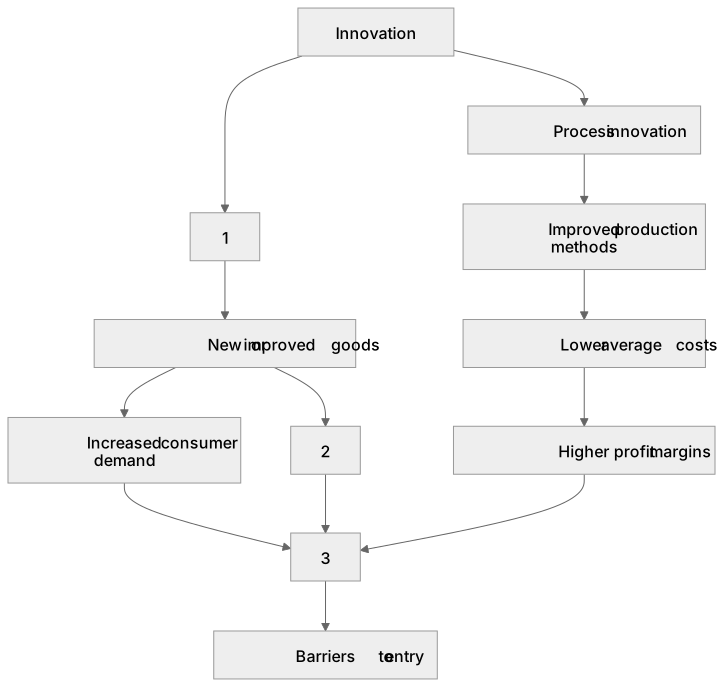
1Box 1
2Box 2
3Box 3
There is more to this lesson
The full lesson goes on to check your understanding and help you earn the marks. Create a free account to carry on, with your progress saved.
A week of Premium from your first lesson · Then the free plan continues · No card, no charge
Test your understanding of Research and development (R&D) and innovation: a) Competitive advantage through innovation
Active recall beats re-reading. Take an instant quiz now to test what you’ve learned and lock it into long-term memory.
A week of Premium from your first lesson · Then the free plan continues · No card, no charge