Pearson Edexcel · A-Level · Economics B
Course version: 9EB0 · Version from Sept 2015
B) Incentive to increase market power
Full specification wording
Research and development (R&D) and innovation: b) Incentive to increase market power
Firms have a strong incentive to increase their market power through research and development and innovation.
Checked against the Pearson Edexcel 9EB0 specification (opens in a new tab) on .
- Point 2 of 5
- 2 key terms
Study notes
From the checked teaching notes for this specification point.
The idea
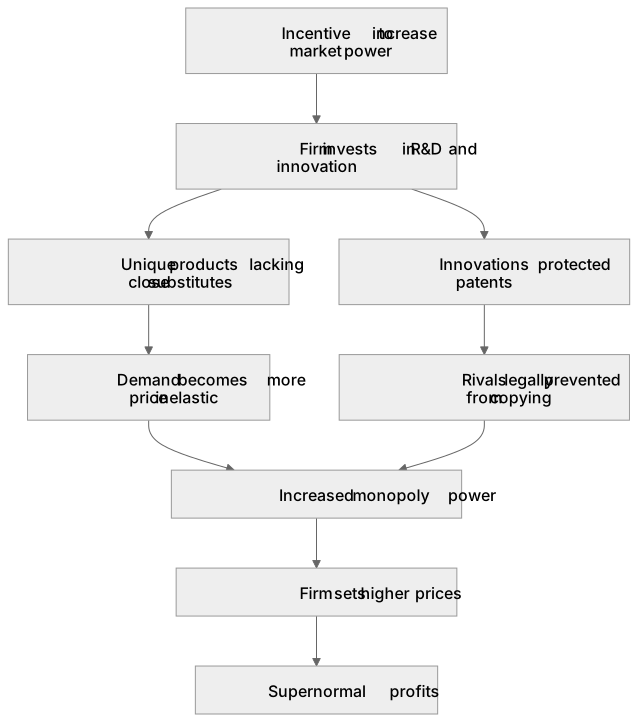
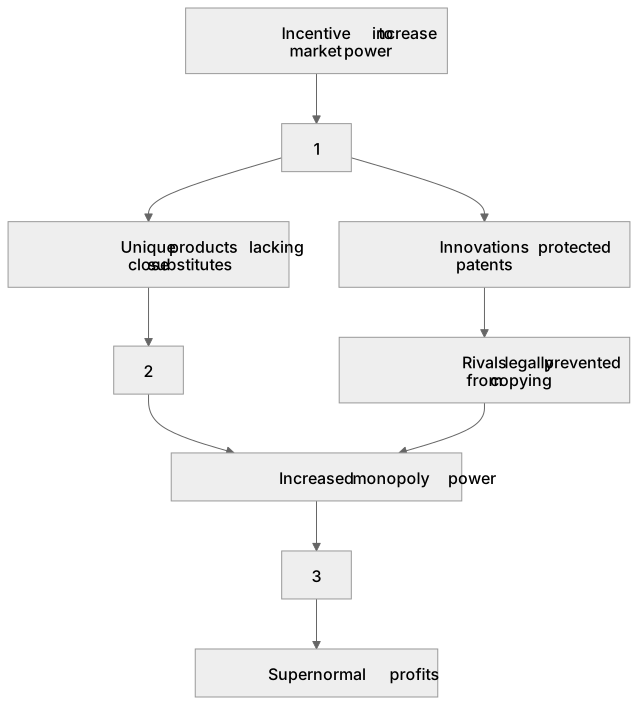
Firms have a strong incentive to increase their market power through research and development and innovation. Market power refers to a firm's ability to influence the price of an item by exercising control over its demand or supply. By innovating, a firm can create unique products that lack close substitutes, thereby reducing price elasticity of demand and increasing its monopoly power. Furthermore, successful innovations can be protected by patents, legally preventing rivals from copying the invention and cementing the firm's dominant market position. For instance, a pharmaceutical company developing a patented new drug gains significant market power, allowing it to set higher prices and earn supernormal profits while the patent lasts.
What earns the marks
- Define market power as the ability of a firm to influence the price and quantity in a market.
- Explain that innovation can reduce the availability of close substitutes, making demand more price inelastic.
- Identify patents and intellectual property rights as legal barriers to entry that enhance market power.
- Describe how increased market power allows firms to earn supernormal profits.
- Recognise that the prospect of gaining market power acts as a primary financial incentive for firms to invest in research and development.
Common mistakes and how to put them right
Equating market power solely with market share.
Put it right: A firm can have high market power in a niche segment without dominating the entire industry.
Assuming patents provide permanent market power.
Put it right: Patents expire, after which market power typically decreases as generic competitors enter.
Overlooking the role of process innovation in market power.
Put it right: Lowering costs can also allow a firm to undercut rivals and gain market control.
Exam tips
- Connect the concept of market power to price elasticity of demand when discussing the effects of unique innovations.
- Discuss patents as a crucial mechanism that translates research and development investment into sustained market power.
- Evaluate whether the pursuit of market power through innovation benefits consumers through better products or harms them through higher prices.
Try the lesson
The start of the Research and development (R&D) and innovation: b) Incentive to increase market power lesson, made from checked teaching notes for this specification point.
Have a go first
What is a primary incentive for a firm to invest heavily in research and development to secure a patent?
Listen
Firms have a strong incentive to increase their market power through research and development and innovation. Market power refers to a firm's ability to influence the price of an item by exercising control over its demand or supply. By innovating, a firm can create unique products that lack close substitutes, thereby reducing price elasticity of demand and increasing its monopoly power. Furthermore, successful innovations can be protected by patents, legally preventing rivals from copying the invention and cementing the firm's dominant market position. For instance, a pharmaceutical company developing a patented new drug gains significant market power, allowing it to set higher prices and earn supernormal profits while the patent lasts. A strong answer earns marks for these points. Define market power as the ability of a firm to influence the price and quantity in a market. Explain that innovation can reduce the availability of close substitutes, making demand more price inelastic. Identify patents and intellectual property rights as legal barriers to entry that enhance market power. Describe how increased market power allows firms to earn supernormal profits. Exam tip: Connect the concept of market power to price elasticity of demand when discussing the effects of unique innovations.
See it
Key words
Say what each word means before you turn the card.
Market power
Try answering aloud or in your head before turning the card.
Patents
Try answering aloud or in your head before turning the card.
See every definition
- Market power
- A firm's ability to influence the price of an item by exercising control over its demand or supply.
- Patents
- Legal protection for successful innovations that prevents rivals from copying the invention.
Label the diagram
Some boxes have lost their names. Pick the right name for each number.
1Box 1
2Box 2
3Box 3
There is more to this lesson
The full lesson goes on to check your understanding and help you earn the marks. Create a free account to carry on, with your progress saved.
A week of Premium from your first lesson · Then the free plan continues · No card, no charge
Test your understanding of Research and development (R&D) and innovation: b) Incentive to increase market power
Active recall beats re-reading. Take an instant quiz now to test what you’ve learned and lock it into long-term memory.
A week of Premium from your first lesson · Then the free plan continues · No card, no charge