Pearson Edexcel · A-Level · Economics B
Course version: 9EB0 · Version from Sept 2015
Research and development (R&D) and innovation: d) Role of state funding
Full specification wording
Research and development (R&D) and innovation: d) Role of state funding
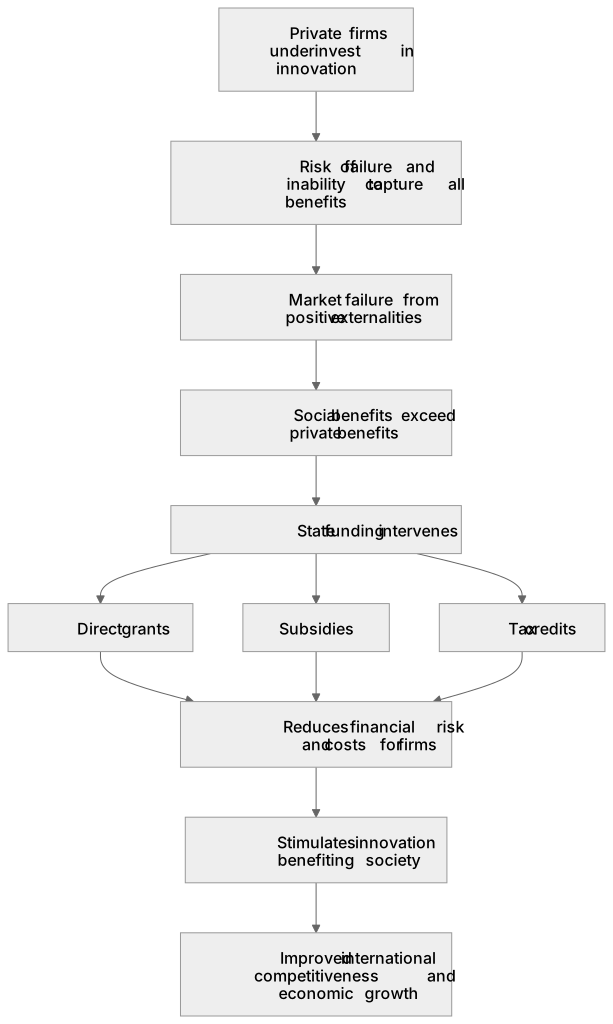
State funding plays a crucial role in research and development because private firms often underinvest in innovation due to the risk of failure and the inability to capture all the benefits.
Checked against the Pearson Edexcel 9EB0 specification (opens in a new tab) on .
- Point 4 of 5
- 4 key terms
Study notes
From the checked teaching notes for this specification point.
The idea
State funding plays a crucial role in research and development because private firms often underinvest in innovation due to the risk of failure and the inability to capture all the benefits. This underinvestment represents a market failure caused by positive externalities, where the social benefits of innovation exceed the private benefits. The state intervenes by providing financial support through direct grants, subsidies, or tax credits to encourage R&D. For example, government grants for renewable energy research lower the financial risk for private firms, stimulating technological advancements that benefit society through reduced carbon emissions, while helping domestic industries remain globally competitive.
What earns the marks
- Explains that state funding is used to correct market failure arising from the positive externalities of research and development.
- Identifies methods of state funding, such as direct government grants, research and development tax credits, and subsidies.
- Evaluates how state funding reduces the financial risk and costs for private firms undertaking long-term innovation projects.
- Links state funding of innovation to broader macroeconomic objectives, such as improved international competitiveness and economic growth.
Common mistakes and how to put them right
Stating that state funding completely eliminates the risk of research and development for private firms.
Put it right: State funding reduces the financial burden, but firms still face commercial risks if the innovation fails in the market.
Confusing state funding with state provision.
Put it right: State funding involves the government providing money to private firms to conduct research, whereas state provision means the government conducts the research itself.
Ignoring the opportunity cost of state funding.
Put it right: Acknowledge that government funds spent on innovation subsidies cannot be used for other public services like healthcare or education.
Exam tips
- Use the concept of positive externalities to justify why state funding for research and development is necessary in a free market.
- Discuss research and development tax credits as a specific mechanism of state funding that incentivises firms by reducing their corporation tax liabilities.
- Evaluate state funding by considering the risk of government failure, such as subsidising inefficient firms or projects with little commercial viability.
Try the lesson
The start of the Research and development (R&D) and innovation: d) Role of state funding lesson, made from checked teaching notes for this specification point.
Have a go first
What is the primary economic rationale for state funding of research and development (R&D) in the private sector?
Listen
State funding plays a crucial role in research and development because private firms often underinvest in innovation due to the risk of failure and the inability to capture all the benefits. This underinvestment represents a market failure caused by positive externalities, where the social benefits of innovation exceed the private benefits. The state intervenes by providing financial support through direct grants, subsidies, or tax credits to encourage R&D. For example, government grants for renewable energy research lower the financial risk for private firms, stimulating technological advancements that benefit society through reduced carbon emissions, while helping domestic industries remain globally competitive. A strong answer earns marks for these points. Explains that state funding is used to correct market failure arising from the positive externalities of research and development. Identifies methods of state funding, such as direct government grants, research and development tax credits, and subsidies. Evaluates how state funding reduces the financial risk and costs for private firms undertaking long-term innovation projects. Links state funding of innovation to broader macroeconomic objectives, such as improved international competitiveness and economic growth. A common slip: Stating that state funding completely eliminates the risk of research and development for private firms. Instead, State funding reduces the financial burden, but firms still face commercial risks if the innovation fails in the market. Exam tip: Use the concept of positive externalities to justify why state funding for research and development is necessary in a free market.
See it
Key words
Say what each word means before you turn the card.
Market failure
Try answering aloud or in your head before turning the card.
Positive externalities
Try answering aloud or in your head before turning the card.
Government intervention
Try answering aloud or in your head before turning the card.
Economic growth
Try answering aloud or in your head before turning the card.
See every definition
- Market failure
- A situation where private firms underinvest in innovation because they cannot capture all the benefits, so the social benefits exceed the private benefits.
- Positive externalities
- Benefits of innovation that extend beyond the private firm to society, causing the social benefits to exceed the private benefits.
- Government intervention
- The state providing financial support through direct grants, subsidies or tax credits to encourage research and development.
- Economic growth
- A broader macroeconomic objective linked to state funding of innovation, alongside improved international competitiveness.
Label the diagram
Some boxes have lost their names. Pick the right name for each number.
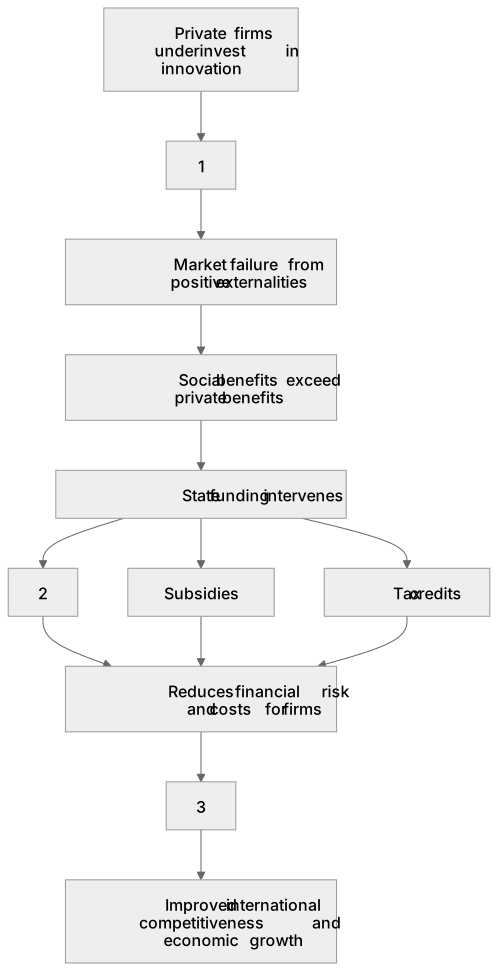
1Box 1
2Box 2
3Box 3
There is more to this lesson
The full lesson goes on to check your understanding and help you earn the marks. Create a free account to carry on, with your progress saved.
A week of Premium from your first lesson · Then the free plan continues · No card, no charge
Test your understanding of Research and development (R&D) and innovation: d) Role of state funding
Active recall beats re-reading. Take an instant quiz now to test what you’ve learned and lock it into long-term memory.
A week of Premium from your first lesson · Then the free plan continues · No card, no charge