Pearson Edexcel · A-Level · Economics B
Course version: 9EB0 · Version from Sept 2015
E) Product life cycle and extension strategies
Full specification wording
Research and development (R&D) and innovation: e) Product life cycle and extension strategies
The product life cycle tracks sales over time through development, introduction, growth, maturity, and decline.
Checked against the Pearson Edexcel 9EB0 specification (opens in a new tab) on .
- Point 5 of 5
- 4 key terms
Study notes
From the checked teaching notes for this specification point.
The idea
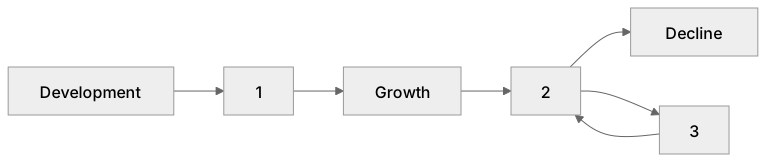
The product life cycle tracks sales over time through development, introduction, growth, maturity, and decline. Development incurs R&D costs with zero sales, causing negative cash flow. Introduction requires high promotional spending. Growth brings rapid sales increases and rising profits. Maturity features peak sales but intense competition. Decline sees falling sales due to market saturation. To delay decline, firms deploy extension strategies to prolong the profitable maturity phase. Examples include product modifications, like adding a better camera to a smartphone, or targeting new geographical markets. These strategies require investment but maximise returns on initial R&D by extending the product's revenue-generating lifespan.
What earns the marks
- Identification of the distinct stages of the product life cycle.
- Explanation of how cash flow, revenue and profit vary across the different stages of the cycle.
- Definition and purpose of extension strategies in prolonging the maturity phase of a product.
- Application of specific extension strategies such as product modification, rebranding or repositioning.
Common mistakes and how to put them right
Confusing the product life cycle with the business cycle.
Put it right: The product life cycle applies to individual goods or services, not the macroeconomic environment.
Assuming extension strategies are implemented during the decline phase.
Put it right: They are most effective when introduced during the maturity phase before sales begin to fall.
Believing that profit is highest during the introduction phase.
Put it right: Profit is typically negative during development and introduction due to high costs and low sales.
Exam tips
- Always link the chosen extension strategy to the specific context of the business provided in the stimulus material.
- Use a diagram of the product life cycle to support your analysis of when an extension strategy should be applied.
- Consider the opportunity cost of investing in an extension strategy versus developing an entirely new product.
Try the lesson
The start of the Research and development (R&D) and innovation: e) Product life cycle and extension strategies lesson, made from checked teaching notes for this specification point.
Have a go first
Which stage of the product life cycle is typically characterised by slowing sales growth and peak market share, often prompting a firm to use extension strategies?
Listen
The product life cycle tracks sales over time through development, introduction, growth, maturity, and decline. Development incurs R&D costs with zero sales, causing negative cash flow. Introduction requires high promotional spending. Growth brings rapid sales increases and rising profits. Maturity features peak sales but intense competition. Decline sees falling sales due to market saturation. To delay decline, firms deploy extension strategies to prolong the profitable maturity phase. Examples include product modifications, like adding a better camera to a smartphone, or targeting new geographical markets. These strategies require investment but maximise returns on initial R&D by extending the product's revenue-generating lifespan. A strong answer earns marks for these points. Identification of the distinct stages of the product life cycle. Explanation of how cash flow, revenue and profit vary across the different stages of the cycle. Definition and purpose of extension strategies in prolonging the maturity phase of a product. Application of specific extension strategies such as product modification, rebranding or repositioning. Exam tip: Always link the chosen extension strategy to the specific context of the business provided in the stimulus material.
See it

Key words
Say what each word means before you turn the card.
Product life cycle
Try answering aloud or in your head before turning the card.
Extension strategies
Try answering aloud or in your head before turning the card.
Development
Try answering aloud or in your head before turning the card.
Maturity
Try answering aloud or in your head before turning the card.
See every definition
- Product life cycle
- Tracks sales over time through development, introduction, growth, maturity, and decline.
- Extension strategies
- Deployed by firms to delay decline and prolong the profitable maturity phase.
- Development
- Incurs R&D costs with zero sales, causing negative cash flow.
- Maturity
- Features peak sales but intense competition.
Label the diagram
Some boxes have lost their names. Pick the right name for each number.
1Box 1
2Box 2
3Box 3
There is more to this lesson
The full lesson goes on to check your understanding and help you earn the marks. Create a free account to carry on, with your progress saved.
A week of Premium from your first lesson · Then the free plan continues · No card, no charge
Test your understanding of Research and development (R&D) and innovation: e) Product life cycle and extension strategies
Active recall beats re-reading. Take an instant quiz now to test what you’ve learned and lock it into long-term memory.
A week of Premium from your first lesson · Then the free plan continues · No card, no charge