Pearson Edexcel · A-Level · Economics B
Course version: 9EB0 · Version from Sept 2015
Responding to global demand: a) Globalisation vs glocalisation
Full specification wording
Responding to global demand: a) Globalisation vs glocalisation
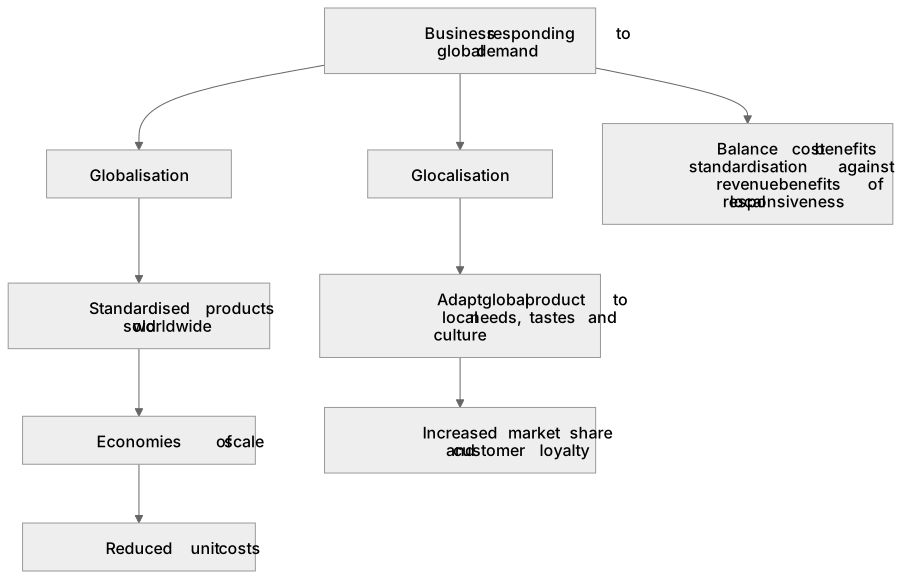
Globalisation refers to the increasing integration of the world's economies, often leading to standardised products being sold worldwide to achieve economies of scale.
Checked against the Pearson Edexcel 9EB0 specification (opens in a new tab) on .
- Point 1 of 4
- 3 key terms
Study notes
From the checked teaching notes for this specification point.
The idea
Globalisation refers to the increasing integration of the world's economies, often leading to standardised products being sold worldwide to achieve economies of scale. In contrast, glocalisation is the adaptation of global products to meet the specific needs, tastes, and cultural expectations of local markets. For example, a multinational fast-food chain might standardise its branding globally (globalisation) but alter its menu to include vegetarian options in India or spicy variations in Mexico (glocalisation). Understanding the tension between these concepts is crucial for businesses responding to global demand, as they must balance the cost benefits of standardisation against the revenue benefits of local responsiveness.
What earns the marks
- Define globalisation as the trend towards a single, integrated and interdependent global economy with standardised products.
- Define glocalisation as adapting a global product or marketing strategy to fit local cultural tastes and preferences.
- Identify that globalisation allows firms to exploit significant economies of scale and reduce unit costs.
- Explain that glocalisation can increase market share and customer loyalty in diverse regions by satisfying specific local demand.
Common mistakes and how to put them right
Confusing the two terms.
Put it right: Globalisation focuses on uniformity, whereas glocalisation focuses on local adaptation.
Assuming glocalisation means abandoning global branding.
Put it right: Glocalisation maintains the global brand identity while tweaking specific product features or marketing messages.
Believing globalisation always guarantees higher profits.
Put it right: Standardisation might fail if local cultural preferences are ignored, making glocalisation necessary for revenue growth.
Exam tips
- Use a clear example, such as a global menu adaptation, to illustrate glocalisation in multiple-choice or short-answer questions.
- When evaluating a firm's strategy, weigh the cost savings of globalisation against the potential sales growth from glocalisation.
- Read case study contexts carefully to identify whether a firm is struggling due to a lack of local adaptation.
Try the lesson
The start of the Responding to global demand: a) Globalisation vs glocalisation lesson, made from checked teaching notes for this specification point.
Have a go first
Which of the following best describes the business strategy of glocalisation?
Listen
Globalisation refers to the increasing integration of the world's economies, often leading to standardised products being sold worldwide to achieve economies of scale. In contrast, glocalisation is the adaptation of global products to meet the specific needs, tastes, and cultural expectations of local markets. For example, a multinational fast-food chain might standardise its branding globally (globalisation) but alter its menu to include vegetarian options in India or spicy variations in Mexico (glocalisation). Understanding the tension between these concepts is crucial for businesses responding to global demand, as they must balance the cost benefits of standardisation against the revenue benefits of local responsiveness. A strong answer earns marks for these points. Define globalisation as the trend towards a single, integrated and interdependent global economy with standardised products. Define glocalisation as adapting a global product or marketing strategy to fit local cultural tastes and preferences. Identify that globalisation allows firms to exploit significant economies of scale and reduce unit costs. Explain that glocalisation can increase market share and customer loyalty in diverse regions by satisfying specific local demand. A common slip: Confusing the two terms. Instead, globalisation focuses on uniformity, whereas glocalisation focuses on local adaptation. Exam tip: Use a clear example, such as a global menu adaptation, to illustrate glocalisation in multiple-choice or short-answer questions.
See it
Key words
Say what each word means before you turn the card.
Globalisation
Try answering aloud or in your head before turning the card.
Glocalisation
Try answering aloud or in your head before turning the card.
Economies of scale
Try answering aloud or in your head before turning the card.
See every definition
- Globalisation
- The increasing integration of the world's economies, often leading to standardised products being sold worldwide to achieve economies of scale.
- Glocalisation
- The adaptation of global products to meet the specific needs, tastes, and cultural expectations of local markets.
- Economies of scale
- Cost benefits that firms can exploit through standardisation, reducing unit costs.
Label the diagram
Some boxes have lost their names. Pick the right name for each number.
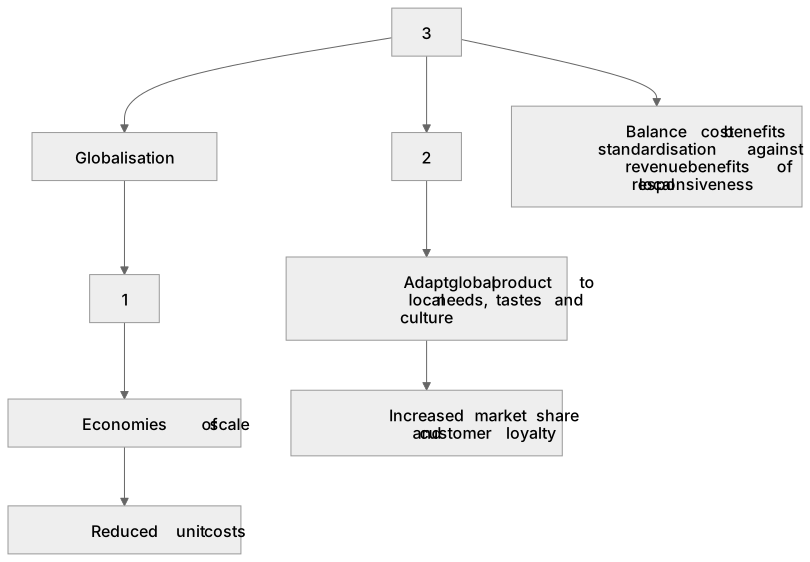
1Box 1
2Box 2
3Box 3
There is more to this lesson
The full lesson goes on to check your understanding and help you earn the marks. Create a free account to carry on, with your progress saved.
A week of Premium from your first lesson · Then the free plan continues · No card, no charge
Test your understanding of Responding to global demand: a) Globalisation vs glocalisation
Active recall beats re-reading. Take an instant quiz now to test what you’ve learned and lock it into long-term memory.
A week of Premium from your first lesson · Then the free plan continues · No card, no charge