Pearson Edexcel · A-Level · Economics B
Course version: 9EB0 · Version from Sept 2015
B) Different approaches to global markets: o domestic/ethnocentric o…
Full specification wording
Responding to global demand: b) Different approaches to global markets: o domestic/ethnocentric o mixed/geocentric o international/polycentric
Businesses adopt different approaches to global markets based on their strategic orientation.
Checked against the Pearson Edexcel 9EB0 specification (opens in a new tab) on .
- Point 2 of 4
- 3 key terms
Study notes
From the checked teaching notes for this specification point.
The idea
Businesses adopt different approaches to global markets based on their strategic orientation. A domestic or ethnocentric approach assumes what works in the home market will work globally, leading to standardised products and centralised decision-making. An international or polycentric approach recognises each market is unique, resulting in adapted products and decentralised control given to local subsidiaries. A mixed or geocentric approach seeks a balance, aiming for global integration while remaining locally responsive, often summarised as 'think global, act local'.
For example: An ethnocentric firm might sell identical software worldwide, whereas a geocentric firm uses a standard core platform but offers localised user interfaces.
What earns the marks
- Identify the ethnocentric (domestic) approach as one where overseas markets are seen as secondary and products are not adapted.
- Identify the polycentric (international) approach as one where host-country markets are treated as unique, requiring significant product adaptation.
- Identify the geocentric (mixed) approach as a global strategy that integrates both standardisation and local responsiveness.
- Link the ethnocentric approach to centralised decision-making and the polycentric approach to decentralised decision-making.
Common mistakes and how to put them right
Mixing up polycentric and geocentric approaches.
Put it right: Polycentric focuses heavily on local differences (decentralised), while geocentric seeks a global standard with local variations (integrated).
Assuming ethnocentric means only selling domestically.
Put it right: Ethnocentric firms do sell internationally, but they use their domestic strategies and products to do so.
Believing one approach is universally best.
Put it right: The best approach depends on the product type, market conditions, and the firm's resources.
Exam tips
- Memorise the EPRG framework terms (Ethnocentric, Polycentric, Geocentric) as they frequently appear as distractors in multiple-choice questions.
- Look for clues about decision-making power in a case study to identify the approach: headquarters control suggests ethnocentric, while local manager autonomy suggests polycentric.
- Connect the geocentric approach directly to the concept of glocalisation when analysing a firm's global strategy.
Try the lesson
The start of the Responding to global demand: b) Different approaches to global markets: o domestic/ethnocentric o mixed/geocentric o international/polycentric lesson, made from checked teaching notes for this specification point.
Have a go first
In the context of global marketing approaches, what is the defining characteristic of an ethnocentric (domestic) strategy?
Listen
Businesses adopt different approaches to global markets based on their strategic orientation. A domestic or ethnocentric approach assumes what works in the home market will work globally, leading to standardised products and centralised decision-making. An international or polycentric approach recognises each market is unique, resulting in adapted products and decentralised control given to local subsidiaries. A mixed or geocentric approach seeks a balance, aiming for global integration while remaining locally responsive, often summarised as 'think global, act local'. For example, an ethnocentric firm might sell identical software worldwide, whereas a geocentric firm uses a standard core platform but offers localised user interfaces. A strong answer earns marks for these points. Identify the ethnocentric (domestic) approach as one where overseas markets are seen as secondary and products are not adapted. Identify the polycentric (international) approach as one where host-country markets are treated as unique, requiring significant product adaptation. Identify the geocentric (mixed) approach as a global strategy that integrates both standardisation and local responsiveness. Link the ethnocentric approach to centralised decision-making and the polycentric approach to decentralised decision-making. A common slip: Mixing up polycentric and geocentric approaches. Instead, polycentric focuses heavily on local differences (decentralised), while geocentric seeks a global standard with local variations (integrated). Exam tip: Memorise the EPRG framework terms (Ethnocentric, Polycentric, Geocentric) as they frequently appear as distractors in multiple-choice questions.
See it

Key words
Say what each word means before you turn the card.
Ethnocentric approach
Try answering aloud or in your head before turning the card.
Polycentric approach
Try answering aloud or in your head before turning the card.
Geocentric approach
Try answering aloud or in your head before turning the card.
See every definition
- Ethnocentric approach
- A domestic approach that assumes what works in the home market will work globally, leading to standardised products and centralised decision-making.
- Polycentric approach
- An international approach that recognises each market is unique, resulting in adapted products and decentralised control given to local subsidiaries.
- Geocentric approach
- A mixed approach that seeks a balance, aiming for global integration while remaining locally responsive, often summarised as 'think global, act local'.
Label the diagram
Some boxes have lost their names. Pick the right name for each number.
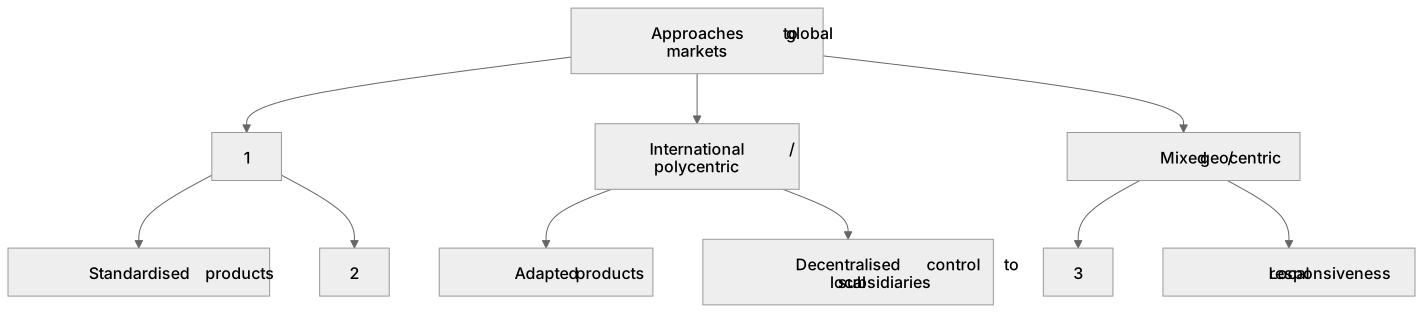
1Box 1
2Box 2
3Box 3
There is more to this lesson
The full lesson goes on to check your understanding and help you earn the marks. Create a free account to carry on, with your progress saved.
A week of Premium from your first lesson · Then the free plan continues · No card, no charge
Test your understanding of Responding to global demand: b) Different approaches to global markets: o domestic/ethnocentric o mixed/geocentric o international/polycentric
Active recall beats re-reading. Take an instant quiz now to test what you’ve learned and lock it into long-term memory.
A week of Premium from your first lesson · Then the free plan continues · No card, no charge