Pearson Edexcel · A-Level · Economics B
Course version: 9EB0 · Version from Sept 2015
Risk and liability: a) The meaning of risk
Risk in a business context refers to the possibility that an enterprise will have lower than anticipated profits or experience a loss rather than taking a profit.
Checked against the Pearson Edexcel 9EB0 specification (opens in a new tab) on .
- Point 1 of 2
- 3 key terms
Study notes
From the checked teaching notes for this specification point.
The idea
Risk in a business context refers to the possibility that an enterprise will have lower than anticipated profits or experience a loss rather than taking a profit. It involves quantifiable probabilities of different outcomes occurring. For example, a business launching a new product faces the risk that consumer demand will be lower than expected, which can be estimated using market research data. Unlike uncertainty, which involves unpredictable events with unknown probabilities (such as a sudden global pandemic), risk can often be measured, managed, and mitigated through strategies like insurance, diversification, or careful financial planning. Understanding risk is essential for entrepreneurs when making investment decisions, as they must weigh the potential financial returns against the probability of losing their invested capital.
What earns the marks
- Define risk as the quantifiable probability of a negative outcome or financial loss occurring.
- Distinguish between risk (quantifiable) and uncertainty (unquantifiable).
- Identify examples of business risks, such as changing consumer tastes or competitor actions.
- Explain that entrepreneurs take on risk in expectation of a financial reward or profit.
Common mistakes and how to put them right
Confusing risk with uncertainty.
Put it right: Risk involves outcomes with measurable probabilities, whereas uncertainty involves unpredictable events where probabilities cannot be calculated.
Assuming all risks are unmanageable.
Put it right: Many business risks can be quantified and mitigated through strategies like insurance or diversification.
Believing risk only applies to new businesses.
Put it right: Established businesses also face ongoing risks, such as market changes or operational failures.
Exam tips
- When defining risk, always mention that it involves quantifiable probabilities.
- Use a brief, concrete example, such as the risk of a new product failing, to illustrate your definition.
- Be prepared to distinguish risk from uncertainty in multiple-choice questions.
Try the lesson
The start of the Risk and liability: a) The meaning of risk lesson, made from checked teaching notes for this specification point.
Have a go first
Which of the following best describes the economic meaning of risk for a business?
Listen
Risk in a business context refers to the possibility that an enterprise will have lower than anticipated profits or experience a loss rather than taking a profit. It involves quantifiable probabilities of different outcomes occurring. For example, a business launching a new product faces the risk that consumer demand will be lower than expected, which can be estimated using market research data. Unlike uncertainty, which involves unpredictable events with unknown probabilities (such as a sudden global pandemic), risk can often be measured, managed, and mitigated through strategies like insurance, diversification, or careful financial planning. Understanding risk is essential for entrepreneurs when making investment decisions, as they must weigh the potential financial returns against the probability of losing their invested capital. A strong answer earns marks for these points. Define risk as the quantifiable probability of a negative outcome or financial loss occurring. Distinguish between risk (quantifiable) and uncertainty (unquantifiable). Identify examples of business risks, such as changing consumer tastes or competitor actions. Explain that entrepreneurs take on risk in expectation of a financial reward or profit. A common slip: Confusing risk with uncertainty. Instead, Risk involves outcomes with measurable probabilities, whereas uncertainty involves unpredictable events where probabilities cannot be calculated. Exam tip: When defining risk, always mention that it involves quantifiable probabilities.
See it
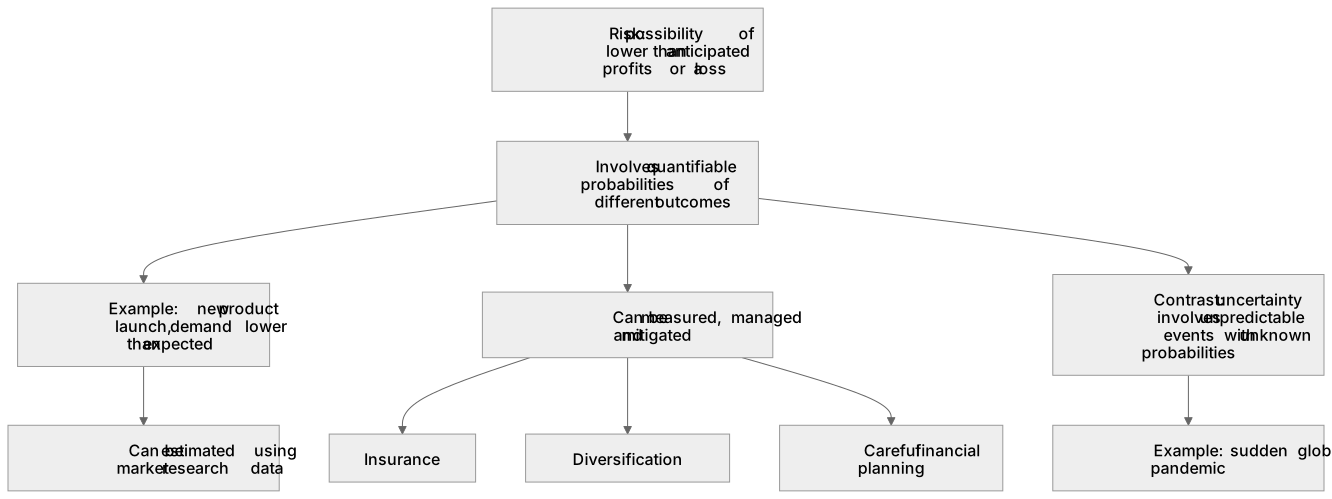
Key words
Say what each word means before you turn the card.
Risk
Try answering aloud or in your head before turning the card.
Uncertainty
Try answering aloud or in your head before turning the card.
Entrepreneurs
Try answering aloud or in your head before turning the card.
See every definition
- Risk
- The possibility that an enterprise will have lower than anticipated profits or experience a loss rather than taking a profit, involving quantifiable probabilities of different outcomes occurring.
- Uncertainty
- Involves unpredictable events with unknown probabilities, such as a sudden global pandemic, unlike risk which can often be measured and managed.
- Entrepreneurs
- Those who take on risk when making investment decisions, weighing potential financial returns against the probability of losing their invested capital.
Label the diagram
Some boxes have lost their names. Pick the right name for each number.
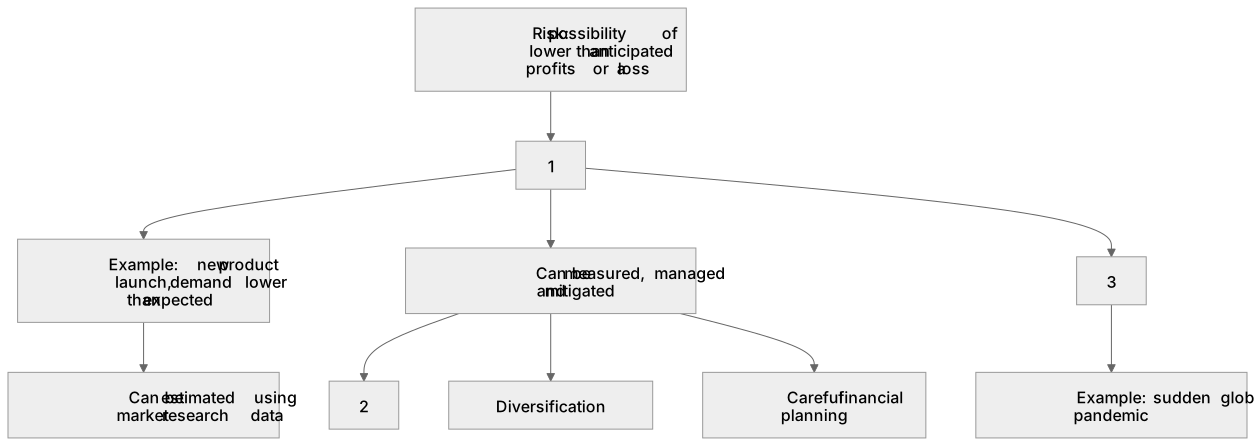
1Box 1
2Box 2
3Box 3
There is more to this lesson
The full lesson goes on to check your understanding and help you earn the marks. Create a free account to carry on, with your progress saved.
A week of Premium from your first lesson · Then the free plan continues · No card, no charge
Test your understanding of Risk and liability: a) The meaning of risk
Active recall beats re-reading. Take an instant quiz now to test what you’ve learned and lock it into long-term memory.
A week of Premium from your first lesson · Then the free plan continues · No card, no charge