Pearson Edexcel · A-Level · Economics B
Course version: 9EB0 · Version from Sept 2015
Risk and liability: b) Implications of limited and unlimited liability
Liability determines the extent to which owners are responsible for business debts.
Checked against the Pearson Edexcel 9EB0 specification (opens in a new tab) on .
- Point 2 of 2
- 3 key terms
Study notes
From the checked teaching notes for this specification point.
The idea
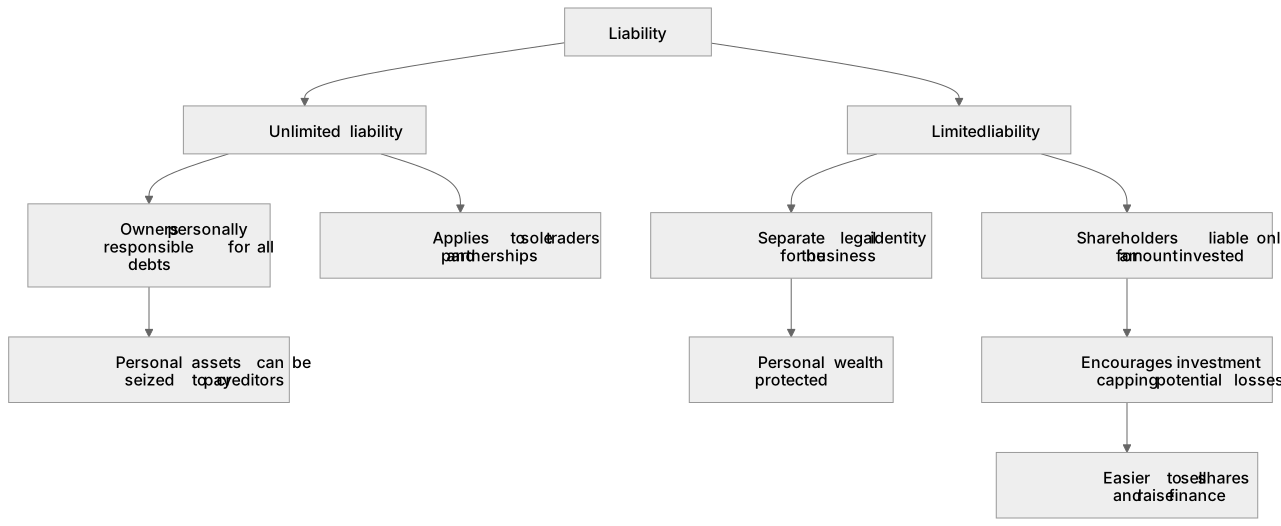
Liability determines the extent to which owners are responsible for business debts. Unlimited liability means owners are personally responsible for all debts; if the business fails, personal assets like their home can be seized to pay creditors. This applies to sole traders and partnerships. Conversely, limited liability creates a separate legal identity for the business. Shareholders are only liable for the amount invested in their shares, protecting personal wealth. This affects risk-taking and raising finance. Limited liability encourages investment by capping potential losses, making it easier to sell shares, whereas unlimited liability exposes owners to severe financial risk but is simpler and cheaper to establish.
What earns the marks
- Define unlimited liability as the owner being personally responsible for all business debts.
- Define limited liability as investors only losing the amount they have invested in the business.
- Explain that limited liability applies to incorporated businesses (private and public limited companies).
- Analyse how limited liability makes it easier to raise share capital due to reduced risk for investors.
- Evaluate the impact of unlimited liability on the personal financial risk of sole traders and partners.
Common mistakes and how to put them right
Stating that limited liability means the business has no debts.
Put it right: The business still owes the debts, but the shareholders' personal assets are protected if the business cannot pay.
Confusing the types of businesses that have limited liability.
Put it right: Sole traders and partnerships have unlimited liability, while Ltds and PLCs have limited liability.
Assuming limited liability protects against illegal activities.
Put it right: Directors can still face personal legal consequences and financial penalties if they trade wrongfully or commit fraud.
Exam tips
- Clearly link the concept of limited liability to the legal separation between the owners and the business (incorporation).
- When discussing the implications of liability, focus on how it affects the ability to raise finance and the level of risk taken by owners.
- Remember that unlimited liability is a major disadvantage for sole traders when evaluating business structures.
Try the lesson
The start of the Risk and liability: b) Implications of limited and unlimited liability lesson, made from checked teaching notes for this specification point.
Have a go first
What is the primary implication of a business owner having unlimited liability?
Listen
Liability determines the extent to which owners are responsible for business debts. Unlimited liability means owners are personally responsible for all debts; if the business fails, personal assets like their home can be seized to pay creditors. This applies to sole traders and partnerships. Conversely, limited liability creates a separate legal identity for the business. Shareholders are only liable for the amount invested in their shares, protecting personal wealth. This affects risk-taking and raising finance. Limited liability encourages investment by capping potential losses, making it easier to sell shares, whereas unlimited liability exposes owners to severe financial risk but is simpler and cheaper to establish. A strong answer earns marks for these points. Define unlimited liability as the owner being personally responsible for all business debts. Define limited liability as investors only losing the amount they have invested in the business. Explain that limited liability applies to incorporated businesses (private and public limited companies). Analyse how limited liability makes it easier to raise share capital due to reduced risk for investors. A common slip: Stating that limited liability means the business has no debts. Instead, The business still owes the debts, but the shareholders' personal assets are protected if the business cannot pay. Exam tip: Clearly link the concept of limited liability to the legal separation between the owners and the business (incorporation).
See it
Key words
Say what each word means before you turn the card.
Unlimited liability
Try answering aloud or in your head before turning the card.
Limited liability
Try answering aloud or in your head before turning the card.
Legal incorporation
Try answering aloud or in your head before turning the card.
See every definition
- Unlimited liability
- Owners are personally responsible for all business debts, so personal assets like their home can be seized to pay creditors if the business fails.
- Limited liability
- The business has a separate legal identity, so shareholders are only liable for the amount invested in their shares, protecting personal wealth.
- Legal incorporation
- Creates a separate legal identity for the business, which applies to incorporated businesses such as private and public limited companies.
Label the diagram
Some boxes have lost their names. Pick the right name for each number.

1Box 1
2Box 2
3Box 3
There is more to this lesson
The full lesson goes on to check your understanding and help you earn the marks. Create a free account to carry on, with your progress saved.
A week of Premium from your first lesson · Then the free plan continues · No card, no charge
Test your understanding of Risk and liability: b) Implications of limited and unlimited liability
Active recall beats re-reading. Take an instant quiz now to test what you’ve learned and lock it into long-term memory.
A week of Premium from your first lesson · Then the free plan continues · No card, no charge