Pearson Edexcel · A-Level · Economics B
Course version: 9EB0 · Version from Sept 2015
Role of banks in the economy: a) Channelling savings towards investment
Full specification wording
Role of banks in the economy: a) Channelling savings towards investment
Banks play a crucial intermediary role in the economy by channelling funds from surplus units (savers) to deficit units (borrowers).
Checked against the Pearson Edexcel 9EB0 specification (opens in a new tab) on .
- Point 1 of 3
- 4 key terms
Study notes
From the checked teaching notes for this specification point.
The idea
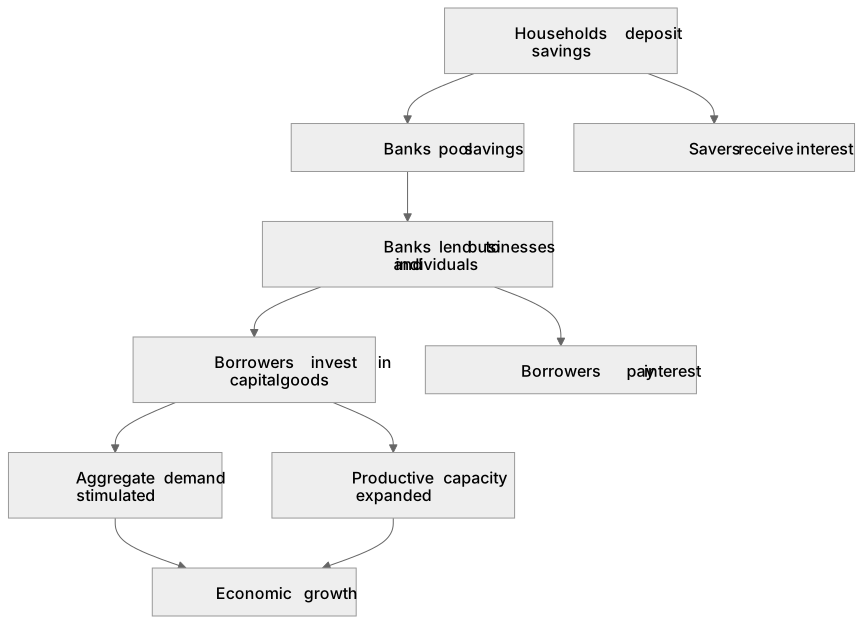
Banks play a crucial intermediary role in the economy by channelling funds from surplus units (savers) to deficit units (borrowers). When households deposit savings into bank accounts, they seek financial security and a return via interest payments. Banks pool these accumulated savings and lend them out as loans to businesses and individuals requiring capital for investment. For example, a manufacturing firm might borrow these funds to purchase new machinery or expand its operations. This process of financial intermediation is vital for economic growth; it ensures that idle resources are allocated efficiently to productive investments, thereby stimulating aggregate demand and expanding the economy's productive capacity.
What earns the marks
- Explain the role of banks as financial intermediaries that bridge the gap between savers and borrowers.
- Describe how banks pool small savings deposits from households to create large loans for business investment.
- Identify that savers receive interest as a reward for depositing funds, while borrowers pay interest for access to capital.
- Link the channelling of savings into investment to the stimulation of economic growth and aggregate demand.
- Recognise that this intermediation process involves risk transformation, as banks manage the risk of default on behalf of depositors.
Common mistakes and how to put them right
Stating that banks only store money safely.
Put it right: Banks actively lend out the majority of deposited funds to generate returns and facilitate investment.
Confusing saving with investment.
Put it right: Saving is foregoing current consumption, whereas investment is expenditure on capital goods by firms.
Assuming banks lend out all of their deposits.
Put it right: Banks must hold a fraction of deposits as liquid reserves to meet daily withdrawal demands.
Exam tips
- Clearly distinguish between the economic definitions of saving by households and investment by firms in your answers.
- Use the term 'financial intermediation' to demonstrate a precise understanding of the bank's role in the economy.
- Connect the bank's lending function to broader macroeconomic objectives, such as economic growth and employment.
Try the lesson
The start of the Role of banks in the economy: a) Channelling savings towards investment lesson, made from checked teaching notes for this specification point.
Have a go first
What is the primary mechanism by which commercial banks channel savings towards investment in the economy?
Listen
Banks play a crucial intermediary role in the economy by channelling funds from surplus units (savers) to deficit units (borrowers). When households deposit savings into bank accounts, they seek financial security and a return via interest payments. Banks pool these accumulated savings and lend them out as loans to businesses and individuals requiring capital for investment. For example, a manufacturing firm might borrow these funds to purchase new machinery or expand its operations. This process of financial intermediation is vital for economic growth; it ensures that idle resources are allocated efficiently to productive investments, thereby stimulating aggregate demand and expanding the economy's productive capacity. A strong answer earns marks for these points. Explain the role of banks as financial intermediaries that bridge the gap between savers and borrowers. Describe how banks pool small savings deposits from households to create large loans for business investment. Identify that savers receive interest as a reward for depositing funds, while borrowers pay interest for access to capital. Link the channelling of savings into investment to the stimulation of economic growth and aggregate demand. A common slip: Stating that banks only store money safely. Instead, banks actively lend out the majority of deposited funds to generate returns and facilitate investment. Exam tip: Clearly distinguish between the economic definitions of saving by households and investment by firms in your answers.
See it
Key words
Say what each word means before you turn the card.
Financial intermediation
Try answering aloud or in your head before turning the card.
Economic growth
Try answering aloud or in your head before turning the card.
Risk transformation
Try answering aloud or in your head before turning the card.
Saving
Try answering aloud or in your head before turning the card.
See every definition
- Financial intermediation
- The process by which banks pool accumulated savings and lend them out as loans to businesses and individuals requiring capital for investment.
- Economic growth
- Stimulated when idle resources are allocated efficiently to productive investments, thereby stimulating aggregate demand and expanding the economy's productive capacity.
- Risk transformation
- Part of the intermediation process in which banks manage the risk of default on behalf of depositors.
- Saving
- Foregoing current consumption, as when households deposit savings into bank accounts seeking financial security and a return via interest payments.
Label the diagram
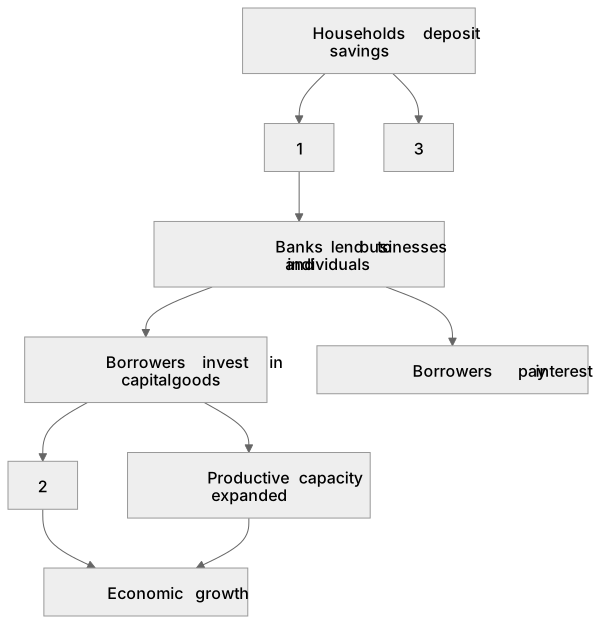
Some boxes have lost their names. Pick the right name for each number.
1Box 1
2Box 2
3Box 3
There is more to this lesson
The full lesson goes on to check your understanding and help you earn the marks. Create a free account to carry on, with your progress saved.
A week of Premium from your first lesson · Then the free plan continues · No card, no charge
Test your understanding of Role of banks in the economy: a) Channelling savings towards investment
Active recall beats re-reading. Take an instant quiz now to test what you’ve learned and lock it into long-term memory.
A week of Premium from your first lesson · Then the free plan continues · No card, no charge