Pearson Edexcel · A-Level · Economics B
Course version: 9EB0 · Version from Sept 2015
Role of banks in the economy: b) Role of banks in providing credit
Full specification wording
Role of banks in the economy: b) Role of banks in providing credit
Banks play a fundamental role in the economy by providing credit, which allows economic agents to borrow funds.
Checked against the Pearson Edexcel 9EB0 specification (opens in a new tab) on .
- Point 2 of 3
- 4 key terms
Study notes
From the checked teaching notes for this specification point.
The idea
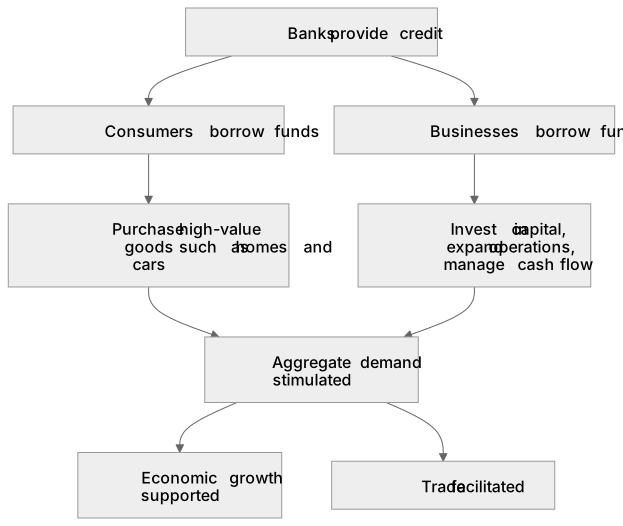
Banks play a fundamental role in the economy by providing credit, which allows economic agents to borrow funds. By providing credit, banks enable consumers to purchase high-value goods, such as homes or cars, and allow businesses to invest in capital, expand operations, and manage cash flow. For example, a commercial bank might issue a business loan for new machinery. This provision of credit stimulates aggregate demand, supports economic growth, and facilitates trade. Without banks providing credit, economic activity would be severely constrained, as economic agents would have to rely solely on their own savings to fund expenditure and investment.
What earns the marks
- Banks provide credit to consumers, facilitating the purchase of expensive items like houses (mortgages) and cars.
- Credit provision allows businesses to finance investment, manage cash flow, and fund expansion.
- The provision of credit stimulates aggregate demand and supports economic growth.
- Commercial banks create credit when they issue loans, which simultaneously creates matching deposits.
Common mistakes and how to put them right
Assuming banks only lend out the exact amount of money deposited by savers.
Put it right: In reality, commercial banks create credit and new deposits when they issue loans to borrowers.
Confusing the role of commercial banks with the central bank.
Put it right: Commercial banks provide credit to consumers and businesses, whereas the central bank provides liquidity to commercial banks and sets the base interest rate.
Believing credit only benefits the borrower.
Put it right: Credit provision benefits the wider economy by stimulating aggregate demand, creating jobs, and generating tax revenue.
Exam tips
- When evaluating the role of banks, consider the impact of credit availability on both consumer spending and business investment.
- Use specific examples of credit, such as overdrafts, mortgages, or business loans, to illustrate your points.
- Remember to link the provision of credit to macroeconomic objectives like economic growth and employment.
Try the lesson
The start of the Role of banks in the economy: b) Role of banks in providing credit lesson, made from checked teaching notes for this specification point.
Have a go first
Which of the following best describes the primary function of a commercial bank when it provides credit to a business?
Listen
Banks play a fundamental role in the economy by providing credit, which allows economic agents to borrow funds. By providing credit, banks enable consumers to purchase high-value goods, such as homes or cars, and allow businesses to invest in capital, expand operations, and manage cash flow. For example, a commercial bank might issue a business loan for new machinery. This provision of credit stimulates aggregate demand, supports economic growth, and facilitates trade. Without banks providing credit, economic activity would be severely constrained, as economic agents would have to rely solely on their own savings to fund expenditure and investment. A strong answer earns marks for these points. Banks provide credit to consumers, facilitating the purchase of expensive items like houses (mortgages) and cars. Credit provision allows businesses to finance investment, manage cash flow, and fund expansion. The provision of credit stimulates aggregate demand and supports economic growth. Commercial banks create credit when they issue loans, which simultaneously creates matching deposits. A common slip: Assuming banks only lend out the exact amount of money deposited by savers. Instead, In reality, commercial banks create credit and new deposits when they issue loans to borrowers. Exam tip: When evaluating the role of banks, consider the impact of credit availability on both consumer spending and business investment.
See it
Key words
Say what each word means before you turn the card.
Credit provision
Try answering aloud or in your head before turning the card.
Consumer spending
Try answering aloud or in your head before turning the card.
Business investment
Try answering aloud or in your head before turning the card.
Economic growth
Try answering aloud or in your head before turning the card.
See every definition
- Credit provision
- Banks providing credit allows economic agents to borrow funds, enabling consumers to purchase high-value goods and businesses to invest in capital, expand operations and manage cash flow.
- Consumer spending
- Spending by consumers that banks facilitate by providing credit, allowing the purchase of expensive items like houses and cars.
- Business investment
- Financing of investment by businesses through credit, allowing them to invest in capital, expand operations and manage cash flow.
- Economic growth
- Supported by the provision of credit, which stimulates aggregate demand and facilitates trade.
Label the diagram
Some boxes have lost their names. Pick the right name for each number.
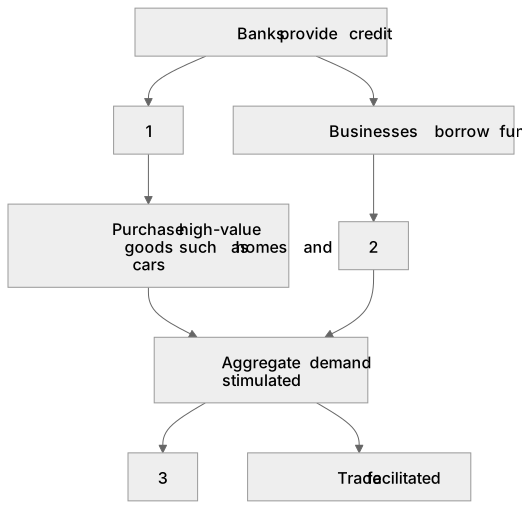
1Box 1
2Box 2
3Box 3
There is more to this lesson
The full lesson goes on to check your understanding and help you earn the marks. Create a free account to carry on, with your progress saved.
A week of Premium from your first lesson · Then the free plan continues · No card, no charge
Test your understanding of Role of banks in the economy: b) Role of banks in providing credit
Active recall beats re-reading. Take an instant quiz now to test what you’ve learned and lock it into long-term memory.
A week of Premium from your first lesson · Then the free plan continues · No card, no charge