Pearson Edexcel · A-Level · Economics B
Course version: 9EB0 · Version from Sept 2015
A) Division of labour: advantages and disadvantages to employers and…
Full specification wording
Specialisation: a) Division of labour: advantages and disadvantages to employers and employees
The division of labour occurs when a production process is broken down into individual tasks, with each worker assigned a specific role.
Checked against the Pearson Edexcel 9EB0 specification (opens in a new tab) on .
- Point 1 of 2
Study notes
From the checked teaching notes for this specification point.
The idea
The division of labour occurs when a production process is broken down into individual tasks, with each worker assigned a specific role. For employers, this increases productivity and lowers average costs because workers become highly skilled at their task and less time is wasted switching between tools. However, employers may face high staff turnover and absenteeism if repetitive work causes boredom. For employees, it reduces training time and allows them to focus on tasks suited to their abilities, potentially leading to higher wages. Conversely, employees may suffer from monotony, a lack of job satisfaction, and the risk of structural unemployment if their narrow skill set becomes obsolete due to automation.
What earns the marks
- Define division of labour as breaking down a production process into separate, sequenced tasks.
- Identify increased productivity and reduced unit costs as primary advantages for employers.
- Explain that employee boredom from repetitive tasks can lead to lower quality output and higher absenteeism for employers.
- Recognise that employees benefit from shorter training periods and the ability to master a specific skill.
- State that employees face the disadvantage of deskilling or structural unemployment if their specific task is automated.
Common mistakes and how to put them right
Confusing division of labour with specialisation at a national level.
Put it right by focusing on the breakdown of tasks within a specific production process.
Assuming division of labour always increases employee motivation.
Put it right by explaining that highly repetitive tasks often lead to boredom and demotivation.
Stating that division of labour increases training costs.
Put it right by noting that training costs usually fall because workers only need to learn one specific task.
Exam tips
- Always distinguish clearly between the impacts on the employer, such as unit costs, and the employee, such as job satisfaction.
- Use Adam Smith's pin factory as a classic example to illustrate how dividing tasks increases total output.
- Link the disadvantage of employee boredom to tangible employer costs, such as increased waste or higher recruitment costs due to staff turnover.
Try the lesson
The start of the Specialisation: a) Division of labour: advantages and disadvantages to employers and employees lesson, made from checked teaching notes for this specification point.
Have a go first
Which of the following is a primary disadvantage of the division of labour for an employee?
Listen
The division of labour occurs when a production process is broken down into individual tasks, with each worker assigned a specific role. For employers, this increases productivity and lowers average costs because workers become highly skilled at their task and less time is wasted switching between tools. However, employers may face high staff turnover and absenteeism if repetitive work causes boredom. For employees, it reduces training time and allows them to focus on tasks suited to their abilities, potentially leading to higher wages. Conversely, employees may suffer from monotony, a lack of job satisfaction, and the risk of structural unemployment if their narrow skill set becomes obsolete due to automation. A strong answer earns marks for these points. Define division of labour as breaking down a production process into separate, sequenced tasks. Identify increased productivity and reduced unit costs as primary advantages for employers. Explain that employee boredom from repetitive tasks can lead to lower quality output and higher absenteeism for employers. Recognise that employees benefit from shorter training periods and the ability to master a specific skill. A common slip: Confusing division of labour with specialisation at a national level. Instead, focusing on the breakdown of tasks within a specific production process. Exam tip: Always distinguish clearly between the impacts on the employer, such as unit costs, and the employee, such as job satisfaction.
See it
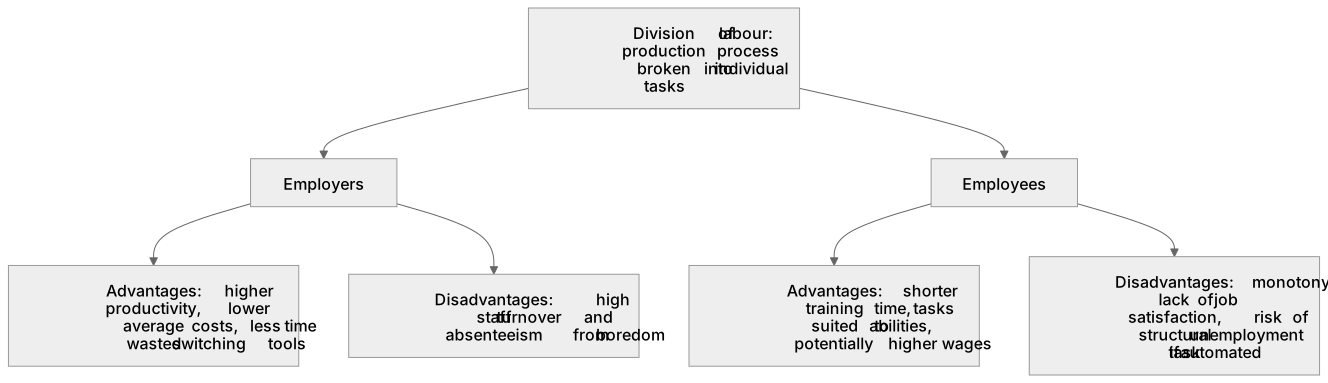
Label the diagram
Some boxes have lost their names. Pick the right name for each number.
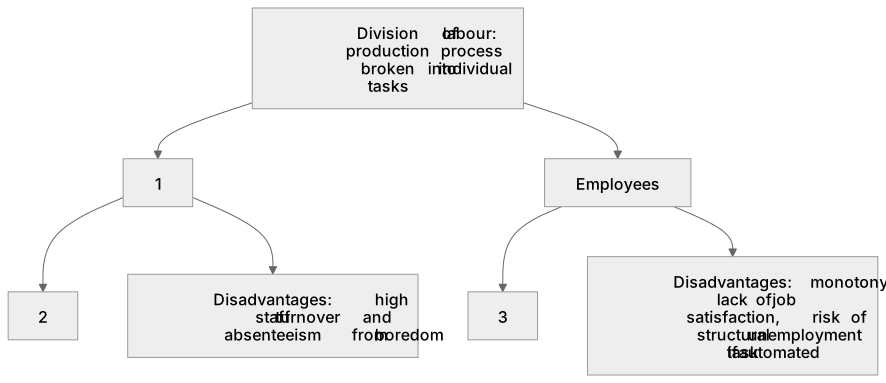
1Box 1
2Box 2
3Box 3
There is more to this lesson
The full lesson goes on to check your understanding and help you earn the marks. Create a free account to carry on, with your progress saved.
A week of Premium from your first lesson · Then the free plan continues · No card, no charge
Test your understanding of Specialisation: a) Division of labour: advantages and disadvantages to employers and employees
Active recall beats re-reading. Take an instant quiz now to test what you’ve learned and lock it into long-term memory.
A week of Premium from your first lesson · Then the free plan continues · No card, no charge