Pearson Edexcel · A-Level · Economics B
Course version: 9EB0 · Version from Sept 2015
Specialisation: b) Specialisation: advantages and disadvantages to the firm
Specialisation occurs when a firm focuses its resources on producing a limited range of goods or services.
Checked against the Pearson Edexcel 9EB0 specification (opens in a new tab) on .
- Point 2 of 2
- 3 key terms
Study notes
From the checked teaching notes for this specification point.
The idea
Specialisation occurs when a firm focuses its resources on producing a limited range of goods or services. A key advantage is the ability to achieve economies of scale, which lowers long-run average costs and improves competitiveness. By specialising, a firm can build a strong brand identity and develop superior expertise, such as a technology company focusing solely on high-end smartphones. However, specialisation carries significant risks. A firm becomes highly vulnerable to changes in consumer tastes or technological advancements that could render its product obsolete. Furthermore, over-reliance on a narrow product range means the firm lacks diversification to cushion against sector-specific economic shocks.
What earns the marks
- Define specialisation as a firm concentrating on a narrow range of products or services.
- Explain that specialisation allows firms to benefit from economies of scale, reducing average costs.
- Identify improved product quality and brand recognition as advantages of focusing on a specific market niche.
- Explain that a major disadvantage is the lack of diversification, increasing risk if demand for the specialised product falls.
- Note that specialised firms are highly vulnerable to technological disruptions or new competitors entering their specific market.
Common mistakes and how to put them right
Using division of labour and specialisation interchangeably.
Put it right by defining specialisation as the firm's focus on specific products, while division of labour refers to breaking down tasks within production.
Assuming specialisation always guarantees higher profits.
Put it right by explaining that profits depend on sustained demand and the firm's ability to manage the risks of a narrow product range.
Believing specialisation eliminates competition.
Put it right by noting that it often attracts highly focused competitors within that specific market segment.
Exam tips
- Connect specialisation to economies of scale when explaining how it reduces a firm's long-run average costs.
- Use real-world examples of specialised firms to illustrate the risks of changing consumer trends.
- Contrast the risks of specialisation with the safety of diversification to build a strong evaluative argument.
Try the lesson
The start of the Specialisation: b) Specialisation: advantages and disadvantages to the firm lesson, made from checked teaching notes for this specification point.
Have a go first
Which of the following is a key advantage of specialisation for a manufacturing firm?
Listen
Specialisation occurs when a firm focuses its resources on producing a limited range of goods or services. A key advantage is the ability to achieve economies of scale, which lowers long-run average costs and improves competitiveness. By specialising, a firm can build a strong brand identity and develop superior expertise, such as a technology company focusing solely on high-end smartphones. However, specialisation carries significant risks. A firm becomes highly vulnerable to changes in consumer tastes or technological advancements that could render its product obsolete. Furthermore, over-reliance on a narrow product range means the firm lacks diversification to cushion against sector-specific economic shocks. A strong answer earns marks for these points. Define specialisation as a firm concentrating on a narrow range of products or services. Explain that specialisation allows firms to benefit from economies of scale, reducing average costs. Identify improved product quality and brand recognition as advantages of focusing on a specific market niche. Explain that a major disadvantage is the lack of diversification, increasing risk if demand for the specialised product falls. A common slip: Using division of labour and specialisation interchangeably. Instead, defining specialisation as the firm's focus on specific products, while division of labour refers to breaking down tasks within production. Exam tip: Connect specialisation to economies of scale when explaining how it reduces a firm's long-run average costs.
See it

Key words
Say what each word means before you turn the card.
Specialisation
Try answering aloud or in your head before turning the card.
Diversification
Try answering aloud or in your head before turning the card.
Brand identity
Try answering aloud or in your head before turning the card.
See every definition
- Specialisation
- A firm focuses its resources on producing a limited range of goods or services.
- Diversification
- A wider product range that cushions the firm against sector-specific economic shocks, which over-reliance on a narrow product range lacks.
- Brand identity
- A strong identity a firm can build by specialising.
Label the diagram
Some boxes have lost their names. Pick the right name for each number.
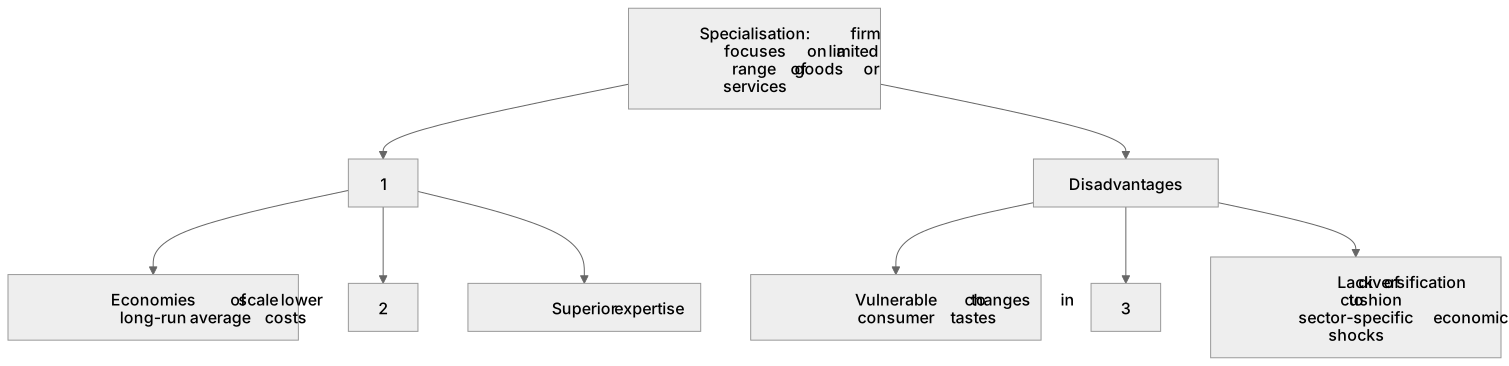
1Box 1
2Box 2
3Box 3
There is more to this lesson
The full lesson goes on to check your understanding and help you earn the marks. Create a free account to carry on, with your progress saved.
A week of Premium from your first lesson · Then the free plan continues · No card, no charge
Test your understanding of Specialisation: b) Specialisation: advantages and disadvantages to the firm
Active recall beats re-reading. Take an instant quiz now to test what you’ve learned and lock it into long-term memory.
A week of Premium from your first lesson · Then the free plan continues · No card, no charge