Pearson Edexcel · A-Level · Economics B
Course version: 9EB0 · Version from Sept 2015
The AD/AS model: a) Changes in Aggregate Demand (AD)
Aggregate Demand (AD) represents the total planned expenditure on goods and services produced within an economy at a given price level over a specific period.
Checked against the Pearson Edexcel 9EB0 specification (opens in a new tab) on .
- Point 1 of 5
- 3 key terms
Study notes
From the checked teaching notes for this specification point.
The idea
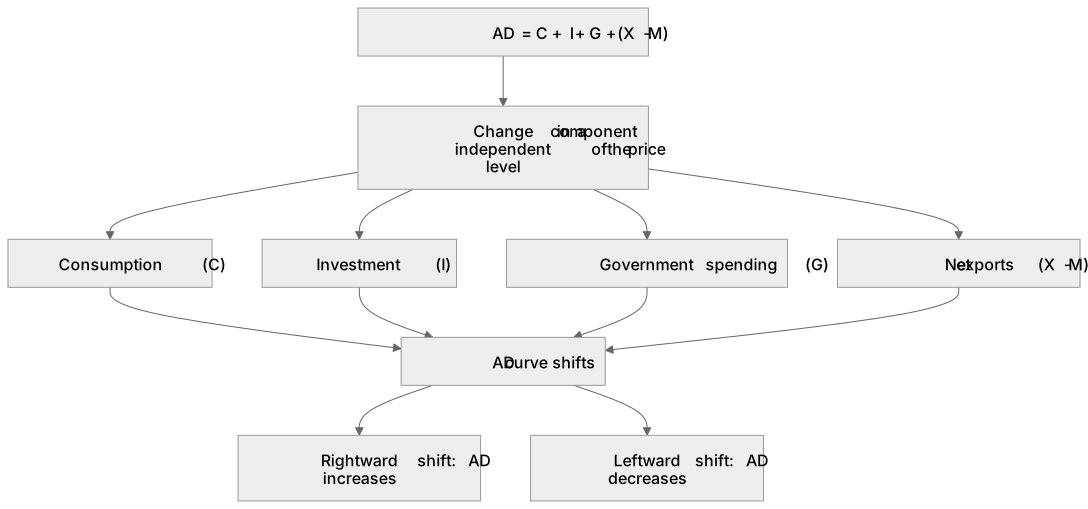
Aggregate Demand (AD) represents the total planned expenditure on goods and services produced within an economy at a given price level over a specific period. It is calculated using the formula AD = C + I + G + (X - M). Changes in AD occur when any of these components alter independently of the general price level, causing the entire AD curve to shift. For example, a reduction in interest rates lowers borrowing costs, stimulating consumer spending (C) and business investment (I), which shifts the AD curve to the right. Conversely, a recession in a major trading partner reduces export demand (X), shifting AD to the left. Understanding these shifts is essential for analysing macroeconomic impacts on real GDP and inflation.
What earns the marks
- Aggregate Demand (AD) is the total planned expenditure in an economy, calculated as AD = C + I + G + (X - M).
- A shift in the AD curve occurs when there is a change in Consumption, Investment, Government spending, or Net Exports, independent of the price level.
- An increase in AD shifts the curve to the right, which can be caused by factors such as lower interest rates, decreased taxation, or a weaker exchange rate.
- A movement along the AD curve is caused exclusively by a change in the general price level, whereas a shift represents a change in the underlying components.
Common mistakes and how to put them right
Confusing a movement along the AD curve with a shift in the AD curve.
Put it right: Only changes in the general price level cause a movement; changes in C, I, G, or (X - M) cause a shift.
Assuming an increase in imports increases AD.
Put it right: Imports (M) are a leakage from the circular flow, so an increase in imports reduces net exports (X - M) and shifts AD to the left.
Believing that government spending (G) includes transfer payments.
Put it right: Transfer payments (like state pensions) are not included in G; they only affect AD when recipients spend the money, which is recorded as Consumption (C).
Exam tips
- Always state the AD formula (AD = C + I + G + (X - M)) when explaining a shift in the curve to demonstrate foundational knowledge.
- Clearly identify which specific component of AD is affected by the scenario provided in the stimulus material.
- Use accurately labelled AD/AS diagrams to illustrate the effect of a change in AD on the macroeconomic equilibrium, ensuring arrows show the direction of the shift.
Try the lesson
The start of the The AD/AS model: a) Changes in Aggregate Demand (AD) lesson, made from checked teaching notes for this specification point.
Have a go first
Which of the following would cause a rightward shift in the aggregate demand (AD) curve?
Listen
Aggregate Demand (AD) represents the total planned expenditure on goods and services produced within an economy at a given price level over a specific period. It is calculated using the formula AD = C + I + G + (X - M). Changes in AD occur when any of these components alter independently of the general price level, causing the entire AD curve to shift. For example, a reduction in interest rates lowers borrowing costs, stimulating consumer spending (C) and business investment (I), which shifts the AD curve to the right. Conversely, a recession in a major trading partner reduces export demand (X), shifting AD to the left. Understanding these shifts is essential for analysing macroeconomic impacts on real GDP and inflation. A strong answer earns marks for these points. Aggregate Demand (AD) is the total planned expenditure in an economy, calculated as AD = C + I + G + (X - M). A shift in the AD curve occurs when there is a change in Consumption, Investment, Government spending, or Net Exports, independent of the price level. An increase in AD shifts the curve to the right, which can be caused by factors such as lower interest rates, decreased taxation, or a weaker exchange rate. A movement along the AD curve is caused exclusively by a change in the general price level, whereas a shift represents a change in the underlying components. A common slip: Confusing a movement along the AD curve with a shift in the AD curve. Instead, Only changes in the general price level cause a movement; changes in C, I, G, or (X - M) cause a shift. Exam tip: Always state the AD formula (AD = C + I + G + (X - M)) when explaining a shift in the curve to demonstrate foundational knowledge.
See it
Key words
Say what each word means before you turn the card.
Aggregate Demand (AD)
Try answering aloud or in your head before turning the card.
Shift in the AD curve
Try answering aloud or in your head before turning the card.
Movement along the AD curve
Try answering aloud or in your head before turning the card.
See every definition
- Aggregate Demand (AD)
- The total planned expenditure on goods and services produced within an economy at a given price level over a specific period, calculated as AD = C + I + G + (X - M).
- Shift in the AD curve
- Occurs when Consumption, Investment, Government spending or Net Exports change independently of the general price level, moving the entire curve.
- Movement along the AD curve
- Caused exclusively by a change in the general price level, whereas a shift represents a change in the underlying components.
Label the diagram
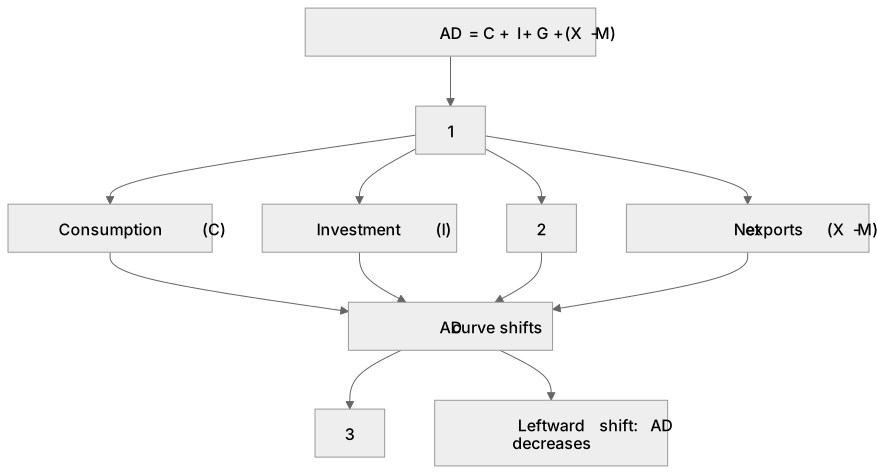
Some boxes have lost their names. Pick the right name for each number.
1Box 1
2Box 2
3Box 3
There is more to this lesson
The full lesson goes on to check your understanding and help you earn the marks. Create a free account to carry on, with your progress saved.
A week of Premium from your first lesson · Then the free plan continues · No card, no charge
Test your understanding of The AD/AS model: a) Changes in Aggregate Demand (AD)
Active recall beats re-reading. Take an instant quiz now to test what you’ve learned and lock it into long-term memory.
A week of Premium from your first lesson · Then the free plan continues · No card, no charge