Pearson Edexcel · A-Level · Economics B
Course version: 9EB0 · Version from Sept 2015
The AD/AS model: b) Changes in Aggregate Supply (AS)
Aggregate Supply (AS) is the total volume of goods and services producers are willing and able to supply at a given price level.
Checked against the Pearson Edexcel 9EB0 specification (opens in a new tab) on .
- Point 2 of 5
- 4 key terms
Study notes
From the checked teaching notes for this specification point.
The idea
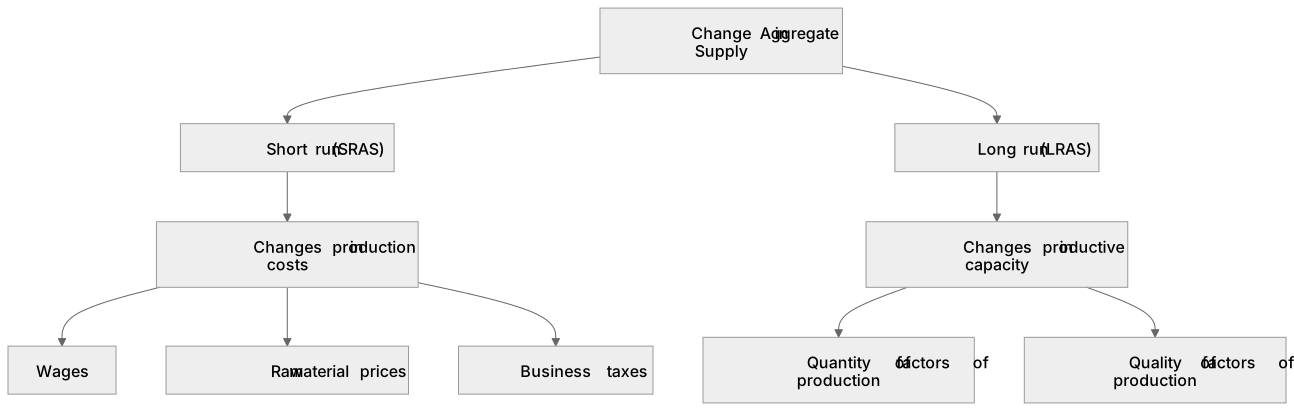
Aggregate Supply (AS) is the total volume of goods and services producers are willing and able to supply at a given price level. Changes in AS occur in the short run (SRAS) or long run (LRAS). SRAS shifts are caused by changes in production costs, such as wages, raw material prices, or business taxes. For example, a sudden rise in global oil prices increases costs, shifting SRAS to the left. LRAS shifts reflect changes in the economy's productive capacity, driven by the quantity or quality of factors of production. For instance, increased spending on education improves labour productivity, shifting LRAS to the right. LRAS can be depicted using Classical (perfectly inelastic) or Keynesian (showing spare capacity) models.
What earns the marks
- A leftward shift in the Short-Run Aggregate Supply (SRAS) curve is caused by an increase in production costs, such as higher wages or raw material prices.
- A rightward shift in the Long-Run Aggregate Supply (LRAS) curve indicates an increase in the economy's productive capacity, driven by improvements in the quantity or quality of factors of production.
- An outward shift in LRAS leads to a lower price level and higher real GDP, assuming Aggregate Demand remains constant.
- Supply shocks, such as a sudden increase in global oil prices, cause an immediate leftward shift in SRAS, leading to cost-push inflation and lower real output.
Common mistakes and how to put them right
Confusing the factors that shift SRAS with those that shift LRAS.
Put it right: SRAS is shifted by short-term cost changes, whereas LRAS is shifted by long-term changes in productive capacity.
Assuming an increase in the minimum wage shifts LRAS.
Put it right: An increase in the minimum wage raises production costs, shifting SRAS to the left, but does not inherently increase the economy's maximum productive capacity.
Believing that an increase in the price level shifts the AS curve.
Put it right: A change in the general price level causes a movement along the AS curve, whereas changes in costs or productive capacity cause the curve to shift.
Exam tips
- When analysing supply-side policies, explicitly link them to a rightward shift in the LRAS curve and explain the impact on the macroeconomic equilibrium.
- Use the concept of cost-push inflation to explain the macroeconomic effects of a leftward shift in the SRAS curve, such as during a commodity price shock.
- Ensure your diagrams clearly distinguish between SRAS and LRAS curves, and select the appropriate LRAS model (Keynesian or Classical) based on the context of the question.
Try the lesson
The start of the The AD/AS model: b) Changes in Aggregate Supply (AS) lesson, made from checked teaching notes for this specification point.
Have a go first
Which of the following events would most likely cause an immediate leftward shift in a country's short-run aggregate supply (SRAS) curve?
Listen
Aggregate Supply (AS) is the total volume of goods and services producers are willing and able to supply at a given price level. Changes in AS occur in the short run (SRAS) or long run (LRAS). SRAS shifts are caused by changes in production costs, such as wages, raw material prices, or business taxes. For example, a sudden rise in global oil prices increases costs, shifting SRAS to the left. LRAS shifts reflect changes in the economy's productive capacity, driven by the quantity or quality of factors of production. For instance, increased spending on education improves labour productivity, shifting LRAS to the right. LRAS can be depicted using Classical (perfectly inelastic) or Keynesian (showing spare capacity) models. A strong answer earns marks for these points. A leftward shift in the Short-Run Aggregate Supply (SRAS) curve is caused by an increase in production costs, such as higher wages or raw material prices. A rightward shift in the Long-Run Aggregate Supply (LRAS) curve indicates an increase in the economy's productive capacity, driven by improvements in the quantity or quality of factors of production. An outward shift in LRAS leads to a lower price level and higher real GDP, assuming Aggregate Demand remains constant. Supply shocks, such as a sudden increase in global oil prices, cause an immediate leftward shift in SRAS, leading to cost-push inflation and lower real output. A common slip: Confusing the factors that shift SRAS with those that shift LRAS. Instead, SRAS is shifted by short-term cost changes, whereas LRAS is shifted by long-term changes in productive capacity. Exam tip: When analysing supply-side policies, explicitly link them to a rightward shift in the LRAS curve and explain the impact on the macroeconomic equilibrium.
See it
Key words
Say what each word means before you turn the card.
Costs of production
Try answering aloud or in your head before turning the card.
Productive capacity
Try answering aloud or in your head before turning the card.
Supply-side shocks
Try answering aloud or in your head before turning the card.
Macroeconomic equilibrium
Try answering aloud or in your head before turning the card.
See every definition
- Costs of production
- Changes in these, such as wages, raw material prices or business taxes, cause shifts in short-run aggregate supply.
- Productive capacity
- Changes in this, driven by the quantity or quality of factors of production, shift long-run aggregate supply.
- Supply-side shocks
- A sudden increase in global oil prices is an example, causing an immediate leftward shift in short-run aggregate supply.
- Macroeconomic equilibrium
- The point affected when a rightward shift in long-run aggregate supply is linked to supply-side policies.
Label the diagram
Some boxes have lost their names. Pick the right name for each number.
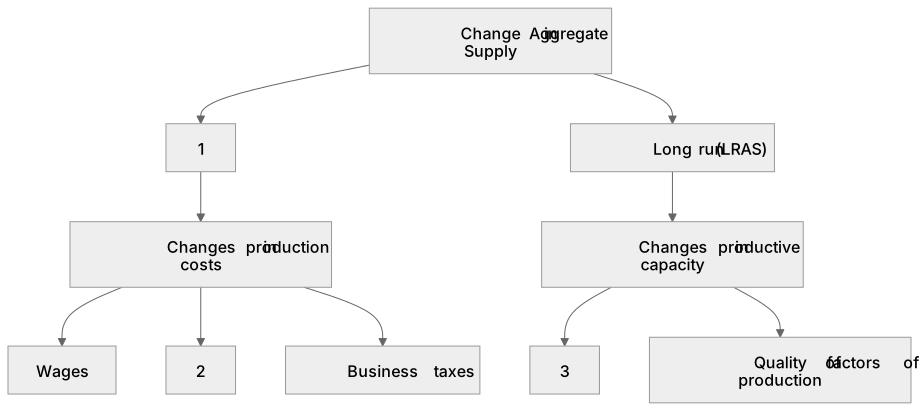
1Box 1
2Box 2
3Box 3
There is more to this lesson
The full lesson goes on to check your understanding and help you earn the marks. Create a free account to carry on, with your progress saved.
A week of Premium from your first lesson · Then the free plan continues · No card, no charge
Test your understanding of The AD/AS model: b) Changes in Aggregate Supply (AS)
Active recall beats re-reading. Take an instant quiz now to test what you’ve learned and lock it into long-term memory.
A week of Premium from your first lesson · Then the free plan continues · No card, no charge