Pearson Edexcel · A-Level · Economics B
Course version: 9EB0 · Version from Sept 2015
The AD/AS model: c) Full capacity output
Full capacity output represents the maximum level of real GDP an economy can produce when all available factors of production are fully and efficiently employed.
Checked against the Pearson Edexcel 9EB0 specification (opens in a new tab) on .
- Point 3 of 5
- 2 key terms
Study notes
From the checked teaching notes for this specification point.
The idea
Full capacity output represents the maximum level of real GDP an economy can produce when all available factors of production are fully and efficiently employed. In the AD/AS model, this is illustrated by the vertical section of the Keynesian long-run aggregate supply (LRAS) curve or the entirely vertical classical LRAS curve. At this point, the economy is operating on its production possibility frontier. If aggregate demand (AD) increases when the economy is at full capacity, it cannot stimulate further increases in real output; instead, the excess demand purely drives up the general price level, causing demand-pull inflation. To increase full capacity output, the quantity or quality of economic resources must improve, shifting LRAS rightwards.
What earns the marks
- Full capacity output occurs when all factors of production are fully utilised, meaning no spare capacity exists in the economy.
- Any increase in aggregate demand when the economy is at full capacity will only result in a higher price level, not higher real GDP.
- An increase in full capacity output requires an outward shift of the LRAS curve, which is achieved through supply-side improvements.
Common mistakes and how to put them right
Confusing full capacity with short-run equilibrium.
Put it right: Full capacity is a long-run concept where no further output can be generated without increasing the quantity or quality of resources.
Assuming an increase in AD at full capacity increases output.
Put it right: At full capacity, an outward shift in AD only causes demand-pull inflation because output cannot expand further.
Believing full capacity means zero unemployment.
Put it right: Full capacity output corresponds to the natural rate of unemployment, which includes frictional and structural unemployment, not zero unemployment.
Exam tips
- Always draw the LRAS curve vertically at the full capacity level of output when using the classical AD/AS model.
- When evaluating demand-side policies, consider the economy's current position relative to full capacity to determine the likely inflationary impact.
- Use the concept of the production possibility frontier to explain why an economy cannot produce beyond its full capacity output in the long run.
Try the lesson
The start of the The AD/AS model: c) Full capacity output lesson, made from checked teaching notes for this specification point.
Have a go first
Which of the following best describes 'full capacity output' in a macroeconomic AD/AS model?
Listen
Full capacity output represents the maximum level of real GDP an economy can produce when all available factors of production are fully and efficiently employed. In the AD/AS model, this is illustrated by the vertical section of the Keynesian long-run aggregate supply (LRAS) curve or the entirely vertical classical LRAS curve. At this point, the economy is operating on its production possibility frontier. If aggregate demand (AD) increases when the economy is at full capacity, it cannot stimulate further increases in real output; instead, the excess demand purely drives up the general price level, causing demand-pull inflation. To increase full capacity output, the quantity or quality of economic resources must improve, shifting LRAS rightwards. A strong answer earns marks for these points. Full capacity output occurs when all factors of production are fully utilised, meaning no spare capacity exists in the economy. Any increase in aggregate demand when the economy is at full capacity will only result in a higher price level, not higher real GDP. An increase in full capacity output requires an outward shift of the LRAS curve, which is achieved through supply-side improvements. A common slip: Confusing full capacity with short-run equilibrium. Instead, full capacity is a long-run concept where no further output can be generated without increasing the quantity or quality of resources. Exam tip: Always draw the LRAS curve vertically at the full capacity level of output when using the classical AD/AS model.
See it
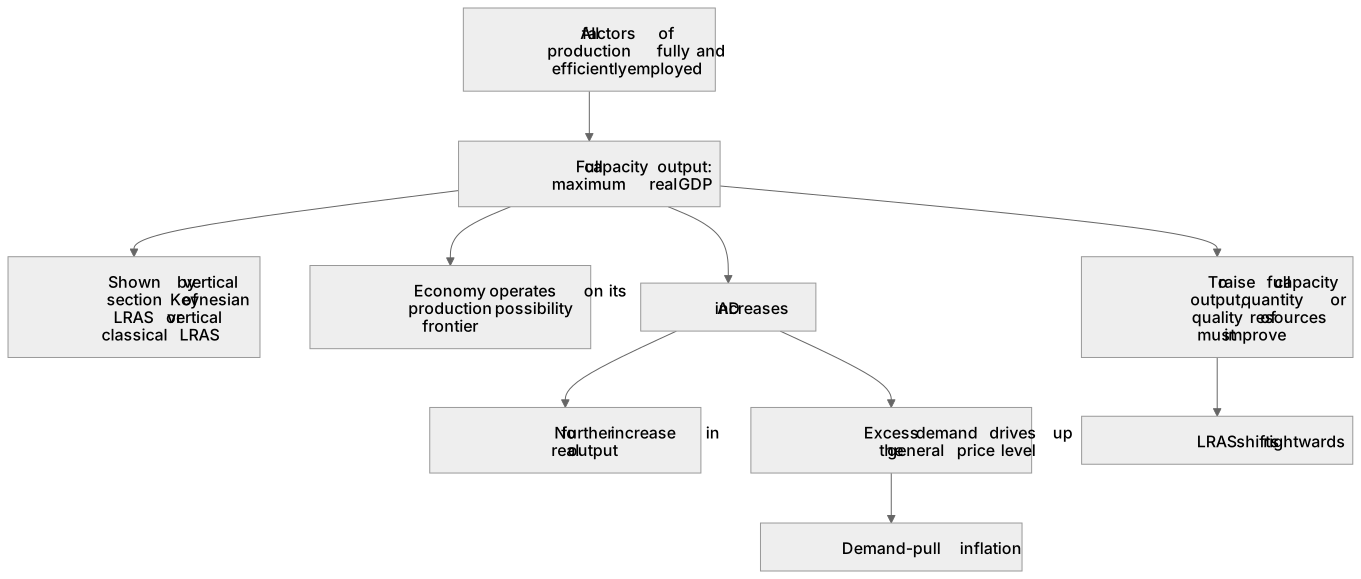
Key words
Say what each word means before you turn the card.
Full capacity output
Try answering aloud or in your head before turning the card.
Factors of production
Try answering aloud or in your head before turning the card.
See every definition
- Full capacity output
- The maximum level of real GDP an economy can produce when all available factors of production are fully and efficiently employed.
- Factors of production
- Economic resources that must be fully and efficiently employed for an economy to reach full capacity output.
Label the diagram
Some boxes have lost their names. Pick the right name for each number.
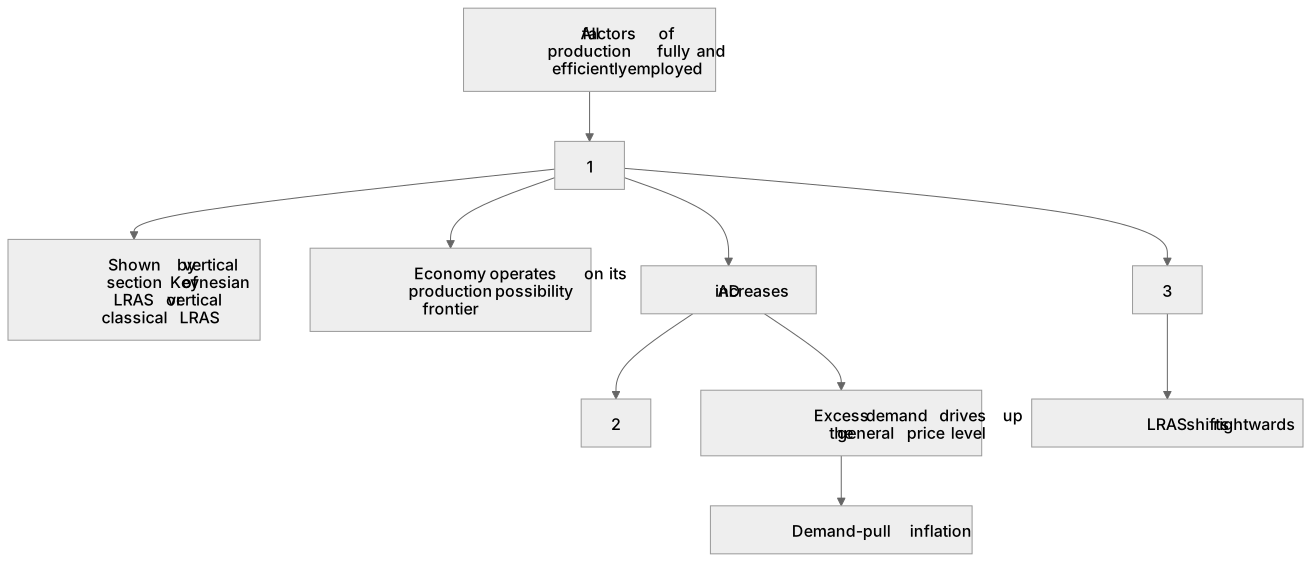
1Box 1
2Box 2
3Box 3
There is more to this lesson
The full lesson goes on to check your understanding and help you earn the marks. Create a free account to carry on, with your progress saved.
A week of Premium from your first lesson · Then the free plan continues · No card, no charge
Test your understanding of The AD/AS model: c) Full capacity output
Active recall beats re-reading. Take an instant quiz now to test what you’ve learned and lock it into long-term memory.
A week of Premium from your first lesson · Then the free plan continues · No card, no charge