Pearson Edexcel · A-Level · Economics B
Course version: 9EB0 · Version from Sept 2015
The competition: a) Market positioning: market mapping and market maps
Market positioning refers to how a product is perceived by consumers relative to competing products.
Checked against the Pearson Edexcel 9EB0 specification (opens in a new tab) on .
- Point 1 of 6
- 3 key terms
Study notes
From the checked teaching notes for this specification point.
The idea
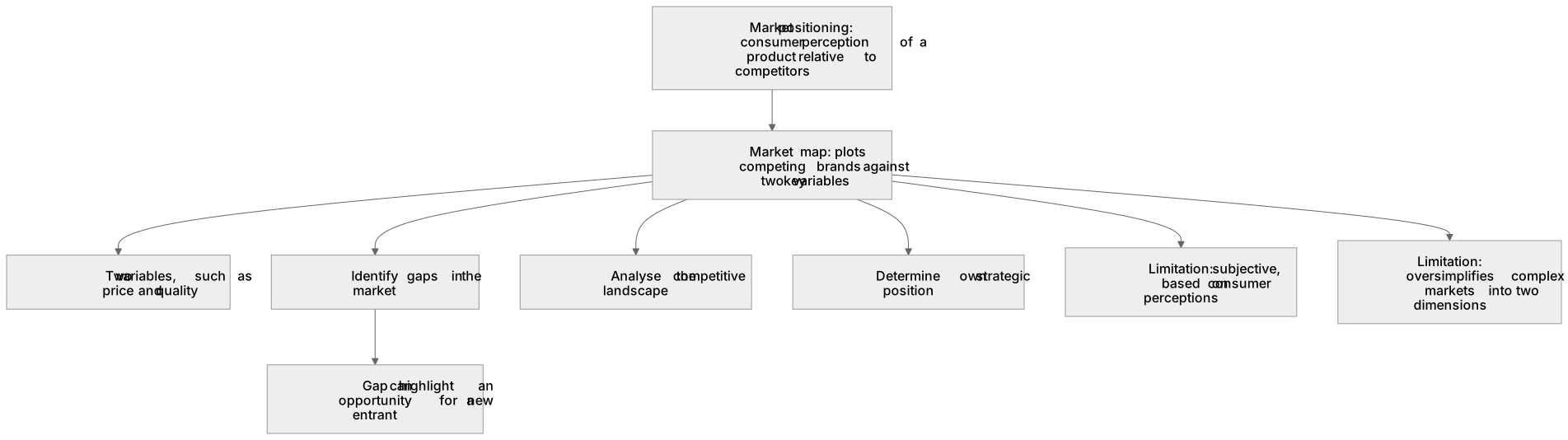
Market positioning refers to how a product is perceived by consumers relative to competing products. A market map (or positioning map) is a visual tool used to plot the position of competing brands based on two key variables, such as price and quality. By constructing a market map, businesses can identify gaps in the market, analyse the competitive landscape, and determine their own strategic position. For instance, a chocolate market map might reveal a gap for high-quality, low-price products, presenting an opportunity for a new entrant. However, market maps are subjective and rely on consumer perceptions, which may not always align with reality.
What earns the marks
- Market positioning represents the consumer perception of a brand or product compared to its competitors in the market.
- A market map visually represents the competitive landscape by plotting brands against two key variables, typically price and quality.
- Market maps are utilised to spot gaps in the market, which can highlight opportunities for new product development or repositioning.
- The subjective nature of market maps means they are based on consumer perceptions rather than objective, quantifiable facts.
- While useful for developing competitive strategy, market mapping oversimplifies complex markets into just two dimensions.
Common mistakes and how to put them right
Assuming market maps are based on objective data.
Put it right: Recognise that market maps plot consumer perceptions, which are inherently subjective.
Believing a gap in the market always represents a profitable opportunity.
Put it right: Understand that a gap might exist because there is no consumer demand for that specific combination of variables.
Using more than two variables on a standard market map.
Put it right: A traditional market map uses exactly two axes (e.g., price and quality) to plot positions.
Exam tips
- When drawing or interpreting a market map, clearly label both axes with relevant variables from the case study.
- Use market mapping to justify a proposed business strategy, such as launching a new product in an identified gap.
- Acknowledge the limitations of market maps, particularly their reliance on subjective consumer opinions and the simplification of complex markets.
Try the lesson
The start of the The competition: a) Market positioning: market mapping and market maps lesson, made from checked teaching notes for this specification point.
Have a go first
What is the primary purpose of a market map in business strategy?
Listen
Market positioning refers to how a product is perceived by consumers relative to competing products. A market map (or positioning map) is a visual tool used to plot the position of competing brands based on two key variables, such as price and quality. By constructing a market map, businesses can identify gaps in the market, analyse the competitive landscape, and determine their own strategic position. For instance, a chocolate market map might reveal a gap for high-quality, low-price products, presenting an opportunity for a new entrant. However, market maps are subjective and rely on consumer perceptions, which may not always align with reality. A strong answer earns marks for these points. Market positioning represents the consumer perception of a brand or product compared to its competitors in the market. A market map visually represents the competitive landscape by plotting brands against two key variables, typically price and quality. Market maps are utilised to spot gaps in the market, which can highlight opportunities for new product development or repositioning. The subjective nature of market maps means they are based on consumer perceptions rather than objective, quantifiable facts. Exam tip: When drawing or interpreting a market map, clearly label both axes with relevant variables from the case study.
See it
Key words
Say what each word means before you turn the card.
Market positioning
Try answering aloud or in your head before turning the card.
Market map
Try answering aloud or in your head before turning the card.
Gaps in the market
Try answering aloud or in your head before turning the card.
See every definition
- Market positioning
- How a product is perceived by consumers relative to competing products.
- Market map
- A visual tool used to plot the position of competing brands based on two key variables, such as price and quality.
- Gaps in the market
- Opportunities identified by constructing a market map, which can highlight possibilities for new product development or repositioning.
Label the diagram
Some boxes have lost their names. Pick the right name for each number.
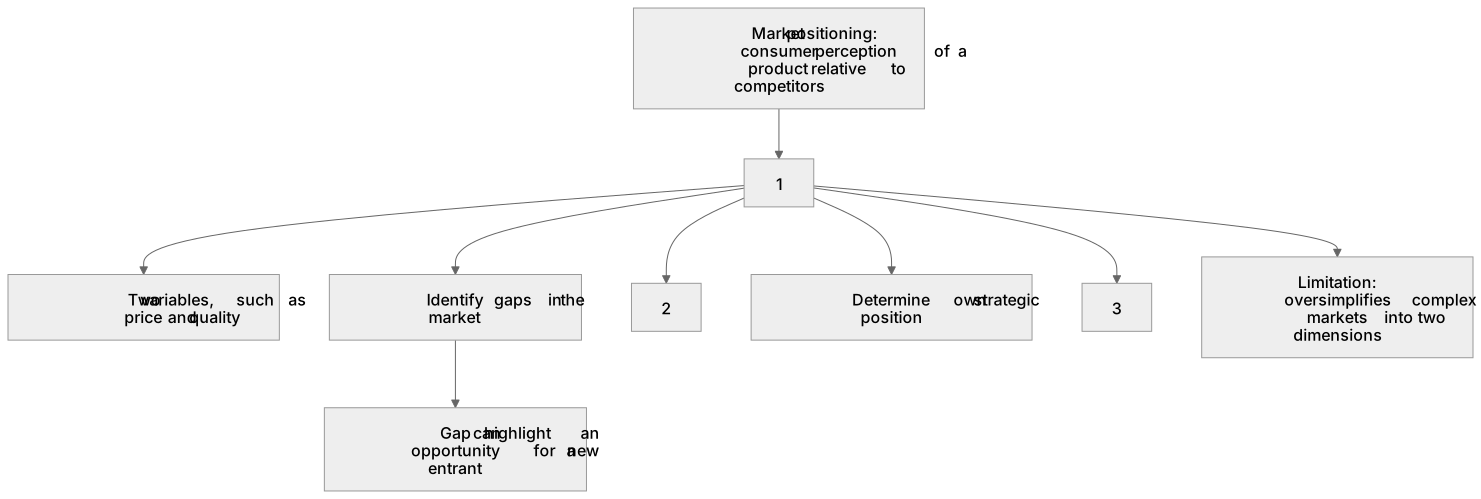
1Box 1
2Box 2
3Box 3
There is more to this lesson
The full lesson goes on to check your understanding and help you earn the marks. Create a free account to carry on, with your progress saved.
A week of Premium from your first lesson · Then the free plan continues · No card, no charge
Test your understanding of The competition: a) Market positioning: market mapping and market maps
Active recall beats re-reading. Take an instant quiz now to test what you’ve learned and lock it into long-term memory.
A week of Premium from your first lesson · Then the free plan continues · No card, no charge