Pearson Edexcel · A-Level · Economics B
Course version: 9EB0 · Version from Sept 2015
The competition: b) Competitive advantage of a product or service
Competitive advantage occurs when a business offers a product or service that provides greater value to customers than its rivals, allowing it to generate higher sales or margins.
Checked against the Pearson Edexcel 9EB0 specification (opens in a new tab) on .
- Point 2 of 6
- 4 key terms
Study notes
From the checked teaching notes for this specification point.
The idea
Competitive advantage occurs when a business offers a product or service that provides greater value to customers than its rivals, allowing it to generate higher sales or margins. This advantage can be achieved through cost leadership, where a firm produces at a lower cost and offers lower prices, or through differentiation, where unique features justify a premium price. For example, a smartphone manufacturer might achieve a competitive advantage by developing an exclusive, highly secure operating system that appeals to business users, or an airline might use a low-cost model to offer the cheapest flights. A sustainable competitive advantage is difficult for competitors to copy, ensuring long-term profitability and market share growth.
What earns the marks
- Define competitive advantage as a unique feature or benefit that makes a product or service more desirable than competitors' offerings.
- Identify cost leadership (lower prices) and differentiation (unique features) as the two main routes to competitive advantage.
- Explain how competitive advantage leads to increased market share, higher sales volume, or the ability to charge a premium price.
- Analyse how a sustainable competitive advantage acts as a barrier to entry for new competitors.
Common mistakes and how to put them right
Confusing competitive advantage with simply having a large market share.
Put it right: Market share is often a result of competitive advantage, not the advantage itself; the advantage is the reason customers choose the product.
Assuming competitive advantage is permanent.
Put it right: Competitors can innovate or copy features, meaning businesses must continuously invest to maintain their advantage.
Believing only large firms can have a competitive advantage.
Put it right: Small businesses can achieve competitive advantage through niche targeting, superior customer service, or local expertise.
Exam tips
- Always link a firm's competitive advantage to its impact on revenue, profit margins, or market share in your analysis.
- Use the specific context provided in the case study to identify whether the firm is competing on cost or differentiation.
- Evaluate the sustainability of a competitive advantage by considering how easily rivals could replicate the product or service.
Try the lesson
The start of the The competition: b) Competitive advantage of a product or service lesson, made from checked teaching notes for this specification point.
Have a go first
Which of the following best describes a competitive advantage for a business?
Listen
Competitive advantage occurs when a business offers a product or service that provides greater value to customers than its rivals, allowing it to generate higher sales or margins. This advantage can be achieved through cost leadership, where a firm produces at a lower cost and offers lower prices, or through differentiation, where unique features justify a premium price. For example, a smartphone manufacturer might achieve a competitive advantage by developing an exclusive, highly secure operating system that appeals to business users, or an airline might use a low-cost model to offer the cheapest flights. A sustainable competitive advantage is difficult for competitors to copy, ensuring long-term profitability and market share growth. A strong answer earns marks for these points. Define competitive advantage as a unique feature or benefit that makes a product or service more desirable than competitors' offerings. Identify cost leadership (lower prices) and differentiation (unique features) as the two main routes to competitive advantage. Explain how competitive advantage leads to increased market share, higher sales volume, or the ability to charge a premium price. Analyse how a sustainable competitive advantage acts as a barrier to entry for new competitors. A common slip: Confusing competitive advantage with simply having a large market share. Instead, Market share is often a result of competitive advantage, not the advantage itself; the advantage is the reason customers choose the product. Exam tip: Always link a firm's competitive advantage to its impact on revenue, profit margins, or market share in your analysis.
See it

Key words
Say what each word means before you turn the card.
Competitive advantage
Try answering aloud or in your head before turning the card.
Cost leadership
Try answering aloud or in your head before turning the card.
Differentiation
Try answering aloud or in your head before turning the card.
Sustainable competitive advantage
Try answering aloud or in your head before turning the card.
See every definition
- Competitive advantage
- A unique feature or benefit that makes a product or service more desirable than competitors' offerings.
- Cost leadership
- A route to competitive advantage where a firm produces at a lower cost and offers lower prices.
- Differentiation
- A route to competitive advantage where unique features justify a premium price.
- Sustainable competitive advantage
- An advantage that is difficult for competitors to copy, ensuring long-term profitability and market share growth.
Label the diagram
Some boxes have lost their names. Pick the right name for each number.
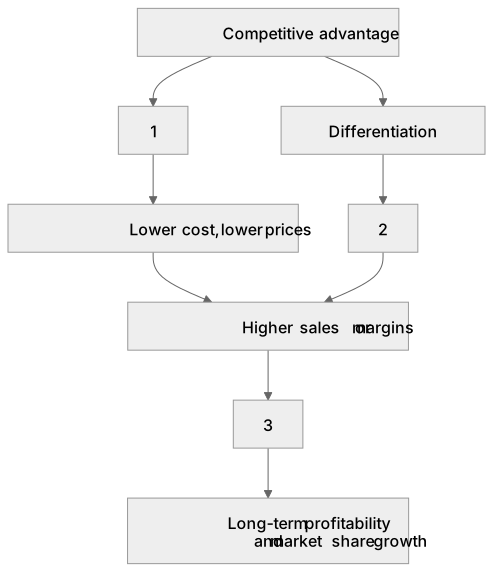
1Box 1
2Box 2
3Box 3
There is more to this lesson
The full lesson goes on to check your understanding and help you earn the marks. Create a free account to carry on, with your progress saved.
A week of Premium from your first lesson · Then the free plan continues · No card, no charge
Test your understanding of The competition: b) Competitive advantage of a product or service
Active recall beats re-reading. Take an instant quiz now to test what you’ve learned and lock it into long-term memory.
A week of Premium from your first lesson · Then the free plan continues · No card, no charge