Pearson Edexcel · A-Level · Economics B
Course version: 9EB0 · Version from Sept 2015
The competition: c) Product differentiation
Product differentiation is the process of distinguishing a product or service from others in the market to make it more attractive to a target audience.
Checked against the Pearson Edexcel 9EB0 specification (opens in a new tab) on .
- Point 3 of 6
- 2 key terms
Study notes
From the checked teaching notes for this specification point.
The idea
Product differentiation is the process of distinguishing a product or service from others in the market to make it more attractive to a target audience. This involves highlighting unique characteristics, such as superior quality, innovative design, strong branding, or exceptional customer service. By successfully differentiating a product, a business reduces the price elasticity of demand, allowing it to charge a premium price without losing customers to rivals. For instance, a coffee shop might differentiate itself by offering ethically sourced beans and a unique store ambience, setting it apart from standard chains. Effective differentiation builds brand loyalty and insulates the firm from intense price competition.
What earns the marks
- Define product differentiation as the creation of real or perceived differences between a product and its competitors.
- Identify methods of differentiation, including branding, quality, design, customer service, and unique selling propositions (USPs).
- Explain how differentiation reduces price elasticity of demand, enabling a business to charge a premium price.
- Analyse the costs associated with differentiation, such as increased research and development or marketing expenditure.
Common mistakes and how to put them right
Assuming differentiation must involve physical changes to the product.
Put it right: Differentiation can be purely psychological, achieved through branding, advertising, or customer service.
Stating that differentiation always leads to higher profits.
Put it right: The costs of differentiating (e.g. marketing, R&D) must be weighed against the additional revenue generated; it only increases profit if the premium price covers the extra costs.
Confusing product differentiation with market segmentation.
Put it right: Segmentation is dividing the market into groups of consumers, whereas differentiation is making the product stand out to those consumers.
Exam tips
- When evaluating differentiation, consider whether the target market is willing and able to pay the premium price required to cover the costs.
- Use the concept of price elasticity of demand to explain why differentiated products are less sensitive to price changes.
- Look for evidence in the data of how a business uses branding or unique features to protect itself from cheaper alternatives.
Try the lesson
The start of the The competition: c) Product differentiation lesson, made from checked teaching notes for this specification point.
Have a go first
What is the primary purpose of product differentiation in a competitive market?
Listen
Product differentiation is the process of distinguishing a product or service from others in the market to make it more attractive to a target audience. This involves highlighting unique characteristics, such as superior quality, innovative design, strong branding, or exceptional customer service. By successfully differentiating a product, a business reduces the price elasticity of demand, allowing it to charge a premium price without losing customers to rivals. For instance, a coffee shop might differentiate itself by offering ethically sourced beans and a unique store ambience, setting it apart from standard chains. Effective differentiation builds brand loyalty and insulates the firm from intense price competition. A strong answer earns marks for these points. Define product differentiation as the creation of real or perceived differences between a product and its competitors. Identify methods of differentiation, including branding, quality, design, customer service, and unique selling propositions (USPs). Explain how differentiation reduces price elasticity of demand, enabling a business to charge a premium price. Analyse the costs associated with differentiation, such as increased research and development or marketing expenditure. A common slip: Assuming differentiation must involve physical changes to the product. Instead, Differentiation can be purely psychological, achieved through branding, advertising, or customer service. Exam tip: When evaluating differentiation, consider whether the target market is willing and able to pay the premium price required to cover the costs.
See it

Key words
Say what each word means before you turn the card.
Price elasticity of demand
Try answering aloud or in your head before turning the card.
Branding
Try answering aloud or in your head before turning the card.
See every definition
- Price elasticity of demand
- A measure that differentiation reduces, allowing a business to charge a premium price without losing customers to rivals.
- Branding
- A method of differentiation that can be purely psychological, achieving differentiation without physical changes to the product.
Label the diagram
Some boxes have lost their names. Pick the right name for each number.
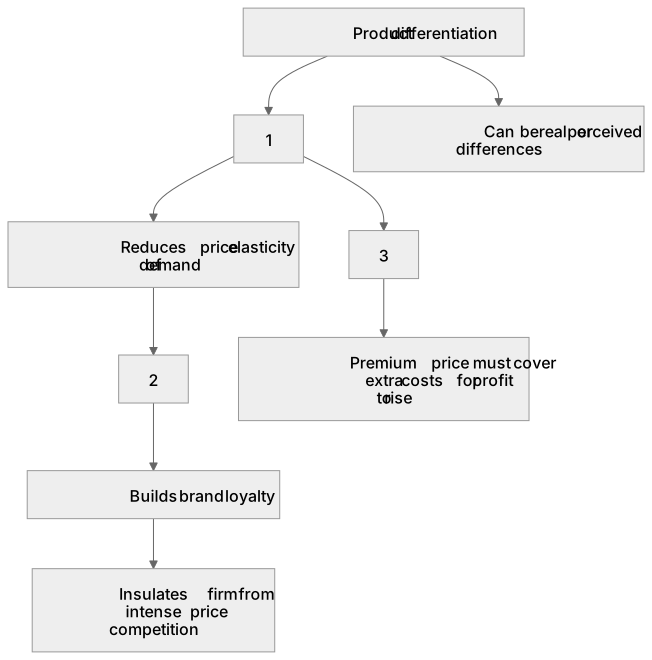
1Box 1
2Box 2
3Box 3
There is more to this lesson
The full lesson goes on to check your understanding and help you earn the marks. Create a free account to carry on, with your progress saved.
A week of Premium from your first lesson · Then the free plan continues · No card, no charge
Test your understanding of The competition: c) Product differentiation
Active recall beats re-reading. Take an instant quiz now to test what you’ve learned and lock it into long-term memory.
A week of Premium from your first lesson · Then the free plan continues · No card, no charge