Pearson Edexcel · A-Level · Economics B
Course version: 9EB0 · Version from Sept 2015
The competition: e) How firms decide on price and level of output
Firms determine price and output levels by analysing business objectives, cost structures, and market competition intensity.
Checked against the Pearson Edexcel 9EB0 specification (opens in a new tab) on .
- Point 5 of 6
- 4 key terms
Study notes
From the checked teaching notes for this specification point.
The idea
Firms determine price and output levels by analysing business objectives, cost structures, and market competition intensity. In highly competitive environments, businesses typically act as price takers; they must accept the prevailing market price and adjust output volumes to maximise profitability. For instance, a small independent café may have to match local competitors' prices to retain customers. Conversely, firms with significant market power, such as a pharmaceutical company with a patented drug, operate as price makers. They can restrict output to command a premium price. Furthermore, firms must evaluate the price elasticity of demand and anticipate competitor reactions when finalising these strategic pricing and output decisions.
What earns the marks
- Identify factors influencing price and output decisions, including market structure, costs, and business objectives.
- Explain the distinction between price makers and price takers within different competitive environments.
- Analyse the role of price elasticity of demand in determining the optimal price point for a product.
- Evaluate how competitor behaviour and prevailing market conditions dictate a firm's pricing strategy and output control.
Common mistakes and how to put them right
Assuming all firms can freely set their own prices.
Put it right: Firms in highly competitive markets are price takers and must accept the market price.
Confusing price making with unlimited pricing power.
Put it right: Even monopolies are constrained by the downward-sloping demand curve and consumer willingness to pay.
Overlooking the impact of costs on output decisions.
Put it right: Firms must consider both fixed and variable costs, aiming to produce where they can at least cover variable costs in the short run.
Exam tips
- When evaluating pricing decisions, always consider the market structure and the degree of competition the firm faces.
- Use the concept of price elasticity of demand to explain why a firm might choose to lower or raise its prices.
- Relate output decisions to the firm's capacity and its overarching business objectives, such as profit maximisation.
Try the lesson
The start of the The competition: e) How firms decide on price and level of output lesson, made from checked teaching notes for this specification point.
Have a go first
According to standard economic theory, at which point will a profit-maximising firm choose to set its level of output?
Listen
Firms determine price and output levels by analysing business objectives, cost structures, and market competition intensity. In highly competitive environments, businesses typically act as price takers; they must accept the prevailing market price and adjust output volumes to maximise profitability. For instance, a small independent café may have to match local competitors' prices to retain customers. Conversely, firms with significant market power, such as a pharmaceutical company with a patented drug, operate as price makers. They can restrict output to command a premium price. Furthermore, firms must evaluate the price elasticity of demand and anticipate competitor reactions when finalising these strategic pricing and output decisions. A strong answer earns marks for these points. Identify factors influencing price and output decisions, including market structure, costs, and business objectives. Explain the distinction between price makers and price takers within different competitive environments. Analyse the role of price elasticity of demand in determining the optimal price point for a product. Evaluate how competitor behaviour and prevailing market conditions dictate a firm's pricing strategy and output control. A common slip: Assuming all firms can freely set their own prices. Instead, firms in highly competitive markets are price takers and must accept the market price. Exam tip: When evaluating pricing decisions, always consider the market structure and the degree of competition the firm faces.
See it

Key words
Say what each word means before you turn the card.
Market structure
Try answering aloud or in your head before turning the card.
Pricing strategies
Try answering aloud or in your head before turning the card.
Profit maximisation
Try answering aloud or in your head before turning the card.
Price elasticity of demand
Try answering aloud or in your head before turning the card.
See every definition
- Market structure
- The intensity of market competition, which influences how a firm decides on its price and level of output.
- Pricing strategies
- Strategic pricing and output decisions that firms finalise after evaluating the price elasticity of demand and anticipating competitor reactions.
- Profit maximisation
- A business objective that firms pursue by adjusting output volumes when they must accept the prevailing market price.
- Price elasticity of demand
- A factor firms must evaluate, alongside anticipated competitor reactions, when finalising their strategic pricing and output decisions.
Label the diagram
Some boxes have lost their names. Pick the right name for each number.
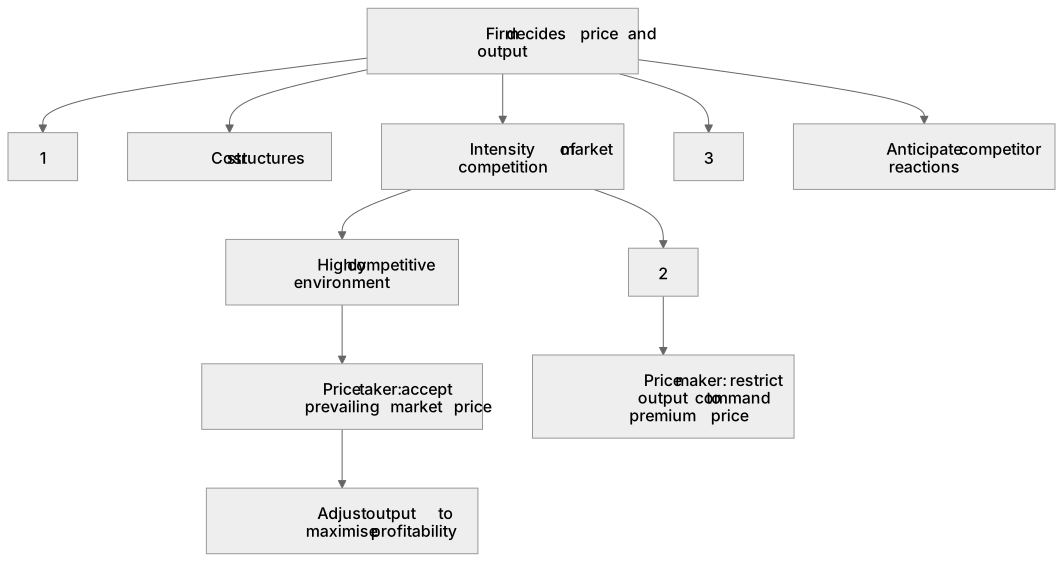
1Box 1
2Box 2
3Box 3
There is more to this lesson
The full lesson goes on to check your understanding and help you earn the marks. Create a free account to carry on, with your progress saved.
A week of Premium from your first lesson · Then the free plan continues · No card, no charge
Test your understanding of The competition: e) How firms decide on price and level of output
Active recall beats re-reading. Take an instant quiz now to test what you’ve learned and lock it into long-term memory.
A week of Premium from your first lesson · Then the free plan continues · No card, no charge