Pearson Edexcel · A-Level · Economics B
Course version: 9EB0 · Version from Sept 2015
The competition: f) Nature and range of markets: stable and dynamic markets
Markets are classified by their pace of change and predictability.
Checked against the Pearson Edexcel 9EB0 specification (opens in a new tab) on .
- Point 6 of 6
- 2 key terms
Study notes
From the checked teaching notes for this specification point.
The idea
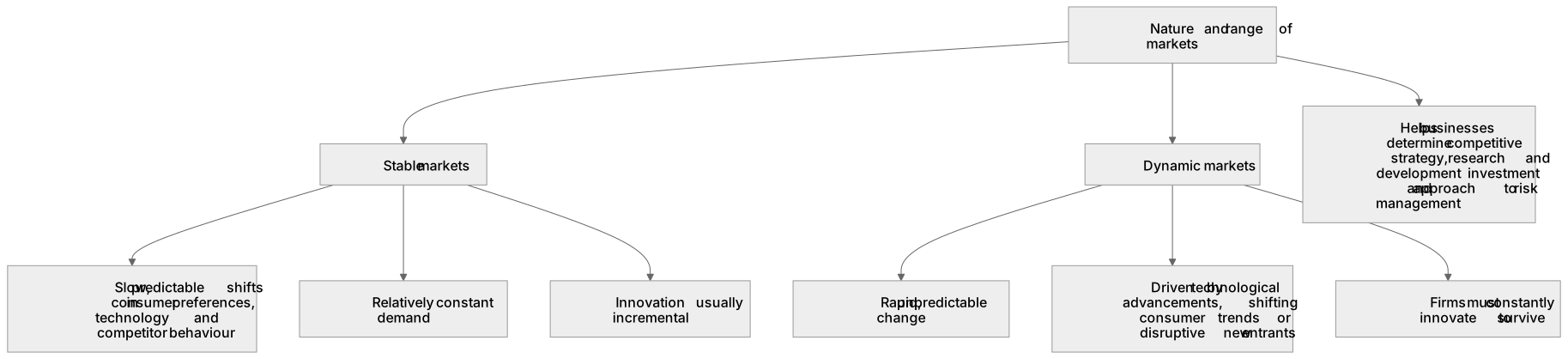
Markets are classified by their pace of change and predictability. Stable markets experience slow, predictable shifts in consumer preferences, technology, and competitor behaviour. For example, the market for staple foods like milk sees relatively constant demand, meaning innovation is usually incremental. In contrast, dynamic markets feature rapid, unpredictable changes driven by technological advancements, shifting consumer trends, or disruptive new entrants. The smartphone industry is highly dynamic, requiring firms to constantly innovate to survive. Understanding whether a market is stable or dynamic helps businesses determine their competitive strategy, research and development investment, and approach to risk management.
What earns the marks
- Define a stable market as one with predictable demand, established consumer preferences, and slow technological change.
- Define a dynamic market as one subject to rapid, continuous change, high uncertainty, and frequent innovation.
- Identify factors that make a market dynamic, such as technological disruption, changing consumer tastes, or new entrants.
- Explain how firms in dynamic markets must invest heavily in research and development to remain competitive.
- Contrast the risk levels between stable and dynamic markets, noting the higher uncertainty present in dynamic environments.
Common mistakes and how to put them right
Assuming stable markets have no competition.
Put it right: Stable markets can be highly competitive, but the nature of the product and demand changes slowly.
Confusing dynamic markets with growing markets.
Put it right: A dynamic market refers to the pace of change and innovation, not just an increase in sales volume.
Believing firms in stable markets do not need to innovate.
Put it right: Firms in stable markets still require incremental innovation to maintain market share and improve efficiency.
Exam tips
- Use specific industry examples, such as agriculture for stable markets and consumer electronics for dynamic markets, to illustrate your points.
- When analysing a business scenario, identify the market's nature to evaluate the appropriateness of the firm's chosen strategy.
- Consider how external shocks, like a sudden technological breakthrough, can temporarily turn a stable market into a dynamic one.
Try the lesson
The start of the The competition: f) Nature and range of markets: stable and dynamic markets lesson, made from checked teaching notes for this specification point.
Have a go first
Which characteristic defines a dynamic market compared to a stable market?
Listen
Markets are classified by their pace of change and predictability. Stable markets experience slow, predictable shifts in consumer preferences, technology, and competitor behaviour. For example, the market for staple foods like milk sees relatively constant demand, meaning innovation is usually incremental. In contrast, dynamic markets feature rapid, unpredictable changes driven by technological advancements, shifting consumer trends, or disruptive new entrants. The smartphone industry is highly dynamic, requiring firms to constantly innovate to survive. Understanding whether a market is stable or dynamic helps businesses determine their competitive strategy, research and development investment, and approach to risk management. A strong answer earns marks for these points. Define a stable market as one with predictable demand, established consumer preferences, and slow technological change. Define a dynamic market as one subject to rapid, continuous change, high uncertainty, and frequent innovation. Identify factors that make a market dynamic, such as technological disruption, changing consumer tastes, or new entrants. Explain how firms in dynamic markets must invest heavily in research and development to remain competitive. A common slip: Assuming stable markets have no competition. Instead, stable markets can be highly competitive, but the nature of the product and demand changes slowly. Exam tip: Use specific industry examples, such as agriculture for stable markets and consumer electronics for dynamic markets, to illustrate your points.
See it
Key words
Say what each word means before you turn the card.
Stable market
Try answering aloud or in your head before turning the card.
Dynamic market
Try answering aloud or in your head before turning the card.
See every definition
- Stable market
- A market with predictable demand, established consumer preferences and slow technological change, where innovation is usually incremental.
- Dynamic market
- A market subject to rapid, continuous change, high uncertainty and frequent innovation, driven by technological advancements, shifting consumer trends or disruptive new entrants.
Label the diagram
Some boxes have lost their names. Pick the right name for each number.
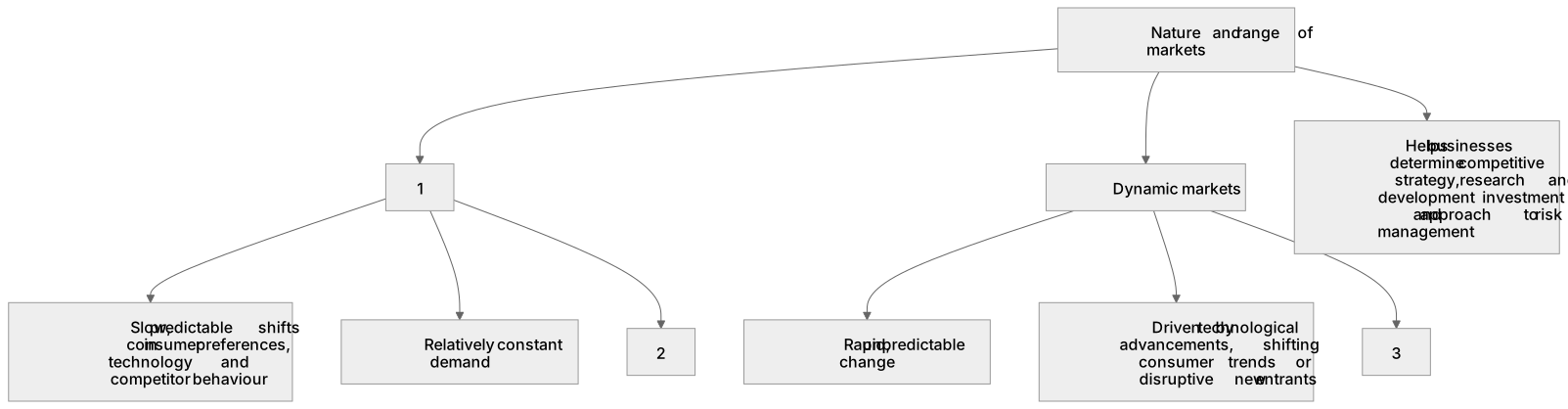
1Box 1
2Box 2
3Box 3
There is more to this lesson
The full lesson goes on to check your understanding and help you earn the marks. Create a free account to carry on, with your progress saved.
A week of Premium from your first lesson · Then the free plan continues · No card, no charge
Test your understanding of The competition: f) Nature and range of markets: stable and dynamic markets
Active recall beats re-reading. Take an instant quiz now to test what you’ve learned and lock it into long-term memory.
A week of Premium from your first lesson · Then the free plan continues · No card, no charge