Pearson Edexcel · A-Level · Economics B
Course version: 9EB0 · Version from Sept 2015
A) The problem of scarcity (where there are unlimited wants and finite…
Full specification wording
The economic problem: a) The problem of scarcity (where there are unlimited wants and finite resources)
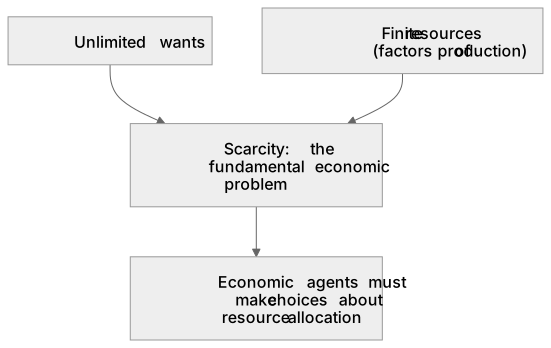
The fundamental economic problem arises because human desires for goods and services are infinite, yet the factors of production required to create them are strictly limited.
Checked against the Pearson Edexcel 9EB0 specification (opens in a new tab) on .
- Point 1 of 3
- 4 key terms
Study notes
From the checked teaching notes for this specification point.
The idea
The fundamental economic problem arises because human desires for goods and services are infinite, yet the factors of production required to create them are strictly limited. This imbalance creates the condition of scarcity, meaning society cannot produce enough to satisfy everyone's desires. For example, a government may want to build new hospitals, schools, and railways, but it only has a finite amount of tax revenue, labour, and raw materials available. Consequently, scarcity forces economic agents—individuals, firms, and governments—to make decisions about how best to allocate these scarce resources. Understanding this concept is the foundation of all economic analysis, as it dictates what, how, and for whom to produce.
What earns the marks
- Define scarcity as the fundamental economic problem resulting from infinite wants and finite resources.
- Identify that resources, known as the factors of production (land, labour, capital, enterprise), are limited in supply.
- Explain that human wants for goods and services are unlimited and continuously expanding.
- Conclude that because of scarcity, economic agents must make choices regarding resource allocation.
Common mistakes and how to put them right
Confusing 'wants' with 'needs'.
Put it right: Needs are essential for survival and are finite, whereas wants are desires that are unlimited.
Stating that scarcity only affects developing economies or poor individuals.
Put it right: Scarcity is a universal problem that affects all economies and individuals, regardless of wealth, because wants always exceed available resources.
Defining scarcity simply as a 'shortage' of a specific good.
Put it right: A shortage is a temporary market disequilibrium, whereas scarcity is a permanent, fundamental condition of the universe.
Exam tips
- Always explicitly link the concept of finite resources to unlimited wants when defining the economic problem.
- Use the term 'factors of production' when discussing finite resources to demonstrate precise economic vocabulary.
- Be prepared to identify examples of scarcity in multiple-choice questions by looking for scenarios where demand outstrips available resources.
Try the lesson
The start of the The economic problem: a) The problem of scarcity (where there are unlimited wants and finite resources) lesson, made from checked teaching notes for this specification point.
Have a go first
Which of the following best defines the fundamental economic problem of scarcity?
Listen
The fundamental economic problem arises because human desires for goods and services are infinite, yet the factors of production required to create them are strictly limited. This imbalance creates the condition of scarcity, meaning society cannot produce enough to satisfy everyone's desires. For example, a government may want to build new hospitals, schools, and railways, but it only has a finite amount of tax revenue, labour, and raw materials available. Consequently, scarcity forces economic agents—individuals, firms, and governments—to make decisions about how best to allocate these scarce resources. Understanding this concept is the foundation of all economic analysis, as it dictates what, how, and for whom to produce. A strong answer earns marks for these points. Define scarcity as the fundamental economic problem resulting from infinite wants and finite resources. Identify that resources, known as the factors of production (land, labour, capital, enterprise), are limited in supply. Explain that human wants for goods and services are unlimited and continuously expanding. Conclude that because of scarcity, economic agents must make choices regarding resource allocation. Exam tip: Always explicitly link the concept of finite resources to unlimited wants when defining the economic problem.
See it
Key words
Say what each word means before you turn the card.
Scarcity
Try answering aloud or in your head before turning the card.
Factors of production
Try answering aloud or in your head before turning the card.
Economic agents
Try answering aloud or in your head before turning the card.
Resource allocation
Try answering aloud or in your head before turning the card.
See every definition
- Scarcity
- The fundamental economic problem resulting from unlimited wants and finite resources, meaning society cannot produce enough to satisfy everyone's desires.
- Factors of production
- The resources known as land, labour, capital and enterprise, which are limited in supply.
- Economic agents
- Individuals, firms and governments, who must make decisions about how best to allocate scarce resources.
- Resource allocation
- The decisions economic agents must make about how best to allocate scarce resources.
Label the diagram
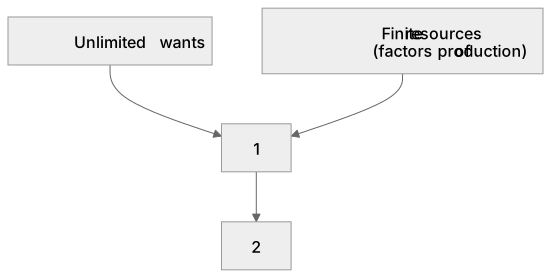
Some boxes have lost their names. Pick the right name for each number.
1Box 1
2Box 2
There is more to this lesson
The full lesson goes on to check your understanding and help you earn the marks. Create a free account to carry on, with your progress saved.
A week of Premium from your first lesson · Then the free plan continues · No card, no charge
Test your understanding of The economic problem: a) The problem of scarcity (where there are unlimited wants and finite resources)
Active recall beats re-reading. Take an instant quiz now to test what you’ve learned and lock it into long-term memory.
A week of Premium from your first lesson · Then the free plan continues · No card, no charge